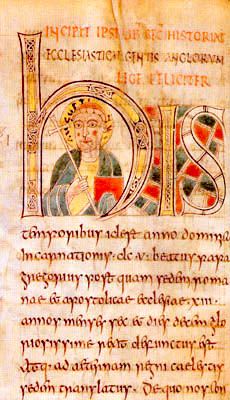
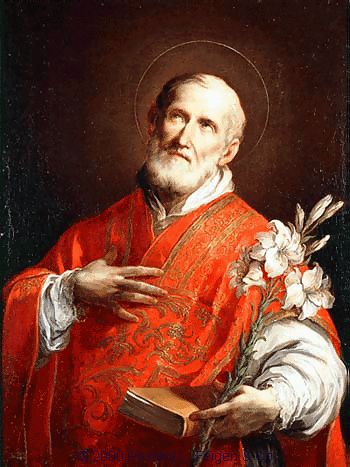
First Archbishop of Canterbury, Apostle of the English; date of birth unknown; d. 26 May, 604. Symbols: cope, pallium [a woolen band the pope gives to archbishops as a sign of their authority], and mitre as Bishop of Canterbury, and pastoral staff and gospels as missionary. Nothing is known of his youth except that he was probably a Roman of the better class, and that early in life he become a monk in the famous monastery of St. Andrew erected by St. Gregory out of his own patrimony on the Cælian Hill. It was thus amid the religious intimacies of the Benedictine [monks following the Rule of St. Benedict] Rule and in the bracing atmosphere of a recent foundation that the character of the future missionary was formed. Chance is said to have furnished the opportunity for the enterprise which was destined to link his name for all time with that of his friend and patron, St. Gregory, as the "true beginner" of one of the most important Churches in Christendom and the medium by which the authority of the Roman See was established over men of the English-speaking race. It is unnecessary to dwell here upon Bede [English monk and historian (d. 735)]'s well-known version of Gregory's casual encounter with English slaves in the Roman market place (H.E., II, i), which is treated under GREGORY THE GREAT.
Some five years after his elevation to the Roman See (590) Gregory began to look about him for ways and means to carry out the dream of his earlier days. He naturally turned to the community he had ruled more than a decade of years before in the monastery on the Cælian Hill. Out of these he selected a company of about forty and designated Augustine, at that time Prior of St. Andrew's, to be their representative and spokesman. The appointment, as will appear later on, seems to have been of a somewhat indeterminate character; but from this time forward until his death in 604 it is to Augustine as "strengthened by the confirmation of the blessed Father Gregory (roboratus confirmatione beati patris Gregorii, Bede, H. E., I, xxv) that English, as distinguished from British, Christianity owes its primary inspiration.
The event which afforded Pope Gregory the opportunity he had so long desired of carrying out his great missionary plan in favour of the English happened in the year 595 or 596. A rumour had reached Rome that the pagan inhabitants of Britain were ready to embrace the Faith in great numbers, if only preachers could be found to instruct them. The first plan which seems to have occurred to the pontiff was to take measures for the purchase of English captive boys of seventeen years of age and upwards. These he would have brought up in the Catholic Faith with idea of ordaining them and sending them back in due time as apostles to their own people. He according wrote to Candidus, a presbyter entrusted with the administration of a small estate belonging to the patrimony of the Roman Church in Gaul [roughly modern France and Belgium], asking him to secure revenues and set them aside for this purpose. (Greg., Epp., VI, vii in Migne, P.L., LXXVII.) It is possible, not only to determine approximately the dates of these events, but also to indicate the particular quarter of Britain from which the rumour had come. Aethelberht became King of Kent in 559 or 560, and in less than twenty years he succeeded in establishing an overlordship that extended from the boulders of the country of the West Saxons eastward to the sea and as far north as the Humber and the Trent. The Saxons of Middlesex and of Essex, together with the men of East Anglia and of Mercia [the Anglo-Saxon kingdom of the English Midlands], were thus brought to acknowledge him at Bretwalda, and he acquired a political importance which began to be felt by the Frankish princes on the other side of the Channel. Charibert of Paris gave him his daughter Bertha in marriage, stipulating, as part of the nuptial agreement, that she should be allowed the free exercise of her religion. The condition was accepted (Bede, H. E., I, xxv) and Luidhard, a Frankish bishop, accompanied the princess to her new home in Canterbury, where the ruined church of St. Martin, situated a short distance beyond the walls, and dating from Roman-British times, was set apart for her use (Bede, H. E.,I, xxvi). The date of this marriage, so important in its results to the future fortunes of Western Christianity, is of course largely a matter of conjecture; but from the evidence furnished by one or two scattered remarks in St. Gregory's letters (Epp., VI) and from the circumstances which attended the emergence of the kingdom of the Jutes to a position of prominence in the Britain of this period, we may safely assume that it had taken place fully twenty years before the plan of sending Augustine and his companions suggested itself to the pope.
Read the rest of the article
The pope was obliged to complain of the lack of episcopal zeal among Aethelberht Christian neighbours. Whether we are to understand the phrase ex vicinis (Greg., Epp.,VI) as referring to Gaulish prelates or to the Celtic bishops of northern and western Britain, the fact remains that neither Bertha's piety, nor Luidhard's preaching, nor Aethelberht's toleration, nor the supposedly robust faith of British or Gaulish neighbouring peoples was found adequate to so obvious an opportunity until a Roman pontiff, distracted with the cares of a world supposed to be hastening to its eclipse, first exhorted forty Benedictines of Italian blood to the enterprise. The itinerary seem to have been speedily, if vaguely, prepared; the little company set out upon their long journey in the month of June, 596. They were armed with letters to the bishops and Christian princes of the countries through which they were likely to pass, and they were further instructed to provide themselves with Frankish interpreters before setting foot in Britain itself. Discouragement, however, appears early to have overtaken them on their way. Tales of the uncouth islanders to whom they were going chilled their enthusiasm, and some of their number actually proposed that they should draw back. Augustine so far compromised with the waverers that he agreed to return in person to Pope Gregory and lay before him plainly the difficulties which they might be compelled to encounter. The band of missionaries waited for him in the neighbourhood of Aix-en-Provence. Pope Gregory, however, raised the drooping spirits of Augustine and sent him back without delay to his faint-hearted brethren, armed with more precise, and as it appeared, more convincing authority.
Augustine was named abbot of the missionaries (Bede, H. E.,I, xxiii) and was furnished with fresh letters in which the pope made kindly acknowledgment of the aid thus far offered by Protasius, Bishop of Aix-en-Provence, by Stephen, Abbot of Lérins, and by a wealthy lay official of patrician rank called Arigius [Greg., Epp., VI (indic. xiv) num. 52 sqq.;sc. 3,4,5 of the Benedictine series]. Augustine must have reached Aix on his return journey some time in August; for Gregory's message of encouragement to the party bears the date of July the twenty-third, 596. Whatever may have been the real source of the passing discouragement no more delays are recorded. The missionaries pushed on through Gaul, passing up through the valley of the Rhone to Arles on their way to Vienne and Autun, and thence northward, by one of several alternatives routes which it is impossible now to fix with accuracy, until they come to Paris. Here, in all probability, they passed the winter months; and here, too, as is not unlikely, considering the relations that existed between the family of the reigning house and that of Kent, they secured the services of the local presbyters suggested as interpreters in the pope's letters to Theodoric and Theodebert and to Brunichilda, Queen of the Franks [the Germanic people who ruled Gaul and gave France its name].
In the spring of the following year they were ready to embark. The name of the port at which they took ship has not been recorded. Boulogne was at that time a place of some mercantile importance; and it is not improbable that they directed their steps thither to find a suitable vessel in which they could complete the last and not least hazardous portion of their journey. All that we know for certain is that they landed somewhere on the Isle of Thanet (Bede, H. E.,I, xxv) and that they waited there in obedience to King Aethelberht orders until arrangements could be made for a formal interview. The king replied to their messengers that he would come in person from Canterbury, which was less than a dozen miles away. It is not easy to decide at this date between the four rival spots, each of which has claimed the distinction of being the place upon which St. Augustine and his companions first set foot. The Boarded Groin, Stonar, Ebbsfleet, and Richborough — last named, if the present course of the Stour has not altered in thirteen hundred years, then forming part of the mainland — each has its defenders. The curious in such matters may consult the special literature on the subject cited at the close of this article. The promised interview between the king and the missionaries took place within a few days. It was held in the open air, sub divo, says Bede (Bede, H.E.,I, xxv), on a level spot, probably under a spreading oak in deference to the king's dread of Augustine's possible incantations. His fear, however, was dispelled by the native grace of manner and the kindly personality of his chief guest who addressed him through an interpreter. The message told "how the compassionate Jesus had redeemed a world of sin by His own agony and opened the Kingdom of Heaven to all who would believe" (Aelfric, ap. Haddan and Stubbs, III, ii). The king's answer, while gracious in its friendliness, was curiously prophetic of the religious after-temper of his race. "Your words and promised are very fair" he is said to have replied, "but as they are new to us and of uncertain import, I cannot assent to them and give up what I have long held in common with the whole English nation. But since you have come as strangers from so great a distance, and, as I take it, are anxious to have us also share in what you conceive to be both excellent and true, we will not interfere with you, but receive you, rather, in kindly hospitality and take care to provide what may be necessary for your support. Moreover, we make no objection to your winning as many converts as you can to your creed". (Bede, H.E., I, xxv.)
The king more than made good his words. He invited the missionaries to take up their abode in the royal capital of Canterbury, then a barbarous and half-ruined metropolis, built by the Kentish folk upon the site of the old Roman military town of Durovernum. In spite of the squalid character of the city, the monks must have made an impressive picture as they drew near the abode "over against the Kings' Street facing the north", a detail preserved in William Thorne's (c. 1397) "Chronicle of the Abbots of St. Augustine's Canterbury," p.1759, assigned them for a dwelling. The striking circumstances of their approach seem to have lingered long in popular remembrance; for Bede, writing fully a century and a third after the event, is at pains to describe how they came in characteristic Roman fashion (more suo) bearing "the holy cross together with a picture of the Sovereign King, Our Lord Jesus Christ and chanting in unison this litany", as they advanced: "We beseech thee, O Lord, in the fulness of thy pity that Thine anger and Thy holy wrath be turned away from this city and from Thy holy house, because we have sinned: Alleluia!" It was an anthem out of one of the many "Rogation" litanies then beginning to be familiar in the churches of Gaul and possibly not unknown also at Rome. (Martène, "De antiquis Ecclesiae ritibus", 1764, III, 189; Bede, "H.E.", II, xx; Joanes Diac., "De Vita Gregorii", II, 17 in Migne, P.L., LXXXV; Duchesne's ed., "Liber Pontificalis", II, 12.) The building set apart for their use must have been fairly large to afford shelter to a community numbering fully forty. It stood in the Stable Gate, not far from the ruins of an old heathen temple; and the tradition in Thorn's day was that the parish church of St. Alphage approximately marked the site (Chr. Aug. Abb., 1759). Here Augustine and his companions seemed to have established without delay the ordinary routine of the Benedictine rule as practiced at the close of the sixth century; and to it they seem to have added in a quiet way the apostolic ministry of preaching. The church dedicated to St. Martin in the eastern part of the city which had been set apart for the convenience of Bishop Luidhard and Queen Bertha's followers many years before was also thrown open to them until the king should permit a more highly organized attempt at evangelization.
The evident sincerity of the missionaries, their single-mindedness, their courage under trial, and, above all, the disinterested character of Augustine himself and the unworldly note of his doctrine made a profound impression on the mind of the king. He asked to be instructed and his baptism was appointed to take place at Pentecost. Whether the queen and her Frankish bishop had any real hand in the process of this comparatively sudden conversion, it is impossible to say. St. Gregory's letter written to Bertha herself, when the news of the king's baptism had reached Rome, would lead us to infer, that, while little or nothing had been done before Augustine's arrival, afterwards there was an endeavor on the part of the queen to make up for past remissness. The pope writes: "Et quoniam, Deo volente, aptum nunc tempus est, agate, ut divina gratia co-operante, cum augmento possitis quod neglectum est reparare". [Greg. Epp., XI (indic., iv), 29.] The remissness does seem to have been atoned for, when we take into account the Christian activity associated with the names of this royal pair during the next few months. Aethelberht's conversion naturally gave a great impetus to the enterprise of Augustine and his companions. Augustine himself determined to act at once upon the provisional instruction he had received from Pope Gregory. He crossed over to Gaul and sought episcopal consecration at the hands of Virgilius, the Metropolitan of Arles. Returning almost immediately to Kent, he made preparations for that more active and open form of propaganda for which Aethelberht's baptism had prepared a way. It is characteristic of the spirit which actuated Augustine and his companions that no attempt was made to secure converts on a large scale by the employment of force. Bede tells us that it was part of the king's uniform policy "to compel no man to embrace Christianity" (H. E., I, xxvi) and we know from more than one of his extant letters what the pope though of a method so strangely at variance with the teaching of the Gospels. On Christmas Day, 597, more than ten thousand persons were baptized by the first "Archbishop of the English". The great ceremony probably took place in the waters of the Swale, not far from the mouth of the Medway. News of these extraordinary events was at once dispatched to the pope, who wrote in turn to express his joy to his friend Eulogius, Bishop of Alexandria, to Augustine himself, and to the king and queen. (Epp., VIII, xxx; XI, xxviii; ibid., lxvi; Bede, H. E., I, xxxi, xxxii.) Augustine's message to Gregory was carried by Lawrence the Presbyter, afterwards Archbishop of Canterbury, and Peter one of the original colony of missionary monks. They were instructed to ask for more Gospel labourers, and, if we may trust Bede's account in this particular and the curious group of letters embodied in his narrative, they bore with them a list of dubia, or questions, bearing upon several points of discipline and ritual with regard to which Augustine awaited the pope's answer.
The genuineness of the document or libellus, as Bede calls it (H.E., II, i), in which the pope is alleged to have answered the doubts of the new archbishop has not been seriously called in question; though scholars have felt the force of the objection which St. Boniface, writing in the second quarter of the eighth century, urges, vis, that no trace of it could be found in the official collection of St. Gregory's correspondence preserved in the registry of the Roman Church.(Haddan and Stubbs, III, 336; Dudden, "Gregory the Great", II, 130, note; Mason, "Mission of St. Augustine", preface, pp. viii and ix; Duchesne, "Origines", 3d ed., p. 99, note.) It contains nine responsa, the most important of which are those that touch upon the local differences of ritual, the question of jurisdiction, and the perpetually recurring problem of marriage relationships. "Why", Augustine had asked "since the faith is one, should there be different usages in different churches; one way of saying Mass in the Roman Church, for instance, and another in the Church of Gaul?" The pope's reply is, that while "Augustine is not to forget the Church in which he has been brought up", he is at liberty to adopt from the usage of other Churches whatever is most likely to prove pleasing to Almighty God. "For institutions", he adds, "are not to be loved for the sake of places; but places, rather, for the sake of institutions". With regard to the delicate question of jurisdiction Augustine is informed that he is to exercise no authority over the churches of Gaul; but that "all the bishops of Britain are entrusted to him, to the end that the unlearned may be instructed, the wavering strengthened by persuasion and the perverse corrected with authority". [Greg., Epp., XI (indic., iv), 64; Bede, H. E., I, xxvii.] Augustine seized the first convenient opportunity to carry out the graver provisions of this last enactment. He had already received the pallium on the return of Peter and Lawrence from Rome in 601. The original band of missionaries had also been reinforced by fresh recruits, among whom "the first and most distinguished" as Bede notes, "were Mellitus, Justus, Paulinus, and Ruffinianus". Of these Ruffinianus was afterwards chosen abbot of the monastery established by Augustine in honour of St. Peter outside the eastern walls of the Kentish capital. Mellitus became the first English Bishop of London; Justus was appointed to the new see of Rochester [a bishop’s “see” is his diocese, named from his seat (Latin sedes)], and Paulinus became the Metropolitan of York.
Aethelberht, as Bretwalda, allowed his wider territory to be mapped out into dioceses, and exerted himself in Augustine's behalf to bring about a meeting with the Celtic bishops of Southern Britain. The conference took place in Malmesbury, on the borders of Wessex [the Anglo-Saxon kingdom of southern England], not far from the Severn, at a spot long described in popular legend as Austin's Oak. (Bede, H.E., II, ii.) Nothing came of this attempt to introduce ecclesiastical uniformity. Augustine seems to have been willing enough to yield certain points; but on three important issues he would not compromise. He insisted on an unconditional surrender on the Easter controversy; on the mode of administering the Sacrament of Baptism; and on the duty of taking active measures in concert with him for the evangelization of the Saxon conquerors. The Celtic bishops refused to yield, and the meeting was broken up. A second conference was afterwards planned at which only seven of the British bishops convened. They were accompanied this time by a group of their "most learned men" headed by Dinoth, the abbot of the celebrated monastery of Bangor-is-coed. The result was, if anything, more discouraging than before. Accusations of unworthy motives were freely bandied on both sides. Augustine's Roman regard for form, together with his punctiliousness for personal precedence as Pope Gregory's representative, gave umbrage to the Celts. They denounced the Archbishop for his pride, and retired behind their mountains. As they were on the point of withdrawing, they heard the only angry threat that is recorded of the saint: "If ye will not have peace with the brethren, ye shall have war from your enemies; and if ye will not preach the way of life to the English, ye shall suffer the punishment of death at their hands". Popular imagination, some ten years afterwards, saw a terrible fulfilment of the prophecy in the butchery of the Bangor monks at the hands of Aethelfrid the Destroyer in the great battle won by him at Chester in 613.
These efforts toward Catholic unity with the Celtic bishops and the constitution of a well-defined hierarchy for the Saxon Church are the last recorded acts of the saint's life. His death fell in the same year says a very early tradition (which can be traced back to Archbishop Theodore's time) as that of his beloved father and patron, Pope Gregory. Thorn, however, who attempts always to give the Canterbury version of these legends, asserts — somewhat inaccurately, it would appear, if his coincidences be rigorously tested — that it took place in 605. He was buried, in true Roman fashion, outside the walls of the Kentish capital in a grave dug by the side of the great Roman road which then ran from Deal to Canterbury over St. Martin's Hill and near the unfinished abbey church which he had begun in honour of Sts. Peter and Paul and which was afterwards to be dedicated to his memory. When the monastery was completed, his relics [the bodily remains of a saint, or objects they used, kept with honor] were translated to a tomb prepared for them in the north porch. A modern hospital is said to occupy the site of his last resting place. [Stanley, "Memorials of Canterbury" (1906), 38.] His feast day in the Roman Calendar is kept on 28 May; but in the proper of the English office it occurs two days earlier, the true anniversary of his death.
Bede, Hist. Eccl. I and II; Paulus Diaconus, Johannes Diaconus, and St. Gall MSS., Lives of St. Gregory in P.L., LXXV; Epistlae Gregorii, ibid.; Gregory of Tours [bishop and historian of the Franks (d. 594)], Historia Francorum, ibid., LXXI; Goscelin, Life of St. Gregory in Acta SS., May, VI, 370 sqq.; Wm. Thorne, Chron. Abbat. S. Aug. in Twysden's Decem Scriptores (London, 1652), pp 1758-2202; Haddan and Stubbs, Councils and Ecclesiastical Documents relating to Great Britain and Ireland (Oxford, 1869-1873, 3 vols.); Mason (ed.), The Mission of St. Augustine according to the Original Documents (Cambridge, 1897); Dudden, Gregory the Great, His Place in the History of Thought (London, New York, Bombay, 1905); St Gallen MS., ed, Gasquet (1904);Stanley, Memorials of Canterbury (London, 1855, 1906); Bassenge, Die Sendung Augustins zur Bekehrung d. Angelsachsen (Leipzig, 1890); Brou, St. Augustin de Canterbury et ses Compagnons (Paris, 1897); Lévèque, St Augustin de Canterbury, in Rev. des Quest. Hist. (1899), xxi, 353-423; Martielli, Recits des fetes celebrees a l'occ. du 13e centenaire de l'arrivee de St. Aug. en Angleterre (Paris, 1899)