B

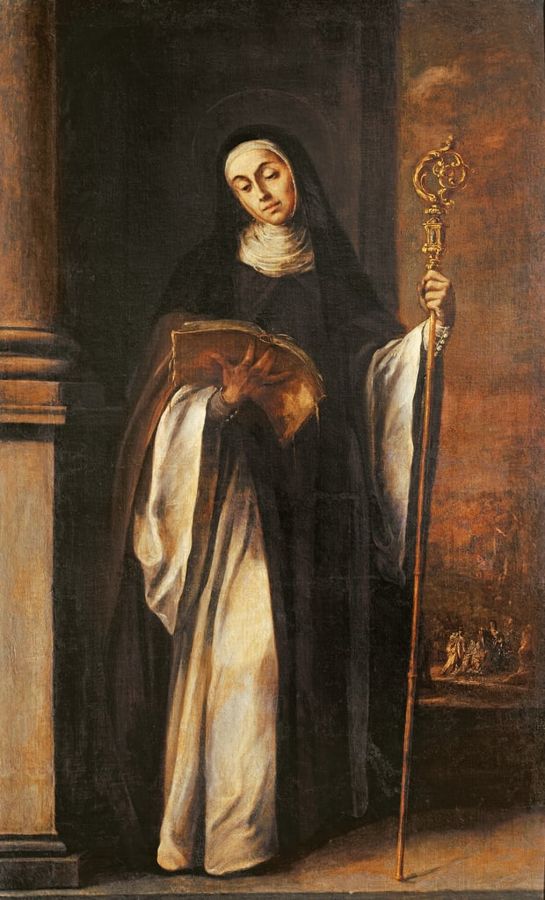
St. Balthild (died c. 680) was an English girl sold as a slave who became queen of the Franks. She worked to end the slave trade and founded monasteries.

Read the essentials →
January 26 · Queen

St. Bathild

St. Bathild

St. Balthild (died c. 680) was an English girl sold as a slave who became queen of the Franks. She worked to end the slave trade and founded monasteries.

Traditional feast

January 26
1914 / pre-1969 calendar, per Baring-Gould (1914)

Current feast

Not verified yet

Represents

Queen

Their story

Adapted in modern English from the Catholic Encyclopedia (1913) · original text below · little is known

Bathilde, possibly of English birth, was a slave in the household of Erchinoald, mayor of the palace of Neustria. When he wished to marry her, she fled until he had married someone else. King Clovis II freed and married her in 649.

Widowed in 656, she ruled as regent for her five-year-old son with the help of holy bishops. She abolished the trade in Christian slaves, repressed simony (buying or selling church offices), and founded Corbie and Chelles. When her sons were settled she retired to Chelles, laid aside every sign of royalty, took her place after the novices, and served the sick for fifteen years until her death in 680.

Early life

The book says little or nothing about early life. This is how the account begins.

Archimbold, mayor of the palace, in the reign of Dagobert, King of France, bought a slender fair-haired English slave girl. The name of this girl was Bathild, given her probably because of her work, for the name signifies "the damsel of the lady's bower." [125] In service she grew up to woman's estate, and was very beautiful, but, withal, adorned with a meek and quiet spirit. She is thus described by one of her biographers:—"Her pious and admirable conversation attracted the admiration of the prince, and all his ministers.

What they represent

How they teach us to live

Drawn from themes in the original account

Make time for silence. Solitude and withdrawal to pray shape this life.

Build up the community you belong to. This life was lived with and for a community.

Learn from the kind of life it was. From slave to queen, and she used her power to free others.

From the Catholic Encyclopedia

1913 · 629 words

Wife of Clovis II, King of France, time and place of birth unknown; d. January; 680. According to some chronicles she came from England and was a descendant of the Anglo-Saxon kings, but this is a doubtful statement. It is certain that she was a slave in the service of the wife of Erchinoald, mayor of the palace of Neustria. Her unusual qualities of mind and her virtues inspired the confidence of her master who gave many of the affairs of the household into her charge and, after the death of his wife, wished to marry her. At this the young girl fled and did not return until Erchinoald had married again. About this time Clovis II met her at the house of the mayor of the palace, and was impressed by her beauty, grace, and the good report he had of her. He freed and married her, 649. This sudden elevation did not diminish the virtues of Bathilde but gave them a new lustre. Her humility, spirit of prayer, and large-hearted generosity to the poor were particularly noticeable.

Seven years after their marriage Clovis II died, 656, leaving Bathilde with three sons, Clothaire, Childeric, and Thierry. An assembly of the leading nobles proclaimed Clothaire III, aged five, king under the regency of his mother, Bathilde. Aided by the authority and advice of Erchinoald and the saintly bishops, Eloi (Eligius) of Noyon, Ouen of Rouen, Leéger of Autun, and Chrodebert of Paris, the queen was able to carry out useful reforms. She abolished the disgraceful trade in Christian slaves, and firmly repressed simony among the clergy. She also led the way in founding charitable and religious institutions, such as hospitals and monasteries. Through her generosity the Abbey of Corbey was founded for men, and the Abbey of Chelles near Paris for women. At about this date the famous Abbeys of Jumièges, Jouarre, and Luxeuil were established, most probably in large part through Bathilde's generosity. Berthilde, the first Abbess of Chelles, who is honoured as a saint, came from Jouarre. The queen wished to renounce her position and enter the religious life, but her duties kept her at court. Erchinoald died in 659 and was succeeded by Ebroin. Notwithstanding the ambition of the new mayor of the palace, the queen was able to maintain her authority and to use it for the benefit of the kingdom. After her children were well established in their respective territories, Childeric IV in Austrasia and Thierry in Burgundy, she returned to her wish for a secluded life and withdrew to her favourite Abbey of Chelles near Paris.

On entering the abbey she laid down the insignia of royalty and desired to be the lowest in rank among the inmates. It was her pleasure to take her position after the novices and to serve the poor and infirm with her own hands. Prayer and manual toil occupied her time, nor did she wish any allusion made to the grandeur of her past position. In this manner she passed fifteen years of retirement. At the beginning of the year 680 she had a presentiment of the approach of death and made religious preparation for it. Before her own end, that of Radegonde occurred, a child whom she had held at the baptismal font and had trained in Christian virtue. She was buried in the Abbey of Chelles and was canonized by Pope Nicholas I. The Roman martyrology places her feast on 26 January; in France it is celebrated 30 January.

Read the rest of the article

Acta SS., II; DUBOIS, Histoire ecclésiastique de Paris, 198; BINET, La vie excellente de Sainte Bathilde (Paris, 1624); CORBLET, Hagiographie du diocèse d'Amiens (1874); DES ESSARTS, Sainte Bathilde in Correspondant (1873), XXXII, 227-246; DRIOUS, La reine Bathilde (Limoges, 1865); GREÉCY in Revue archéologique (1865), XII, 603-610.

Read more

The full original · 938 words

Read Baring-Gould’s full account

Baring-Gould’s sources: Roman and other Martyrologies. In some, however, on Jan. 27th; at Paris on Jan. 30th. Authorities: her life by two contemporary writers. The first is in plain unpolished style. Its date appears from allusions such as this:—"The venerable Theudofred, who is now bishop, was then abbot." "The illustrious offspring of Bathild, now reigning, &c." The writer of the other expressly states that he had seen and known the virtues of her whom he describes.

Archimbold, mayor of the palace, in the reign of Dagobert, King of France, bought a slender fair-haired English slave girl. The name of this girl was Bathild, given her probably because of her work, for the name signifies "the damsel of the lady's bower." [125] In service she grew up to woman's estate, and was very beautiful, but, withal, adorned with a meek and quiet spirit.

She is thus described by one of her biographers:—"Her pious and admirable conversation attracted the admiration of the prince, and all his ministers. For she was of a benignant spirit and sober manners, prudent and shy, never scheming evil, never light in talk, or pert in speech; but in all her actions upright. She was of Saxon race, in shape graceful and pleasing, with a bright face and a staid gait, and as such, she found favour with the prince, so that he constituted her his cup-bearer, and as such, dealing honestly, she stood often by him ministering to him. But so far from being lifted up by her position, she showed the utmost humility to her fellow-servants, cheerfully obeying them, ministering reverently to her elders, often taking their shoes off for them, scraping and cleaning them, and bringing them their washing water, and mending their clothes also. All this she did without a murmur, with gentle and pious alacrity."

Now it fell out that Archimbold lost his wife, and he looked about for one to fill her place. Then his glance rested on the fair-haired, blue-eyed Saxon maid, so kindly and so obliging. But when he announced that it was his intention to make her his wife, she was so alarmed that she hid herself among the under maids of the kitchen, dishevelled her light hair, begrimed her face, and worked in rags, so that the mayor supposed she had gone clean away, and after a while forgot her, and possibly thinking that such a match might have been after all a mistake, he married some one else. Then Bathild shook her tatters off, braided her flaxen hair, washed her sunny face, and shone forth in her accustomed place. But she had fled the mayor to catch the king. How Clovis became attached to her is not recorded; possibly he had long noticed the meek maiden at the mayor's elbow filling his wine goblet, and her disappearance had made him aware of the strength of his passion. Certain it is that shortly after, he asked her to be his lawful wife, and to sit at his side on the throne of France. There was no escaping a king; and at the age of nineteen, in 649, she was married accordingly to Clovis II. As queen she exercised a most salutary influence over the mind of her husband, and persuaded him to enact many salutary laws. She became a nursing mother to the Church in France, and exerted herself to the utmost of her power to relieve the necessities of the poor, and ameliorate the condition of the serfs. She bore her husband three sons, who all successively wore the crown, Clothaire III., Childeric II., and Thierry I. After six years of married life, in 655, Bathild was left a widow, when her eldest son was only five years old. She then became regent of the kingdom. The gentle queen remembered her sorrows as a slave, and resolved to become the benefactress of the slave. Slavery was universally and firmly established in France. To root out such an institution at once was impossible; it could only be done with caution, lest it should alarm and rouse to opposition the great slave owners. She had sufficient penetration to discover the great cause of slavery in France. The old Gallic population was crushed beneath an enormous tax, to pay which mothers were obliged to sell their children, and which reduced into bondage those unfortunates who could not pay. This impost she abolished, and thereby cut off the source of slavery. She also forbade the retention or purchase of Christian slaves; but, to save vested interests, this law did not emancipate those already in bonds, but was of future operation only. She employed, moreover, all the money she could spare in the purchase out of bondage of such children as mothers had sold, out of dire necessity. She also sent ambassadors to all the European courts, to announce that the sale of French subjects was strictly forbidden, and that any slave who should set foot on French soil would be held from that moment to be free.

Bathild also founded a large number of religious houses. France was then overspread with forests; vast districts were pathless wildernesses, uninhabited by men. Old cities which had thriven under the Roman empire had fallen into ruins, and the wolf made his lair in the deserted chambers. How was all this desolation to be remedied, this waste land to be reclaimed? A number of men must be gathered together at certain spots, and these must become civilizing centres, diffusing knowledge amongst the people, and cultivating the soil. Such were the monasteries. They were dotted about in the wildest parts of the vast woods, and little by little the trees were cleared away about them, and pastures and corn land usurped their place, and with the advance of agriculture, civilization spread. Bathild founded Corbie, Chelles, and Jumièges, besides others of less note. Towards the close of her days, when her son Clothaire was of an age to govern, she retired into the monastery of Chelles, where she finished her days in peace, dying at the age of fifty, in 680.
Feast days

Feast: January 26

Nine days · Free

Pray the novena
with us.

One short email a day for nine days. The day's prayer, a line from St. Bathild's story, and a nudge to keep going.

Also on January 26
St. Polycarp of Smyrna

St. Polycarp of Smyrna

January 26 · Bishop, Martyr
St. Simeon the Old

St. Simeon the Old

January 26 · Abbot
St. Paula at Bethlehem

St. Paula at Bethlehem

January 26 · Widow
← All 1726 saints in the library
Sources & notes

Feast-day sources

Story sources

Sources

Credits

From Sabine Baring-Gould, The Lives of the Saints, new and revised edition (Edinburgh: John Grant, 1914; first edition 1872). Public domain.

From “Catholic Encyclopedia (1913)/St. Bathilde,” The Catholic Encyclopedia (New York: Robert Appleton Company, 1907–1914), via Wikisource. Public domain. Matched by name and feast date; text unedited except for our bracketed notes in grey.

From Sabine Baring-Gould, The Lives of the Saints, new and revised edition (Edinburgh: John Grant, 1914; first edition 1872). Public domain in the United States. Reproduced unedited, except for short bracketed notes in grey that we added to explain names and terms (“S.” is the old abbreviation for Saint). Some history and judgments reflect 19th-century scholarship.