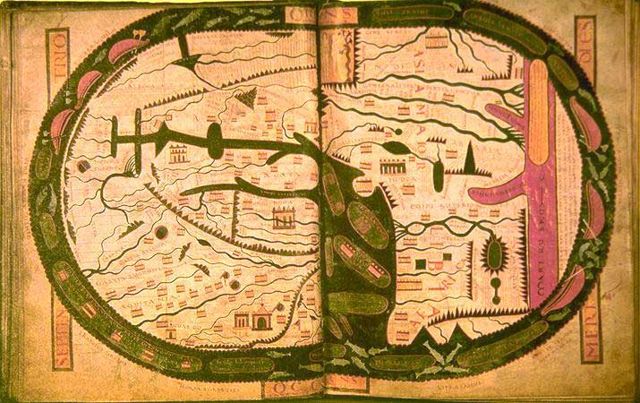
Baring-Gould’s sources: Many German and other Martyrologies. But there is great confusion, Beatns of Vendome being confounded with Beatus of Tbun. Beatus of Vendome is said to have come into Gaul at a very early age, having been sent by S. Peter. But this is certainly a mistake of an early writer who found in some record that he had been sent by the Apostolic See, and so made his mission to be from the apostle himself. S. Beatus, the Swiss hermit, is certainly a different person, but the incidents of the life of the two Bead are attributed first to one, and then to the other. There seems every probability that S. Beatus of Thun was one of the companions of S. Gall.] It was on Whitsun evening, in the year 1868, that I visited the cave of S. Beatus, in the face of a precipice above the Lake of Thun, in Switzerland.
Beatus. A more lovely walk cannot be conceived. The path scrambled along the edge of precipices overhanging the still, green lake, which reflected the glow of the evening in the sky overhead. Tufts of pinks clung to the rock, and bunches of campanula dangled their blue bells at dizzy heights over the still water. Yellow cistus, golden potentilla, and spires of blue salvia made glorious harmonies of colour in the little dells that sank in green grassy slopes to tiny coves where nestled cottages, and a gaily painted boat was moored. The cave of the saint is screened by a fir wood, clinging to the rock ledges. Its wide entrance was once walled up, so as to leave only a door and window, but the stones have fallen. The altar within is overthrown. Shortly after the Reformation, crowds of pilgrims came, as in earlier times, to visit the cave of the apostle of this part of Switzerland, and the authorities of Berne were obliged in the.interests of Zwinglianism, after having violently forced heresy on the reluctant peasants of Haslithal and Interlachen, to drive them away from the cave of their Apostle at the point of the spear. Now the cave is only visited by a few sight-seers. But at Lungern, on the nearest point of the Canton of Ob-walden, where the ancient faith still maintains its ground, loving hearts have built a little chapel dedicated to Beatus, and this is now visited by great crowds, who love to honour the memory of their apostle, on May 9th, in every year, when a sermon is preached by one of the Capuchin friars of Sarnen.
Of the history of S. Beatus little is known, save that he came from Britain or Ireland, probably in company with S. Columbanus [Irish monk (d. 615) who founded monasteries in France and Italy] and S. Gall [Irish companion of Columbanus, founder of the Swiss monastery that bears his name], and settled in this cave, whence, according to the popular legend, he expelled a monstrous serpent, and precipitated it into the lake. About 30 feet below the mouth of the cave a large stream spouts out of the rock, and forming a fine cascade of 800 feet, plunges into the still mirror of the lake, which it strews with bubbles. The sun set as I sat in the door of the hermit’s cave; and as I walked back to Unterseen, its orange fires fell and touched with flame every white and heaven aspiring peak; and the spotless Jungfrau seated amidst a glorious company of mountain forms, each with its flaming brow, called up a thought of the events of that first Whitsun day, when — tf The fires that rushed on Sinai down In sudden torrents dread, Now gently light, a glorious crown, On every saintly head.”