Read Baring-Gould’s full account
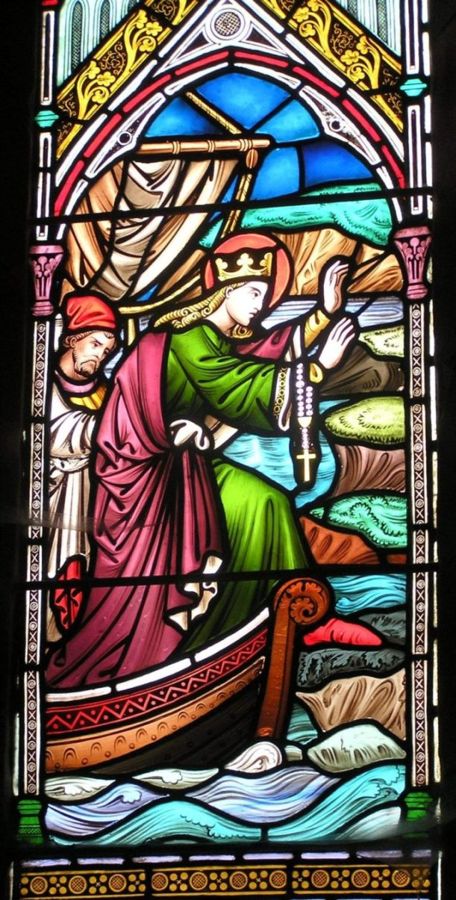
Baring-Gould’s sources: Aberdeen Breviary, on October 31. The Anglican Martyrology of Wilson (a.d. i6o3), and Dempster in his Scottish Menology. Authority; — A Life, late, from a MS. in the British Museum, pub. by Tomlinson, Carlisle, 1842. The following is from Montalembert’s Monks of the West.] In Cumberland, upon a promontory bathed by the waves of the Irish sea, and from which in clear weather the southern shore of Scotland and the distant peaks of the Isle of Man may be seen, a religious edifice still bears the name and preserves the recollection of S. Bega. She was, according to the legend, the daughter of an Irish king, the most beautiful woman in the country, and already asked in marriage by the son of the King of Norway. But she had vowed herself, from her tenderest infancy, to the spouse of virgins, and had received from an angel, as a seal of her celestial betrothal, a bracelet marked with the sign of the cross. On the night before her wedding-day, while the guards of the king her father, instead of keeping watch, as usual, with sabres at their sides and axes on their shoulders, were, like their guests, deep in the revel, she escaped alone, with nothing but the bracelet which the angel had given her, threw herself upon a green sod, and was wafted to the opposite shore, in Northumberland, where she lived long in a cell in the wood, uniting with her prayers the care of the sick poor around. Fear of the pirates who infested these coasts led her, after awhile, farther inland. What then became of her? Here the confusion, which is so general in the de_ bateable ground between legend and history, becomes nearly inextricable. Was it she who, under the name of Heiu, is pointed out to us by Beda as the woman to whom Bishop A'idan, the apostle of Northumbria, gave the veil, and whom he placed at the head of the first nunnery which had been seen in the north of England ? Or was it she who, under S. Bega, or Bee.
…the name of Bega, after having abdicated the dignity of abbess, lived for thirty years a humble and simple nun in one of the monasteries under the rule of the great Abbess of Whitby, Hilda, whose intimate friend she became, as well as her daughter in religion ?
These are questions which have been long disputed by the learned, and which it seems impossible to bring to any satisfactory conclusion. What is certain, however, is that a virgin of the name of Bega figures among the most wellknown and long venerated saints of the north-west of England. She was celebrated during her lifetime for her austerity, her fervour, and an anxiety for the poor, which led her, during the building of her monastery, to prepare with her own hands the food of the masons, and to wait upon them in their workshops, hastening from place to place like a bee laden with honey. She remained down to the Middle Ages the patroness of the laborious and often oppressed population of the district, in which tradition presents her to us as arriving alone and fearless on a foreign shore, flying from her royal bridegroom. In the twelfth century the famous bracelet which the angel had given her was regarded with tender veneration; the pious confidence of the faithful turned it into a relic upon which usurpers, prevaricators, and oppressors against whom there existed no other defence, were made to swear, with the certainty that a perjury committed on so dear and sacred a pledge would not pass unpunished. It was also to Bega and her bracelet that the cultivators of the soil had recourse against the new and unjust taxes with which their lords burdened them. In vain the Scottish rievers or the prepotents of the country, treading down under their horses’ feet the harvest of the Cumbrians, made light of the complaints and threats of the votaries of S. Bega. “ What is the good old woman to me, and what harm can she do me ?” said one. “ Let your Bega come !” said another — “ let her come and do whatever she likes 1 she cannot make one of our horses cast his shoes.” Sooner or later divine vengeance struck these culprits; and the fame of the chastisements sent upon them confirmed the faith of the people in the powerful intercession of her who, six hundred years after her death, still gave a protection effectual and energetic against feudal rudeness, to the captive and to the oppressed, to the chastity of women, and the rights of the lowly, upon the western shore of Northumbria [the Anglo-Saxon kingdom of northern England and south-east Scotland].