St. Blaise

Faithfulness to Christ when it cost everything.

Read the essentials →
February 3 · Bishop, Martyr

St. Blaise

St. Blaise

Faithfulness to Christ when it cost everything.

Traditional feast

February 3
1914 / pre-1969 calendar, per Baring-Gould (1897)

Current feast

February 3
Verified · General Roman Calendar

Represents

Bishop
Martyr

Their story

Adapted in modern English from Baring-Gould (1897) · original text below

Blaise was bishop of Sebaste in Cappadocia. After his day's duties he would withdraw to a hill near the city to be alone with God. When Diocletian's persecution (Diocletian was Roman emperor 284–305; the 'Great Persecution' of 303–311, when imperial edicts ordered churches and Scriptures destroyed and Christians forced to sacrifice to the Roman gods) came he hid there for a time, but he was finally caught and brought before Agricolaus, the governor. He confessed that he was a Christian and was thrown into prison, and after many tortures he was martyred at the beginning of the fourth century. Seven holy women and two young children died with him.

The source warns that the Acts (the written account of a martyr's trial and death) of his martyrdom are so untrustworthy that no further details can be called authentic. Tradition gives him an iron wool-comb as the instrument of his torture, which is why he became patron of wool workers. In art he often appears among wild beasts or with birds bringing him food, a sign that the creatures of the wood had grown used to the hermit-bishop. In England bonfires were once lit on the hills on St Blaise's night, and in parts of Germany his day was called 'Little Candlemas'.

Early life

Selected sentences from the original account, unaltered.

Seven holy women and two young children suffered at the same time.

What they represent

How they teach us to live

Drawn from themes in the original account

Stay faithful when it costs you. This account is about holding firm under pressure.

Learn from the kind of life it was. Faithfulness to Christ when it cost everything.

From the Catholic Encyclopedia

1913 · 719 words

The ninth-century martyrologies of Europe in their lists, which are accompanied by historical notices, give on 15 February the name of St. Blasius, Bishop of Sebaste and martyr. The Greek synaxaria mention him under 11 February. In the oldest known recension of the so-called martyrology of St. Jerome the name of St. Blasius does not appear; it is only in the later, enlarged catalogues that he is mentioned. The historical notices concerning him in the above-mentioned martyrologies and synaxaria rest on the legendary Acts. All the statements agree that St. Blasius was Bishop of Sebaste in Armenia and most of the acounts place his martyrdom in the reign of Licinius [Roman emperor in the East 308–324] (about 316). As these reports may rest on old traditions which are bound up with the veneration of the saint in the Church liturgy, they are not to be absolutely rejected. It can perhaps be assumed that St. Blasius was a bishop and that he suffered martyrdom at the beginning of the fourth century. All the particulars concerning his life and martyrdom which are found in the Acts are purely legendary and have no claim to historical worth. There are besides various recensions of the text of the Acts. According to the legend Blasius was a physician at Sebaste before he was raised to the episcopal see. At the time of the persecution under Licinius he was taken prisoner at the command of the governor, Agricolaus. The hunters of the governor found him in the wilderness in a cave to which he had retired and while in prison he performed a wonderful cure of a boy who had a fishbone in his throat and who was in danger of choking to death. After suffering various forms of torture St. Blasius was beheaded; the Acts relate also the martyrdom of seven women. The veneration of the Oriental saint was brought at an early date into Europe, as is shown by the recitals in the historical martyrologies of the ninth century, and the Latin recension of the legend of St. Blasius; so that Blasius became one of the most popular saints of the Middle Ages. The actual reason for the unusual veneration has not yet been made clear. Most probably one ground was that according to the legend he was a physician and wonderful cures were ascribed to him; for this reason the faithful sought his help and intercession when ill. Numberless churches and altars were dedicated to him and many localities (Taranto, Ragusa, the Abbey of St. Blasius in the Black Forest, etc.) claimed to possess some of his relics [the bodily remains of a saint, or objects they used, kept with honor]. He was also one of the Fourteen Holy Martyrs. In many places on the day of his feast the blessing of St. Blasius is given: two candles are consecrated, generally by a prayer, these are then held in a crossed position by a priest over the heads of the faithful or the people are touched on the throat with them. In other places oil is consecrated in which the wick of a small candle is dipped and the throats of those present are touched with the wick. At the same time the following blessing is given: "Per intercessionem S. Blasii liberet te Deus a malo gutteris et a quovis alio malo" (May God at the intercession of St. Blasius preserve you from throat troubles and every other evil). In some dioceses is added: "in nomine Patris et Filii et Spiritus" and the priest makes the sign of the cross over the faithful. In the Latin Church his feast falls on 3 February, in the Oriental Churches on 11 February. He is represented holding two crossed candles in his hand (the Blessing of St. Blasius), or in a cave surrounded by wild beasts, as he was found by the hunters of the governor.

Acta SS.. February, I 331-336; (Commentarius), 336-353 (Acta); MOMBRITIUS, Sanctuarium, I, 81-83; ed. BOLLANDISTS (Brussels, 1898-99), I, 204-205; METAPHRASTES, Vita Santorum in MIGNE, P.G., CXVI, col. 817 sqq.; Synaxarium Constantinopel., ed. DELAHAYE (Brussels, 1902), 458; UHRIG, Die XIV heiligen Nothelfer in Theol. Quartalschrift (Tübingen, 1888), 72 sqq.: NICCOLAI, Memorie storiche di S. Biagio, vescovo e martire, protettore della republica di Ragusa (Monza, 1889); ELLES, The Holy Helpers, Sts. Blaise and Erasmus in The Dublin Review (1889), 340 sqq.; PISTRE, Vie de S. Blaise, évéque de Sébaste (Toulouse, 1861).
Read more

The full original · 479 words

Read Baring-Gould’s full account

Baring-Gould’s sources: Roman and Western Martyrologies. Commemorated by the Greeks on Feb. 11th, in some ancient Martyrologies, on Feb. 15th. The Greek Acts, of which there are four versions, are modern, and deserve little regard.

Blasius, Blase, Blayse, Blays, or Blaise, was bishop of Sebaste, a city of Cappadocia [a region of central Turkey], in the Lesser Asia. He spent a great part of his time in retirement on a hill not far from the city, whither he withdrew, after the duties of his office were finished, to be alone with God. During the persecution of the Christians in the reign of Diocletian [Roman emperor 284–305, who began the ‘Great Persecution’ of Christians in 303], he lay concealed for some time in this retreat; but was at last taken and brought before Agricolaus, the governor of the province, and confessing himself a Christian, was thrown into prison. After enduring many tortures, he received the crown of martyrdom in the beginning of the fourth century. Some historians refer this event to the year 316, under the reign of Licinius [Roman emperor in the East 308–324]. Seven holy women and two young children suffered at the same time. The Acts of his martyrdom are so untrustworthy that it is not possible to state any further particulars which are authentic. The Council of Oxford, a.d. 1222, prohibited servile labour on this day. Its observance in England was marked by several curious ceremonies. Among others a taper used to be offered at High Mass; and it was lately the custom in many parts of England to light bonfires on the hills on S. Blaise's night. Some have affirmed that these usages arose from an absurd pun on the Saint's name (sc. "blaze"); but this seems clearly erroneous, as they are not peculiar to England. In some parts of Germany, S. Blaise's Day is called "Little Candlemas Day," because of the bonfires that it was usual (for an uncertain reason) to kindle on that night. At Bradford, Yorkshire, a festival is holden every five years in memory of S. Blaise.

In the Greek paintings, S. Blaise is depicted as an old man with a pointed beard. In Western art he appears in the vestments of a bishop; his peculiar emblem is an iron comb, such as is used by wool-combers, which is said to have been an instrument of his torture. Owing, probably, to this reason, he has been esteemed the patron of manufacturers of wool, and that trade in the city of Norwich still observes his day, or did so until lately. S. Blaise is also frequently represented as surrounded by wild beasts, or birds are bringing him food; the text, Job v. 23, which occasionally accompanies these emblems, indicates that, in his case as in that of other saints, by long continuance in a solitary course of life, the denizens of the wood had become accustomed to the Saint's presence. Sometimes again, S. Blaise has a swine's head at his feet, typical of his victory over the sensual desires of the flesh. Finally, he occasionally holds in one hand, or has borne before him by a chorister, a lighted taper, typical of his being "a burning and a shining light."

Feast days

Feast: February 3

Nine days · Free

Pray the novena
with us.

One short email a day for nine days. The day's prayer, a line from St. Blaise's story, and a nudge to keep going.

Also on February 3
C

Sts. Celerinus

February 3 · Deacon, Confessor, Martyrs
F

St. Fortunatus

February 3 · Martyr
L

St. Laurence the…

February 3 · Bishop
← All 1726 saints in the library
Sources & notes

Feast-day sources

Story sources

Sources

Credits

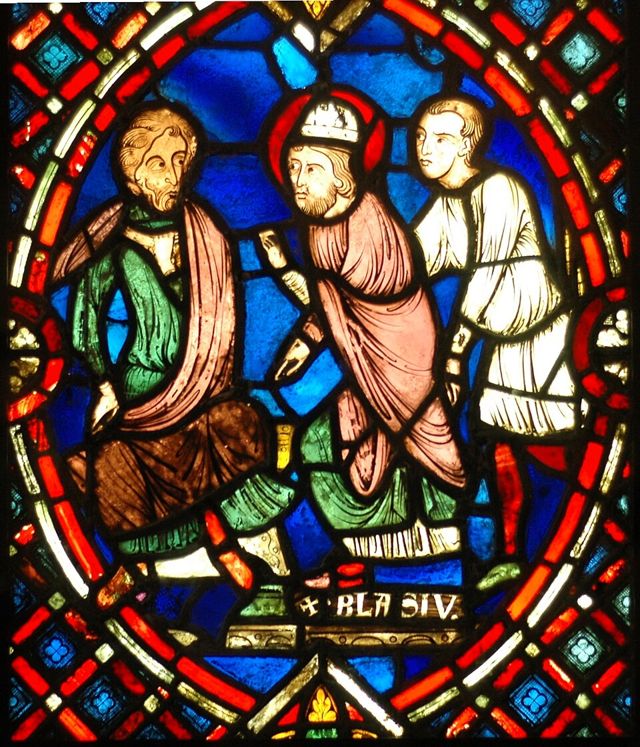
Image: Saint Blaise Louvre OAR504.jpg · Unknown artistUnknown artist · Public domain, via Wikimedia Commons

From Sabine Baring-Gould, The Lives of the Saints, new edition in 16 vols. (London: John C. Nimmo, 1897), digitized text from Project Gutenberg. Public domain.

Image: Unknown artistUnknown artist, Wikimedia Commons (Public domain)

From “Catholic Encyclopedia (1913)/St. Blaise,” The Catholic Encyclopedia (New York: Robert Appleton Company, 1907–1914), via Wikisource. Public domain. Matched by name and feast date; text unedited except for our bracketed notes in grey.

From Sabine Baring-Gould, The Lives of the Saints, new edition in 16 vols. (London: John C. Nimmo, 1897), digitized text from Project Gutenberg. Public domain in the United States. Reproduced unedited, except for short bracketed notes in grey that we added to explain names and terms (“S.” is the old abbreviation for Saint). Some history and judgments reflect 19th-century scholarship.