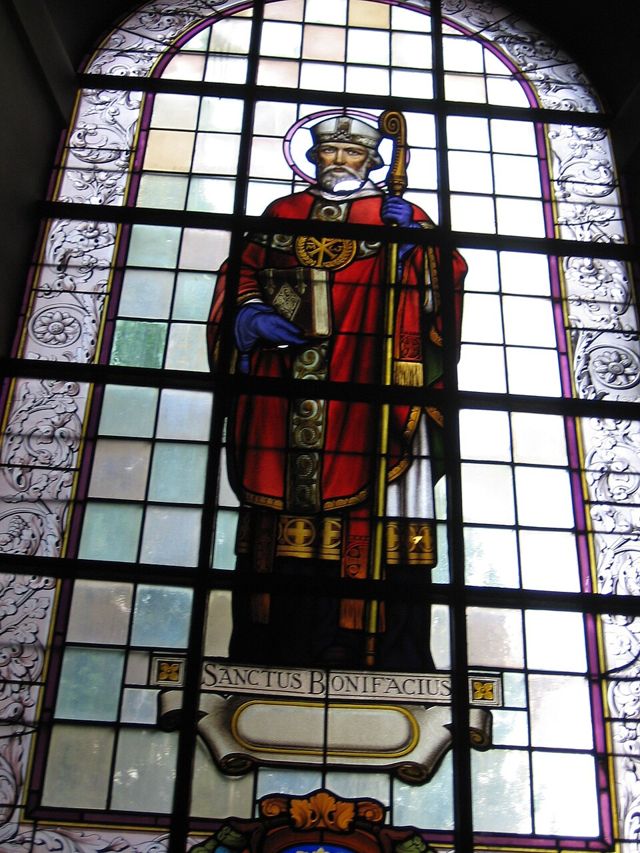
St. Boniface of Lausanne

A shepherd who stayed with his people through hard times.

Read the essentials →
February 19 · Bishop, Confessor

St. Boniface of Lausanne

St. Boniface of Lausanne

A shepherd who stayed with his people through hard times.

Traditional feast

February 19
1914 / pre-1969 calendar, per Baring-Gould (1897)

Current feast

February 19
Secondary source · Wikipedia

Represents

Bishop
Confessor

Their story

Adapted in modern English from Baring-Gould (1897) · original text below

Boniface was a goldsmith's son from Cantersteen. He was trained at the Cistercian (a strict reform of Benedictine monks begun at Cîteaux in 1098) monastery of Cambre near Brussels and later studied in Paris, where in 1258 he became a lecturer in theology at the university. In time his students drifted away, so he moved to Cologne and taught there successfully for two years.

He was then made Bishop of Lausanne. He worked to enforce celibacy on the clergy, and some of them were so angry that they armed themselves and entered the church while he was saying Mass, meaning to kill him. A Franciscan (the order of friars founded by St. Francis of Assisi) friar saw the danger and ran through the streets calling for help, and the people crowded into the cathedral and rescued him.

Boniface despaired of ever achieving the reform. With the Pope's consent he resigned and went back to Cambre, where he died in 1265 and was buried in the choir. His feast is kept in Brabant under a bull of Pope Clement XI from 1702.

Struggles & surrender

What they wrestled with, and how they gave it to God

  • Despairing of his task ·
    As Bishop of Lausanne, Boniface's efforts at reform so enraged some of his clergy that they tried to kill him at Mass. Despairing of ever accomplishing the work, he resigned his see with the Pope's consent and returned to his old monastery.

Early life

Selected sentences from the original account, unaltered.

Boniface , son of a goldsmith at Cantersteen, was trained in the Cistercian monastery of Cambre, near Brussels; he afterwards studied, and in 1258, became lecturer on theology in the university of Paris.

What they represent

How they teach us to live

Drawn from themes in the original account

Feed your mind with Scripture and good books. Learning and the Scriptures matter in this life.

Build up the community you belong to. This life was lived with and for a community.

Learn from the kind of life it was. A shepherd who stayed with his people through hard times.

Read more

The full original · 252 words

Read Baring-Gould’s full account

Baring-Gould’s sources: Molanus, in his additions to Usuardus. Not extensively known. Authority:—A Life by an anonymous monk of the Cistercian Order, date uncertain, but probably very little posterior to the death of S. Boniface.

Boniface , son of a goldsmith at Cantersteen, was trained in the Cistercian [strict Benedictine reform begun at Cîteaux in 1098] monastery of Cambre, near Brussels; he afterwards studied, and in 1258, became lecturer on theology in the university of Paris. But after a while his pupils fell off, and he went to Cologne, where he taught with success for two years. He was then appointed bishop of Lausanne, where he laboured to enforce celibacy on the clergy, and some, enraged, armed themselves, and entered the church where he was celebrating mass, with intent to kill him. But a Franciscan friar, seeing his peril, ran through the streets of Lausanne calling for help; and the people crowding into the cathedral, rescued him. Boniface, despairing of his power to accomplish the work, with the consent of the Holy Father, resigned his charge, and returned to Cambre, where he died in 1265. He was buried in the choir. A small chapel has been recently erected at Cambre, by a Recollet father, Francis Vancutzen, in his honour. His festival is solemnized in Brabant in virtue of a bull of Pope Clement XI., in the year 1702. On June 25th, 1600, his relics [the bodily remains of a saint, or objects they used, kept with honor] were exhumed, and placed in a wooden coffer, by Robert Van Ostebaere, abbot of Cambron, and Hautmont, acting under authority for the archbishop of Mechlin. This reliquary was translated to the Church of Notre-Dame de la Chapelle, at Brussels, in 1796, whence a portion was transported on May 9th, 1852, to the Church of Ixelles, of which S. Boniface [English missionary to Germany, martyred 754] is patron.

Feast days

Feast: February 19

Nine days · Free

Pray the novena
with us.

One short email a day for nine days. The day's prayer, a line from St. Boniface of Lausanne's story, and a nudge to keep going.

Also on February 19
A

St. Auxibius of Solias

February 19 · Bishop
G

St. Gabinius

February 19 · Priest, Martyr
Z

St. Zabdas

February 19 · Bishop, Confessor
← All 1726 saints in the library
Sources & notes

Feast-day sources

Story sources

Sources

Credits

Image: Boniface de Bruxelles.JPG · Grentidez · CC0, via Wikimedia Commons

From Sabine Baring-Gould, The Lives of the Saints, new edition in 16 vols. (London: John C. Nimmo, 1897), digitized text from Project Gutenberg. Public domain.

Image: Grentidez, Wikimedia Commons (CC0)

From Sabine Baring-Gould, The Lives of the Saints, new edition in 16 vols. (London: John C. Nimmo, 1897), digitized text from Project Gutenberg. Public domain in the United States. Reproduced unedited, except for short bracketed notes in grey that we added to explain names and terms (“S.” is the old abbreviation for Saint). Some history and judgments reflect 19th-century scholarship.