Baring-Gould’s sources: Irish Martyrologies. Authorities: — A life written by Augustine Mac Gradin, in 1405. Also an account of his voyage in the life of S. Malo, written by Sigebert of Gembloux, about the year 1100, from Breton traditions. The legend of the Voyage of S. Brendan was very popular in the Middle Ages. A Latin account in prose of the nth cent., and a French prose, one of the 12th, have been published by M. Jubinal, “La Legende Latine de S. Brandaines." Two old English versions have been edited by Mr. Thomas Wright for the Percy Society, vol. xiv. One is in verse, and of the earlier part of the 14th cent., the other is in prose, and was printed by Wynkyn de Worde, in his edition of the “Golden Legend,’’ 1527. Also,£ Vita S. Brendani, ex MSS. Cott. Vesp. A. xix.” Eccl. Bees., Llandovery, 1853.] The accounts we have of this great man are extremely confused. In the first place, opinions differ as to the place of his birth. Some writers make him a native of Connaught; but this is a mistake founded on his having erected a monastery at Clonfert, in which he spent the latter part of his life, and whence he got his name, Brendan of Clonfert, in contradistinction to another Brendan, less famous, who is called Brendan of Birr.
According to the most ancient and trustworthy authorities he was born in Kerry. His father was Finlog, of the distinguished family of Hua Alta. Brendan came into the world in the year 484, and is said to have received the first rudiments of his education under a bishop Ercus, who was, perhaps, the celebrated bishop of Slane, and who, being of a Munster family, might have been connected with that of Brendan. How long Brendan remained under his care, it is impossible to discover. Next we are told that, when a young man, he studied theology under S. Jarlath of Tnam, who was then old and infirm. This statement cannot be reconciled with what is known concerning the times in which Jarlath flourished, and nothing more can be allowed than that these two saints, being contemporaries, used to confer with each other on religious subjects, or that Brendan, although about the same age as Jarlath, had perhaps attended his lectures for some time. In somewhat like manner must be understood what is said of Brendan's having been at the school of Clonard; whereas it is very probable that he was not younger than S. Finnian, who taught there. To atone for the death of a person who had been drowned at sea, and to which Brendan feared that he had involuntarily contributed, he is said to have gone to Brittany, by the advice of S. Itta. Having visited Gildas, who was then living there, and was advanced in years, he went to another part of Brittany, and formed a monastery or school at Aleth, on the mainland, near the modem S. Malo.1 If there be any foundation of truth, as there probably is, in the marvellous story of the voyage of S. Brendan, it must have taken place after his arrival in Brittany, though, according to Irish accounts it was undertaken from a port in Kerry, and had terminated before he set out for Brittany. Although the narrative of his voyages abounds in fables, yet it may be admitted that Brendan sailed, in company with some other monks, towards the West, in search of some island or country that lay beyond where the sun went down into the sea. We have independent testimony to the fact that the Irish monks were great voyagers and explorers. The ancient chroniclers of Iceland relate that when that island was first colonized by the Norse, in 870, on it were found Irish hermits.2 We have also extant the work of the Irish monk Dicuil, written l See Ufe of S. John of the Grate. (Vol. II., February, p. 26.) Norsemen ealled Papar; they afterwards went away, as they could not endure the society of heathens, and they left behind them Irish books, bells and pastoral staves; so that one could ascertain therefrom that they were Irish.” Landnamain 825, 1 in which he gives an account of a voyage of some Irish monks in 795 to the Faroe isles. It is also certain that the Icelanders first heard of the existence of America in Ireland, and Icelandic historians relate that in a portion of America, which they describe as far West over the ocean from Ireland, and which they called Greater Ireland, was a district colonized by Irish, where Christianity had been introduced and established.2 And we have accounts of visits of Icelanders to this district, where, they say an Irish dialect was then spoken.3 Adamnan, in his life of S. Columba [Irish abbot of Iona (d. 597), apostle of Scotland], tells of more than one such voyage, and of the wondrous things that occurred in them. Even as late as the year 891, says the AngloSaxon Chronicle: “ Three Scots (Irish) came to king Alfred, in a boat without oars, from Ireland, whence they had stolen away, because for the love of God they desired to be on pilgrimage, they recked not whither. The boat in which they came was made of two hides and a half; and they took with them provisions for seven days; and about the seventh day they came on shore in Cornwall, and soon after went to king Alfred.”
“ Out of such wild feats as these,” says Mr. Kingsley;4 “out of dim reports of fairy islands in the West; of the Canaries and Azores; of icebergs and floes sailing in the far nordiern sea, upon the edge of the six-months5 night; bok. “ But before Iceland was peopled by the Norsemen, there were folk here who were called by the 'Norsemen Pafar; they were Christians, and it is thought that they came from the West over the sea, for they left behind them Irish books, bells and staves, and many other articles from which one might conjecture they were West-men (Irish).” Thordicus the monk, " De regibus vet. Norwegicis c. 3 (in Langebek, V.) says much the same.
1 Dicuili Liber de mensura orbis terrae, ed. Walckenaer, Paris, 1807. 8 Landnama, II. 22. Eyrbyggja Saga, c. 64; Thorfinns S. Karlsefnis, c. ig; also a passage from an ancient MS. quoted in the Antiquitates Americanae, p. 21 out of Edda stories of the Midgard snake, which is coiled round the world; out of scraps of Greek and Arab myth, from the Odyssey or the Arabian Nights, brought home by vikings who had been for pilgrimage and plunder up the Straits of Gibraltar into the far East; — out of all these materials were made up, as years rolled on, the famous legend of S. Brendan and his seven years' voyage in search of the ‘ land promised to the saints/ “This tale was so popular in the Middle Ages, that it appears, in different shapes, in almost every early Piuropean language. It was not only the delight of monks, but it stirred up to wild voyages many a secular man in search of S. Brendan's Isle, ‘which is not found when it is sought,' but was said to be visible at times, from Palma in the Canaries. The myth must have been well-known to Columbus, and may have helped to send him forth in search of Cathay.
“ The tale, from whatever dim reports of fact it may have sprung, is truly (as M. Jubinal calls it) a monkish Odyssey, and nothing more. It is a dream of the hermit's cell. No woman, no city, nor nation, is ever seen during the seven years' voyage. Ideal monasteries and ideal hermits people the ‘ deserts of the ocean/ All beings therein (save daemons and Cyclops) are Christians, even to the very birds, and keep the festivals of the Church as eternal laws of nature. The voyage succeeds, not by seamanship, or geographic knowledge, nor even by chance: but by the miraculous prescience of the saint, or of those whom he meets; and the wanderings of Ulysses, or of Sinbad, are rational and human in comparison with those of S. Brendan.
“Yet there are in them, as was to be expected, elements in which the Greek and the Arab legends are altogether deficient; perfect innocence, patience, and justice; utter S. Brendan.
faith in a God who prospers the innocent and punishes the guilty; ennobling obedience to the saint, who stands out a truly heroic figure above his trembling crew; and even more valuable still, the belief in, the craving for, an ideal, even though the ideal be that of a mere earthly Paradise; the ‘ divine discontent/ as it has been well called, which is the root of all true progress; which leaves (thank God) no man at peace save him who has said, 6 Let us eat and drink, for to-morrow we die/ ”
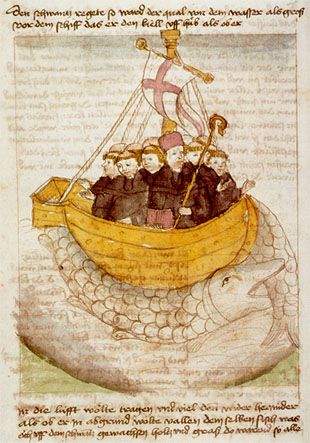
The story of the sailing of S. Brendan is as follows: — We shall not follow the adventures of the expedition, which are fabulous, but narrate only the starting, which may be true. There came to Brendan one evening a hermit named Barintus, of the royal race of Neill; and when he was questioned, he did nought but cast himself on the ground, and weep and pray. And when S. Brendan asked him to make better cheer for him and his monks, he told him a strange tale, — how a nephew of his had fled away to be a solitary, and had found a delicious island, and established a monastery therein; and how he himself had gone to see his nephew, and sailed with him to the eastward to an island, which was called “the Land of promise of the Saints,” wide and grassy, and bearing all manner of fruits; wherein was no night, for the Lord Jesus Christ was the light thereof; and how they abode there for a long while without eating and drinking; and when they returned to his nephew's monastery, the brethren knew well where they had been, for the fragrance of Paradise lingered on their garments for nearly forty days.
So Barintus told his story, and went back to his cell. But S. Brendan called together his most loving fellowwarriors, as he called them, and told them how he had set his heart on seeking that Promised Land. And he went up to the top of the hill in Kerry, which is still called Mount Brendan, with fourteen chosen monks; and there, at the utmost corner of the world, he built him a coracle of wattle, and covered it with hides tanned in oak-bark and softened with butter, and set up in it a mast and a sail, and took forty days7 provision, and commanded his monks to enter the boat, in the name of the Holy Trinity. And as he stood alone, praying on the shore, three more monks from his monastery came up, and fell at his feet, - and begged to go too, or they would die in that place of hunger and thirst; for they were determined to wandei with him all the days of their life. So he gave them leave. Then he sailed, and was away for seven years, and saw great marvels, icebergs floating on the sea, a burning mountain, and things that are not and never were. And at the end of seven years he returned and founded in Galway the great monastery of Clonfert.
For this monastery and several others connected with it, he drew up a rule, which was so highly esteemed that it was supposed to have been dictated by an angel. He is said to have presided over three thousand monks, partly at Clonfert, and partly in other houses of his founding in various parts of Ireland, all of whom maintained themselves by the labour of their hands. He established a nunnery at Enach-duin, over which he placed his sister Briga. He is said also to have erected a cell in an island in Lough Corrib, called Inisquin. According to some writers S. Brendan was a bishop, and was the first bishop of Clonfert; but it is more probable that he was only abbot.
At a late period of his life he paid a visit to the isle of Iona, the monastic metropolis of Western Scotland. There is reason to think that, prior to his death, the saint retired from Clonfert, to the lonely retreat of Inisquin. He died in his sister’s convent, which was near Lough 61. Ubald.
Corrib, on May 16 th, 577, in the ninety -fourth year of his age. From that place his remains were conveyed to Clonfert, and were there buried.