Baring-Gould’s sources: His office permitted in the Carthusian Order by Leo X. in 1514. Canonized by Gregory XV. in 1623. Roman and Carthusian Martyrologies. Authorities: — A Life by the chronologer of the five first priors of the Order, written about 1260. The encyclical letter in which the death of S. Bruno was announced to his disciples. Mention by Guibert of Nogent (d. 1124). There are other, later, lives of less value: one by Francis & Puteo, in 1515, another in hexameters by Zacharia Benedetto, S. Bruno was a native of Cologne, bom of noble parents. From childhood he is said to have exhibited extraordinary gravity and religious earnestness. He studied grammar at Laon or Bee, and was afterwards sent to Paris to finish his education in that renowned university. He rose to distinction, taught philosophy, and applied himself to theology. On his return to Cologne, Anno, the archbishop, gave him a canonry in the church of S. Cunibert, and he received minor orders from his hands. At the death of Anno he was 142 Lives of the Skints.
…made canon of Rheims, without apparently surrendering his canonry at Cologne. At Rheims he taught philosophy, and was advanced to be chancellor of the archdiocese. On the death of Gervaise, Archbishop of Rheims, in 1069, Manasses de Goumai obtained the see, as it was afterwards alleged, by simoniacal means. However that may have been, Bruno remained on good terms with him, and accepted many benefices at his hands; but the archbishop had no taste for ecclesiastical studies, or love of religious duties. His birth was noble, he had been brought up among knights, and he preferred association with them to the tamer, if more profitable, society of his clergy. He affected a splendid retinue, rode about accompanied by armed men, and to keep up this state laid taxes on his clergy, and kept back the revenues of monasteries. “ A capital benefice this of Rheims,” said he, “ were it not for the masses that have to be sung. M 1 Bruno, perhaps unable to endure the conduct of his bishop, in 1076 left Rheims, and probably went to Paris, 2 where he was hospitably received, together with some other Rheimois, by one Adam. One day, whilst there, he was walking in the garden with Ralph le Vert and Fulques the One-eyed, and they talked together of the uncertainty of human prosperity and the joys of the religious life. The three friends agreed together to forsake the world, but not before they had tried to chastise the archbishop for his misdeeds, and especially for his treatment of themselves. Fulques was sent to Rome to complain of Manasses, and Bruno took refuge with the Count of Roucy, who had also causes of complaint against the archbishop. In 1076, the appeals of those who had been excommunicated by Manasses having become numerous, the Pope gave commission to the Bishop of Paris to examine their cases on the spot, and if he found that they had been ‘ Guibert of Nogent.
9 Probably; this is not, however, certain. Adam was canon of Paris. 8. BRUNO. After Cthier. S. Bruno. unjustly treated, to absolve them by the authority of the Holy See. In execution of these orders, Hugh of Die, papal legate [an official representative sent by the pope], summoned a council to assemble at Autun, in 1077. At that council Bruno and another Manasses, Provost of Rheims, lodged their complaints against the archbishop, and he was suspended from his functions. Manasses, in revenge, broke into the houses of his accusers, pillaged them, confiscated their benefices, and gave or sold them to others. But, having received peremptory orders from the Pope, he was forced to go to Rome and clear himself of the charges made against him as best he was able.
A very striking incident in the life of S. Bruno, and which, according to Carthusian [a strict order of hermit-monks founded by St. Bruno in 1084] tradition, led to his conversion, took place, if there be any truth in it, whilst he was at Paris with Adam. There was a certain canon of the cathedral of Paris, a doctor and lecturer in the university of great renown for his learning, and generally regarded as a man of blameless life. He died, and all the members of the university attended his funeral. Whilst the body lay on the bier, between flaming unbleached tapers, the clergy chanted around it, and the officiating priest recited the proper lesson from Job: “ Hear diligently my speech, and my declaration with your ears. Behold now, I have ordered my cause; I know that I shall be justified. Who is he that will plead with me ? for now, if I hold my tongue, I shall give up the ghost. Only do not two things unto me: then will I not hide myself from Thee. Withdraw Thine hand far from me: and let not Thy dread make me afraid. Then call Thou, and I will answer: or let me speak, and answer Thou me.” At that moment the corpse opened its eyes, rose slowly on the bier, and said in a low voice, “ I am accused at the just judgment-seat of God." A horror fell upon all present; they fled from the church, 1 1 According to one version the scene was in the house, according to another in the church.
and the corpse, which had sunk back on the bier, was left alone. Next day again the funeral ceremony was recommenced. With trembling voice the priest began the lesson, “ Hear diligently my speech, and my declaration with your ears..... Then call Thou, and I will answer/* He paused; his nervous fingers could hardly hold the book. With an effort he proceeded, “ Let me speak, and answer thou me.** Again the corpse rose, opened its dead blank eyes, no colour shot into the sallow cheeks, the livid lips opened, and the words issued, “ I am judged at the just tribunal of God.** And again it fell back motionless as before. The same panic fell on priest and assistants. The service was not concluded that day.
On the third day a crowd of wondering people attended with faces blank with alarm. Amidst the funeral trappings of black and silver, the yellow unbleached tapers seemed to bum faintly. A silence most profound fell on all as the choir began to intone the mournful psalms for the dead. And then the lesson from Job was sung. “ Your remembrances are like unto ashes, your bodies to bodies of clay. Hold your peace, let me alone, that I may speak, and let come on me what will.... Hear diligently my speech, and my declaration with your ears.... Who is he that will plead with me ? for now, if I hold my tongue, I shall give up the ghost.... Then call thou, and I will answer, or let me speak, and answer thou me.” Instantly the corpse sat up, a look of horror came into the dead eyes, and a shriek, “ I am condemned by the just judgment of God,” rang through the church. Then the bishop said: “ He whom God has condemned, let him not be laid in holy ground, but be cast forth and buried in a dung-heap.”
Bruno, so runs the tale, was present during those awful scenes. The shock, the horror, overcame him, and he S. Bruno. resolved for ever to quit the world, its pomps and vanities, and live with the just judgment of God ever before his eyes.
Caesarius of Heisterbach, who flourished in 1180, relates the story, but without mentioning its effect on S. Bruno. It is told in the earliest life of S. Bruno, written about 1260, by a Carthusian. It was inserted in the Roman Breviary in one of the lessons for the festival of S. Bruno, by order ot Pope Gregory XVI., but Pope Urban VIII. had it expunged as supported on insufficient evidence.
In the meantime Manasses had succeeded in persuading Pope Gregory VII. that the charges raised against him had been exaggerated or untrue. The pope listened patiently to the accusations made against the archbishop by some of the canons of Rheims and the Count of Roucy, and then restored him to the full exercise of his rights, from which the papal legate, Hugh of Die, and the council of Autun had deprived him. Manasses returned with a papal brief to the legate, bidding him reinstate him in his archbishopric and in no way molest him. All the malcontents now reconciled themselves to the archbishop, except Bmno and one named Pontius. Bruno betook himself to Cologne; the archbishop either refused or delayed to restore to Bruno the benefices of which he had despoiled him, and it was not till the expulsion of Manasses, in 1080, that he was able to return to Rheims. Elinand of Laon at once obtained the see from King Henry, and held it for two years, till deprived by Gregory VII. Bruno, sickened with the miserable contests which desolated Europe, the utterly irreligious character of several of the prelates, the coldness which had invaded the Church, resolved to quit the world without more ado. He resigned his benefices, and in company with six friends, Lantwin, Stephen du Bourg, Stephen de S. Die, an aged priest, Hugh the Chaplain, and two laymen, Andrew and Guerin, went forth in search of a place where they might be far from the strife of the world, and might live in peace to God.
On midsummer day, 1086, Hugh, Bishop of Grenoble, saw seven men cast themselves at his feet, imploring him to guide them to a place where they might spend the rest of their lives in solitude. There was a wild spot in his diocese, shut in by snowy mountains, approachable only by a narrow road on the edge of the ravine. He had visited this spot, the resort of the peasants with their cattle in the summer, on one of his peregrinations of his diocese. It had struck his fancy, and he had dreamt of it, that he saw a convent rise from its grassy sward, sprinkled with gentian and yellow anemone, and that seven stars had wheeled above, illumining it with a supernatural glory. When Bruno and his companions asked his direction, his thoughts rushed at once to this alpine solitude and his dream con ceming it He told them that he knew a suitable valley, and invited them to stay with him for a few days till he had obtained for them a concession of the mountain wilderness with its forests and meadows from Segwin, Abbot of Chaise-Dieu. Then he conducted the seven postulants up the rocky path to the valley of Chartreuse, which was thenceforth to give its name to one of the most famous Orders of the Church.
“Never, perhaps, was chosen a more glorious shrine ot Nature’s making wherein to found a retreat for the practice of the ascetic type of Christian perfection, and which in the result proved the cradle of the great Carthusian Order. The nine houses of this austere Order that were suppressed in England, traced their origin, directly or indirectly, as well as their popular name of Charterhouse, to the Chartreuse of Dauphiny. Of these nine sister priories, built of solid S. Bruno.
masonry, scarce a vestige remains to tell the story of its former splendour; l and the very sites of most of them have sunk into oblivion. Yet the great Chartreuse, though anterior in date to the oldest of Charterhouses, subsists to this day, a lasting monument to the character and genius of its founder, S. Bruno.
“ The lovely valley that lends to the Chartreuse such extrinsic charms, and which, in its turn, has been elevated out of obscurity by the moral attractions of the cloister, will bear comparison with the choicest bits of Swiss scenery. The vale of Chamouni, the rugged pass of the Via Mala on the heights of the Spliigen, or the group of valleys from whose lap the Jungfrau raises aloft her snowy head, with a grace befitting her graceful name, are hardly more beautiful than the Desert, as it is called, of the Chartreuse. This desert, or wilderness, we approached from S. Laurent du Pont, through a precipitous winding defile, the narrow road being hewn out of the rock, with stupendous crags towering over head, and a gaping chasm below, from the shingly bed of which ascends the muffled roar of an alpine torrent; the grandeur of the whole scene enhanced by perpendicular pine forests clothing the steep banks of rock that hem in this mountain pass. As you ascend the steep comiche roadway, which is carried from time to time over the torrent by a stone bridge, delightful glimpses break upon the view at each successive turn — glimpses of distant peaks or vast banks of sombre firs, or patches of blue sky peeping out betwixt overhanging cliffs. “ Gradually the narrow gorge, darkened even at noonday by the lofty fir-bound rocks that almost meet on either side, opens out into a valley less confined, indeed, but equally beautiful. The whitened summit of the Grand Som— the 1 Mount Grace Priory, in Yorkshire, near Northallerton, is in a singularly perfect state of preservation.
Mont Blanc of the Dauphiny Alps — now becomes more easily discernible; the rocks frown down upon you more grandly than ever, and the masses of tall pines are no less dense. In this wild spot stands the world-famed Chartreuse. “ Close behind the monastery rises the Grand Som itself, a mountain of rock whose icy needle-points either lose themselves in clouds, or according to the season, seem, spirelike, to penetrate the sky. It is as if a gigantic wall had been expressly shaped by Nature’s own hand to serve for a majestic background to the convent. The priory occupies the valley between the Grand Som, on one side, and a huge bank of firs on the other; a fine contrast being presented by the bare, bleached crags and sharp peaks of the mountains at the back of the monastery, in juxtaposition with the dark tints of the gigantic fir-bank facing it. “ Among the many convents I have visited at different times and places, none is comparable, in point of situation, with the Great Chartreuse. It realizes, if any material thing can realize, the idea of the sublime. Endless varieties of the grandest mountain forms and cloud -enveloped peaks; fantastic outlines of rugged rocks; impenetrable woods made up of dusky pines, beeches, planes, and other forest trees, throwing a rich garb of verdure over yawning precipices; with the comparatively smiling vale lying quietly ensconced in the midst of the whole — constitute a picture seldom equalled, and more rarely surpassed.,, 1 Such was the place where Bruno laid the foundation of his Order. He immediately set to work to build an oratory and small cells at a distance from one another, like the ancient Lauras of Palestine, in which the members of his community might live. For his society was to be one distinctively of hermits, of solitaries, but of solitaries united under a common rule and protected by their bond from 1 Algernon Taylor, “ Scenes in French Monasteries,” p. 9x6, stg. S. Bruno.
some of the disadvantages under which hermits laboured, and the dangers to which they were exposed. The life of these anchorites was singularly austere. Each in his own cell was obliged to work at some handicraft. They had no refectory, but ate in solitude what was passed to them through a wicket in their doors. Peter the Venerable, Abbot of Cluni fifty years after S. Bruno, writes of them: “ Their dress is meaner and poorer than that of other monks; so short and scanty, and so rough, that the very sight affrights one. They wear coarse hair shirts next their skin, fast almost perpetually; eat only bran-bread; never touch flesh, even when ill; never buy fish, but eat it if given them as an alms; eat eggs and cheese on Sundays and Thursdays; on Tuesdays and Saturdays their fare is pulse or herbs boiled; on Mondays, Wednesdays, and Fridays they take nothing but bread and water; and they have only one meal a day, except within the octaves of Christmas, Easter, Whitsuntide, Epiphany, and some other festivals. Their constant occupation is praying, reading, and manual labour, which consists chiefly in transcribing books. They say the lesser hours of the divine office in their cells at the times when the bell rings; but meet together at vespers and matins with wonderful recollection. They say mass only on Sundays and festivals.” One custom is peculiar to the Order. Once a week the convent gates are opened, and all the solitaries go forth in twos for a walk among the mountains, through the forests, or over the flowery meadows.
. S. Bruno, who had inspired his companions with the desire of flying the world, was regarded by them as their Superior, and S. Hugh of Grenoble, who had guided them to this retreat, chose Bruno as his spiritual adviser. Whilst Bruno was enjoying the peace of this beautiful solitude, in the hopes of ending his days there, Urban II. sent him [Oct.* orders to come to Rome. Urban had been his pupil, and he was resolved to confer on his former master some marks of distinction. Bruno was therefore called away from his beloved retreat after having tasted its delights for only six years. His grief at leaving, the sorrow of his companions at the propect of losing him, forbid description. The six friends consulted together and resolved unanimously not to be separated from their guide. If he must go, they would accompany him. They declared their purpose to S. Bruno. He could not refuse his consent. They received the benediction of S. Hugh of Grenoble and departed for Rome. S. Bruno was received by the Pope with every mark of esteem and affection. He was retained about his person, and admitted into the ecclesiastical council, that he might be consulted on matters of religion. His companions were given a lodging in the city, where they endeavoured to maintain their rule of life observed in the Alpine desert. But the noise and distraction of a great town troubled them: they grew sad, their prayers seemed listless, their meditations pointless; they pined for the cool, clear atmosphere of the mountains, where, in hush and isolation, they could pray and muse on God without disturbance. They could endure it no longer, and, headed by Lantwin, they entreated permission to be restored to the beloved valley of the Chartreuse. Bruno obtained permission for them to depart; he named Lantwin their prior, and the little swarm winged its way, light of heart, to the thyme-scented banks of the stream that flowed through the Chartreuse.
Bruno, though deprived of his friends, maintained a constant correspondence with them. He was himself weary of life in Rome, and pining for solitude. In vain did he implore the pope to permit his departure; his presence was too valuable for Urban to grant his request In 1090 the archbishopric of Reggio fell vacant, and was offered to S. Bruno.
Bruno. But he refused it, though taken into Calabria with the hopes of persuading him to accept it When there, he escaped with some of his companions to the solitude of Torre, in the diocese of Squillace, whilst Pope Urban was in France, and having obtained a grant of the land from Roger, Count of Sicily and Calabria, formed there a new settlement. There he was allowed to remain in tranquillity till his death, which took place in iioi. Feeling his end approach, he called together his religious, and made a general confession in their presence; then protested his faith in all the verities of the Catholic creed, especially in that of the Real Presence, which Berengarius had then begun to dispute, and so surrendered his soul to God before he had reached his fiftieth year.
His body is in the church of S. Stephen, at Torre, but portions of his bones have been distributed among different churches of the Order.
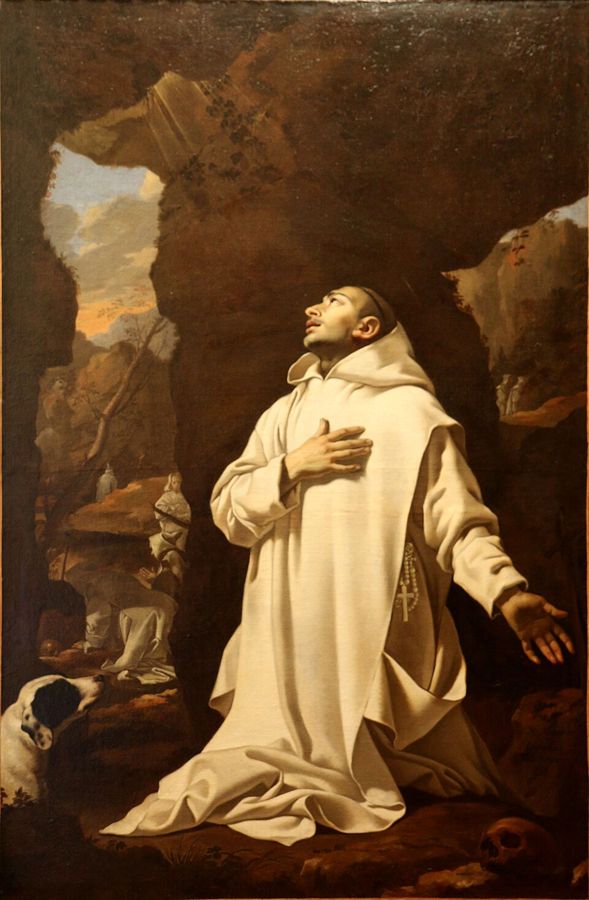
In art S. Bruno is represented contemplating the Crucifix, with the words on a scroll issuing from his mouth, “O bonitas !” or, “ Ecce elongavi fugiens, et mansi in solitudine” (Ps. liv. 8). Sometimes bearing an olive-branch, or a crucifix the ends of which are foliated with olive leaves, on account of an antiphon in the Carthusian Breviary, which likens him to the olive taking root and bearing fruit in the most barren soil.
The subject of the conversion of S. Bruno is a favourite one with painters.