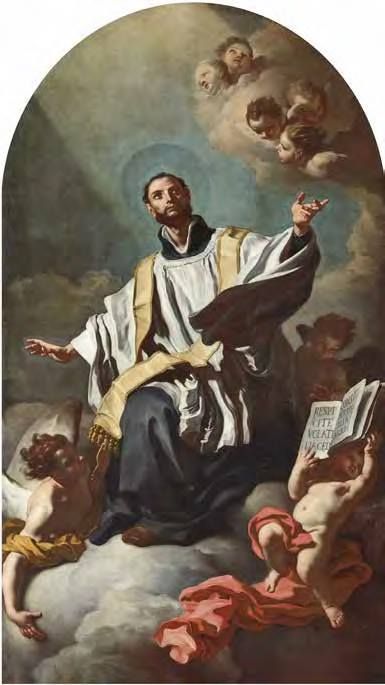
Baring-Gould’s sources: Roman Martyrology. Beatified by Urban VIII., canonized by Clement X. Authorities: — A life by Antonio Caraccioli, Priest of his Order, published in 1612; another by b\ Gins. Silos, Rome, 1671; another by Del Tuffa, B. of Acerra, Paris, 1698; another, in Italian, by Stefano Pepe, 1657: another, also in Italian, by Gio. Batt. Castaldo, Vicenza, 1627, &c."| S. Cajetan, or Gaetan, was born at Vicenza in T480, and was the son of Gaspar de Thienna and Maria Porta. His parents were of noble family. Their eldest son was John Baptist, but the second was called Gaetan, after a greatuncle, Gaetan de Thienna, Canon of Padua, a writer on Aristotle’s natural philosophy.
From an early age he was destined for the ecclesiastical state, and his youthful piety promised to make the arrangement one not of family convenience only, but of deliberate choice on his part. He went to Rome, where, on account of his rank, he was appointed prothonotary at the Papal court, by Julius II., in 1508, when he was twenty-eight years old. There existed at this time at Rome a Congregation of the Love of God, established in the church of SS. Sylvester and Dorothea, the objects of which were the keeping alive the divine love in the hearts of its members, and mutual support against temptations. Cajetan joined this community, and inspired it with his burning enthusiasm for what is good. At that time Christians, even the most devout, communicated rarely, — some three or four times in the year. Cajetan urged that this was an abuse, that the soul needed more frequent nourishment, and at his exhortation, and led by his example, many became monthly, and even weekly communicants.
He received the subdiaconate, the diaconate, and the priesthood on three successive festivals. His fervour and enthusiasm in approaching the altar threw him into transports, and he believed on one occasion that he saw the Blessed Virgin, who placed in his arms her Divine Son. He relates this vision in a letter to his sister Laura, religious of Santa Croce, at Brescia. The death of his mother necessitated his return to Vicenza, where he at once, in opposition to the wishes of his family, joined a confraternity of poor labourers, whose object was much the same as that of the Society of the Love of God, of which he had been a zealous member in Rome. His earnest, loving exhortations stimulated the zeal of their humble souls, and many were seen communicating at the altar thrice in the week. The Congregation grew under his direction, and undertook the charge of a hospital of incurables. All his charitable works prospered. Lie was the life, the soul, of the Society at Vicenza, indefatigable in the hospital, the support and refuge of the poor. In the midst of this active work, suddenly, without giving his reasons, his director, Father Giovanni-Baptisto Creno, ordered him to leave Vicenza and go to Venice. The wise confessor [in old usage, a saint who was not martyred, or who suffered for the faith without being killed] saw that the enthusiasm and abilities of Cajetan demanded a wider sphere than the little town of Vicenza.
Without hesitation or delay, Cajetan went forth, like a second Abraham, from his native place. His fame had reached Venice, and he was at once given work in the hospital. Rapidly he became in Venice what he had been in Vicenza, the centre of all the spiritual and charitable agencies at work in that great city.
His director left him there awhile, till he was satisfied with his unflagging devotion, and then he abruptly ordered him to Rome.
Cajetan at once, without disputing his orders, resigned his work at Venice into other hands, and journeyed to Rome. There he rejoined the Society of Divine Love. It was composed of sixty members, all members of illustrious families, or famous for their position in the Church or in the world of letters.
The state of the Church excited in Cajetan the deepest distress. Throughout his after life, the corruption of morals, the ambition, the irreligion of. the clergy, weighed on the soul of the holy priest, filling him if not with despair, yet certainly with unrelieved despondency.
Alexander VI., with the horrible scandal of his reign, was passed away, but his successor Julius II., if not of equally profligate morals, yet byliis insatiable ambition, which scorned all considerations of gratitude, of decency, or of justice, when they obstructed the execution of his schemes of temporal aggrandizement, has left a name which is a stain on the Papal annals. Many of the prelates, secular as well as regular, were appointed solely because of their family influence. They were younger sons of noble families, who had assumed the ecclesiastical character for no other reason than to find in the Church stations of great dignity and affluence. They neglected the duties of their office without compunction, and abandoned themselves without reserve to all the vices to which great wealth and idleness naturally gave birth. “ For some years before the Lutheran and Calvinist heresies broke forth,” says Bellarmine, “ there was no justice in ecclesiastical courts, no discipline in morals, no knowledge of sacred literature, no reverence for sacred things; there was almost no religion remaining.”1 The Roman Curia, of which Cajetan had become a member, was involved in extortion of money over the Catholic world. If benefices were not sold, heavy fees were exacted for every appointment. As the idea of a composition for crimes was then familiar, every ecclesiastic who had been guilty of breach of the moral law was required to pay a fine before he could receive pardon and be rein1 Condo, xxvii.
stated. The Curia had the effrontery to publish a book containing a tariff of their fees. A deacon guilty of murder was absolved for twenty crowns. A bishop, or abbot, might assassinate for three hundred livres. Any ecclesiastic might violate his vows of chastity, even with the most aggravating circumstances, for the third part of that sum.1 The condition of the Church at this period was such, that a zealous Catholic writer applies to it the words of the prophet, “ The whole head is sick, and the whole heart faint. From the sole of the foot even to the head there is no soundness in it; but wounds, and bruises, and putrefying sores.”2 The object of the Congregation of the Love of God was to labour for the remedy of these miserable evils, at least in the city of Rome. But as, with all their efforts, they made but little way, four of the principal of this Congregation were inspired to institute an Order of Regular Clerks, who, living a high and holy life themselves, might work continually to restore the clergy to their apostolic condition. The first of these was John Peter Caraffa, then Bishop of Theate, and Archbishop of Brindisi, afterwards Pope under the name of Paul IV. The second was our saint, Cajetan of Thienna. The third was Paul Consigliari, of the noble family of Ghisleri, and the fourth was Boniface de Colie, a gentleman of Milan.
These four founders assembled on the feast of the Inven. tion of the Cross, a.d. 1524, and supplicated the Pope to sanction their foundation. His Holiness hesitated about accepting the surrender of his bishopric by the Bishop of Theate, but yielded finally to his prayers. The College of Cardinals was consulted on the project of this new establishment; it objected to the rule laid down by its founders that they were not only to be without property, 1 Taxat. Cancelar. Romance, edit. Francof. 1651. 2 Isai. i. 5, 6. ■S'. Cajetan.
but also were not to beg. Such a condition was impossible, the cardinals supposed. But the persistency of the four founders overcame their objection, and on the feast of the Exaltation of the Cross, Sept. 14, in the same year, 1524, the four having renounced all their benefices and property, made their profession in the church of S. Peter in the Vatican. The bull of approbation had been issued on the preceding June 24th; the Pope gave them the title of Regular Clerks. They proceeded to elect the Bishop of Theate as their superior, to whom the Holy Father had continued the title of Bishop; and thence they obtained the familiar name of Theatines. The objects of the institute were, 1, to set an example of a holy life to the clergy; 2, to observe perfect poverty; 3, to restore to their proper dignity the services of the Church, which were in too many cases performed with slovenliness, and irreverence; 4, to animate the faithful to receive the sacraments more frequently than was then usual; 5, to preach pure and wholesome doctrine to the people, instead of the ridiculous insipid matter which was then heard from the pulpit; 6, to minister to the sick • 7, and to criminals awaiting death; and, 8, to oppose the heresies then spreading through Christendom.
When these four founders had made their profession, they retired into a house which belonged to Boniface de Colle in the Campus Martius. Several persons of merit joined them, and the number rose to twelve; they lived together with one heart, one spirit, one will, serving the sick in the hospitals, preaching to the people, and consoling the unfortunate.
In the fatal battle of Pavia, Francis I. of France had been taken prisoner by the Emperor Charles V. On the r4th January, 1526, Francis signed a treaty at Madrid, whereby he obtained his liberty, promising on his part to resign all his pretensions in Italy. The humiliation of the great opponent of Charles V. did not comport with the political schemes of the Pope; as it left Italy at the mercy of the German Emperor. Clement hastened to contract a league with Francis, the Venetians and the Duke of Milan, against Charles V., and then the Pope solemnly released the French king from his oaths taken in the treaty of Madrid. To his surprise and indignation, the Emperor found a powerful combination rise up against him, and all the advantages of the battle of Pavia escape his grasp. He bitterly accused Clement of ingratitude and ambition, and threatened an appeal to a general council against the Pope. The Constable of Bourbon, at the head of troops in the Emperor’s pay, marched upon Rome. His soldiers had received no money since the battle of Pavia, and were on the verge of mutiny. On the 5th May, ^27, they were within sight of the churches and palaces of Rome. The Constable showed his needy mercenaries the walls of that city into which, as the capital of the Christian commonwealth, the riches of all Europe had flowed during many centuries without having been violated by a hostile hand; and, commanding them to refresh themselves that night, as a preparation for the assault next day, promised them, in reward of their toils and valour, the possession of the treasures it contained.
Early in the morning the assault was made. Three distinct bodies, one of Germans, another of Spaniards, and the last of Italians, the three nations of which the army was composed, rushed upon the walls from opposite quarters. The Constable was killed in the assault, but the veterans who defended the walls were unable to resist the numbers which poured over them; the untrained city recruits gave way at once.
During the combat, Clement was employed at the high S. Cajetan. altax of S. Peter’s, offering unavailing prayers for victory. No sooner was he informed that his troops began to give way, than he fled with precipitation to the castle of S. Angelo, with thirteen of his cardinals. On escaping from the Vatican, he had to thread his way amongst his troops flying before an enemy who pursued without giving quarter; he heard the lamentations of the Roman citizens, and beheld the beginning of those calamities which his want of judgment had provoked.
It is impossible to describe, or even to imagine, the misery and horror of the scene that followed. Whatever a city taken by storm can dread from military rage, unrestrained by discipline; whatever excesses the need of the Germans, the avarice of the Spaniards, or the licentiousness of the Italians could commit, the wretched inhabitants were obliged to suffer; churches, palaces, and the houses of private persons were plundered without distinction. No age, or character, or sex, was exempt from injury. Cardinals, nobles, priests, matrons, virgins, were all the prey of soldiers, and at the mercy of men deaf to the voice of humanity. Nor did these outrages cease, as is usual in towns which are carried by assault, when the first fury of the storm was over; the imperialists, without a master, now that the Constable of Bourbon was dead, kept possession of Rome several months; and during all that time the insolence and brutality of the soldiers hardly abated. Rome, though taken several different times by the northern nations, who overran the empire in the 5th and 6th centuries, was never treated with so much cruelty by the barbarous and heathen Huns [nomadic invaders from Central Asia, led in the 5th century by Attila], the Arian [followers of Arius, who taught that the Son is a created being, not fully God] Vandals or Goths [Germanic peoples who invaded the Roman Empire, many of them Arian Christians], as now by the soldiers of a Catholic monarch, the bulwark of the Church against Protestantism in Germany.1 1 An exception may perhaps be made for the devastation of Rome by the Norman and Saracen allies of Gregory VII. in 1083. In that dreadful period of horror and outrage, Cajetan and the Theatines did not escape. Not permitted to beg, and without money, they would have perished of starvation but for the solicitude of a poor man, who collected for them such scraps of food as had been rejected by the soldiers. An Italian mercenary, who had once been a servant of Cajetan at Vicenza, recognised him; and knowing that his master in former days had been wealthy, concluded he was so still. With other soldiers, he broke into the house of the Theatines, and ransacked it from attic to cellar in search of spoils, but in vain. Thinking that Cajetan must have hidden his money and valuables, the soldiers subjected him to cruel tortures, crushing his fingers, suspending him by his thumbs, and beating him. Cajetan bore all without a murmur; but on the soldiers retiring, he and his companions fled Rome, and descended the Tiber in a boat to Ostia. They then took refuge in Venice, where they were given a house and a church. The three years of superiorship of the Bishop of Theate having expired, Cajetan was elected Superior; and at the termination of his three years of government, spent peaceably at Venice, the Bishop of Theate was re-elected.
Soon after, Cajetan was sent to Naples to found there a house of his Order. On his way he passed through Rome, and presented himself before the Pope with red, sunburnt face. “ How, my son, have you travelled in this summer heat ?”
“It is better, Holy Father,” answered Cajetan, “to despise one’s life, than fail in obedience.” At Naples he took possession of a house outside the town, given him by the Count of Oppido. The Count was illsatisfied with the rule which forbade the clerks owning possessions, and he wished to endow the house with lands. Cajetan steadily refused.
►S'. Cajetan. “ But, my father, what security have you got that you will be able to obtain daily sustenance ?” “ What security have you, my lord ?”
“ Oh ! as for me,’' said the Count, “ I trust that my farmers will pay their rents.’’ “But if the crops fail they will not be able to do so.’’ “ We must trust God to give the seasons.” “So, so!” said Cajetan, smiling; “it comes to trust in God as the root of all security.”
“ But,” urged the Count, “ your mode of living is all well enough at Venice, a large and opulent city, but Naples is small and poor.”
“ The God of Venice is the God also of Naples,” answered Cajetan. Pope Paul III., who succeeded Clement VII., having given the cardinal’s hat to the Bishop of Theate, Superior of the Regular Clerks, our Saint was obliged to make a journey to Rome. As the three years of his superiorship at Naples were over, another mefnber of the Society was chosen. He was a man of modest and timid nature, and he shrunk from the duty of ruling others. Cajetan said to him, “ My father, it is easy to govern others, if you make them love you in the Lord.”
His fervour for souls was so remarkable, that in Naples he obtained the name of the soul-hunter, venato r animarum. But the disorders in the Church, the scandals caused by the worldliness and ambition of the prelates, and the ignorance and relaxed morals of the lower clergy, were to Cajetan a continual sorrow. One day, as he was meditating thereon, he thought he saw the Saviourbowed beneath his cross, his face stained with tears and blood. Christ signed to him to approach, and He laid the edge of the arm of the cross on His servant’s shoulder. The weight, the pain, bruised him to the heart. It was the evil in the Church which the Saviour bore, and which bowed Him down. On Cajetan’s lips was ever the prayer of Daniel, “ O Lord, according to all thy righteousness, I beseech thee, let thine anger and thy fury be turned away from thy city Jerusalem, thy holy mountain; because for our sins, and for the iniquities of our fathers, Jerusalem and thy people are become a reproach to all that are about us. Now, therefore, O our God, hear the prayer of thy servant, and his supplication, and cause thy face to shine upon thy sanctuary that is desolate, for the Lord's sake. O my God, incline thine ear, and hear; open thine eyes, and behold our desolations, and the city that is called by thy name; for we do not present our supplications before thee for our righteousness, but for thy great mercies. O Lord, hear; O Lord, forgive; O Lord, hearken and do; defer not, for thine own sake, O my God; for thy city and thy people are called by thy name.”1 And the condition of affairs was indeed enough to sadden his soul to death. The Emperor Charles V. had fought the Protestant princes in Germany, his object was to completely break their strength by force of arms, and at the same time, by means of the Council of Trent to effect some necessary reforms in the Church, which might render submission possible on the part of the Protestants. The success of his warlike operations exceeded all anticipation, and the autumn of 1546 saw North Germany entirely at his mercy. Cities and princes emulously proffered submission; the moment seemed to have come when the Protestant party in Germany being entirely subjugated, the whole North of Europe might have again become Catholic.
This most blessed consummation was frustrated, astounding as it seems, by the action of the Pope. Paul III. had the political interests of Italy at heart rather than the welfare of the Church and of the Faith. He recalled his troops from 6”. Cajetan.
the imperial army, and transferred the council which he had disliked, and regarded with a jealous eye, from Trent to Bologna, where, on his own territory, it would be completely under his dictation. He was angry at the success of the emperor. He had hoped, as he himself admitted, that the emperor would have fallen into difficulties in the prosecution of his attempt against the Protestant princes. He did not disguise his satisfaction when the Lutheran Elector, John Francis of Saxony, made head against the Imperialists. Once more it seemed probable to the Pope that Charles would fail before the union of the Protestants. He wrote to Francis I. of France, urging him to assist them against the emperor, tl to succour those who were still holding out against the emperor, before they were overborne.” But his hopes were again disappointed. Charles was victorious at Miihlberg, and carried off the two Protestant leaders prisoners. In vain did the emperor urge on the Pope the necessity for the Council to meet at Trent and continue its work of reformation. Paul III., by dividing the Council, broke its significance, and plucked out of the emperor’s power the engine he had designed for the reduction of Protestantism in Germany to submission to the Catholic faith. Cajetan had hoped great things from the Council. Its transfer and prorogation filled him with such sadness, that he sickened and died of disappointment. He died murmuring the prayer of Daniel; his last words were “ Placare Domine, attende, et fac.”
His body was laid in the church of S. Paul, at Naples, where it remains to this day. VOL. IX.