St. Carantog

Building a community where people could actually live the Gospel.

Read the essentials →
May 16 · Abbot

St. Carantog

St. Carantog

Building a community where people could actually live the Gospel.

Traditional feast

May 16
1914 / pre-1969 calendar, per Baring-Gould (1897)

Current feast

May 16
Secondary source · Wikipedia

Represents

Abbot

Their story

Adapted in modern English from Baring-Gould (1897–98) · original text below · little is known

(The surviving account on this page begins partway through the story.)

In a Welsh legend, a marvellous altar fell from heaven; Carantog lost it overboard crossing the Severn. King Arthur promised to say where it had washed up if Carantog would tame a serpent ravaging the Carr, a marsh.

Carantog bound it with his stole, fed it in the king's hall, and released it, commanding it to harm neither man nor beast. Arthur, who had meant to make the altar into a table for his knights, returned it, and Carantog built a church at Carrow (Cardigan). He later died in Ireland.

Early life

The book says little or nothing about early life. This is how the account begins.

Next follows a wondrous story of how a great serpent scared and devastated the Carr, a marshy district in Wales. Now it fell out that Christ cast an altar of a marvellous colour out of heaven, and Carantog took it; and as he was conveying it in a boat over the Severn, it fell overboard into the sea; and the hermit said, “ God will wash it with His waves to the place where it shall be set up.” And he went to King Arthur, and asked him if he knew whether his altar had come ashore anywhere.
What they represent

How they teach us to live

Drawn from themes in the original account

Make time for silence. Solitude and withdrawal to pray shape this life.

Learn from the kind of life it was. Building a community where people could actually live the Gospel.

Read more

The full original · 229 words

Read Baring-Gould’s full account

Baring-Gould’s sources: Wytford in his Anglican Martyrology; and the Bollandists, Anciently venerated in Cardiganshire, where, at Llangrannog, a fair is annually held on May 27th, which according to the Old Style is the feast of the saint. Authorities John of Tynemouth, and a. life in the British Museum, Cottonian MSS., Vesp. A. xiv.J Carantog, in Latin Carantocus, son of Corun ab Ceredig, prince of Cardigan and brother of S. Tyssul, was the founder of the church of Llangrannog in Cardiganshire. He is said early to have embraced the religious life, and to have passed into Ireland, where he preached the Gospel with great success, being constantly attended by a white dove, which the people supposed to be a guardian angel. He returned to Wales and retired into a cave, accompanied by many disciples. Now the dove fluttered before him and darted away, and came back, as though desiring him to follow. So he said, UI will go and see whither the white bird leads.” And it led him through the forest to a smooth grassy spot, and rested there. Then he said, “ Here will I build a church.” And this is the origin of the church of Llangrannog.

Next follows a wondrous story of how a great serpent scared and devastated the Carr, a marshy district in Wales. Now it fell out that Christ cast an altar of a marvellous colour out of heaven, and Carantog took it; and as he was conveying it in a boat over the Severn, it fell overboard into the sea; and the hermit said, “ God will wash it with His waves to the place where it shall be set up.” And he went to King Arthur, and asked him if he knew whether his altar had come ashore anywhere. Then Arthur said, " Bind me the serpent in the Carr and I will tell thee.”

Then the hermit went to the morass and called the venomous beast, and it came, and he cast his stole about it, and brought it into the hall where the king and his knights sat, and there Carantog fed it. And after that he let the serpent go, having first commanded it to do no injury to man or beast. So Arthur gave him up the altar, which had been washed ashore, and which he had purposed to make into a table for himself and his knights. And Carantog set it up and built a church, and it is at the place called Carrow (Cardigan). Afterwards he went back to Ireland, and there he died.

Feast days

Feast: May 16

Nine days · Free

Pray the novena
with us.

One short email a day for nine days. The day's prayer, a line from St. Carantog's story, and a nudge to keep going.

Also on May 16
B

St. Britwin of Beverley

May 16 · Abbot
C

St. Carnech

May 16 · Abbot, Bishop
St. Brendan of Clonfert

St. Brendan of Clonfert

May 16 · Abbot
← All 1726 saints in the library
Sources & notes

Feast-day sources

Story sources

Sources

Credits

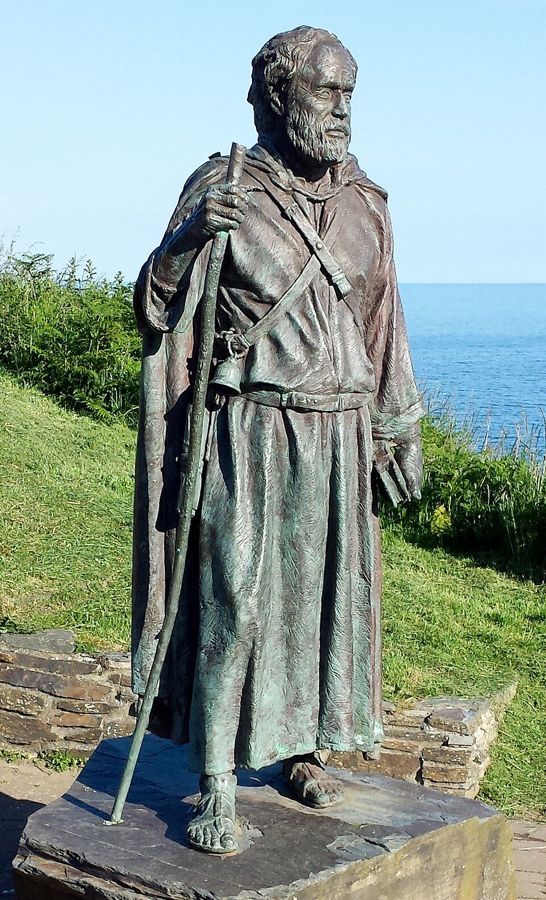
Image: Statue of St Carannog, Llangrannog, Wales.jpg · DeFacto · CC BY-SA 4.0, via Wikimedia Commons

From Sabine Baring-Gould, The Lives of the Saints, new edition in 16 vols. (London: John C. Nimmo, 1897–98); text from the Internet Archive scan (OCR, lightly cleaned; errors possible). Public domain.

Image: DeFacto, Wikimedia Commons (CC BY-SA 4.0)

From Sabine Baring-Gould, The Lives of the Saints, new edition in 16 vols. (London: John C. Nimmo, 1897–98); text from the Internet Archive scan (OCR, lightly cleaned; errors possible). Public domain in the United States. Reproduced unedited, except for short bracketed notes in grey that we added to explain names and terms (“S.” is the old abbreviation for Saint). Some history and judgments reflect 19th-century scholarship.