Baring-Gould’s sources: Roman Martyrology. Authorities:—Zacharias Ferrier, Papal Legate in Poland, A.D. 1525 .
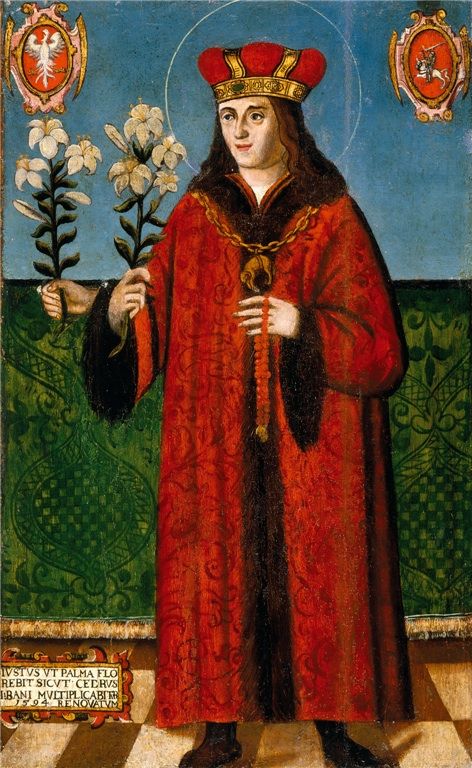
S. Casimir was the second son of Casimir III., king of Poland, and of Elizabeth of Austria, daughter to the emperor Albert II., a most virtuous woman, who died in 1505. He was born in 1458, on the 5th of October. From his childhood he was remarkably pious and devout. His preceptor was John Dugloss, called Longinus, canon of Cracow, a man of extraordinary learning and piety, who constantly refused all bishoprics, and other dignities of the Church and state which were pressed upon him. Vladislas, the eldest son, was elected king of Bohemia in 1471, and became king of Hungary in 1490. Casimir was the second son; John Albert, the third son, succeeded his father in the kingdom of Poland in 1492; and Alexander, the fourth son, was called to the same in 1501. Casimir and the other princes were warmly attached to the holy man who was their preceptor; but Casimir profited most by his pious maxims and example. He consecrated the flower of his age to the exercises of devotion and penance; his clothes were plain, and under them he wore a hair shirt. He often slept upon the ground, and spent a considerable part of the night in prayer and meditation, chiefly on the passion of our Saviour. He was wont at times to go out in the night to pray before the church-doors, and in the morning waited before them till they were opened for matins. He was especially devout to the passion of our blessed Saviour, the very thought of which excited him to tears. He was no less piously affected towards the Sacrifice of the altar, at which he always assisted with such reverence and attention that he seemed in raptures. And as a mark of his singular devotion to the Blessed Virgin, he composed, or, at least, frequently recited, the long hymn that bears his name, a copy of which was, by his desire, buried with him. His love for Jesus Christ showed itself in his regard for the poor, who are His members, to whose relief he applied whatever he had, and employed his credit with his father, and his brother, Vladislas, king of Bohemia, to procure them succour.
March 4.
The nobles of Hungary, dissatisfied with Matthias Corvinus, their king, son of the great Huniades, begged the king of Poland to allow them to place his son Casimir on the throne. The saint, then not quite fifteen years of age, was very unwilling to consent; but in compliance with his father's will, he went at the head of an army of twenty thousand men to the frontiers in 1471. There hearing that Matthias had formed an army of sixteen thousand men to oppose him, and that pope Sixtus IV. had sent an embassy to divert his father from the expedition, and finding that his soldiers were deserting him in great numbers, he joyfully returned. However, his conduct gave such offence to his father, whose ambition had been roused, that he was forbidden by him to enter Cracow, and ordered to take up his residence in the castle of Dobzki. After this, nothing would again induce him to resume the attempt, though again pressed by the Hungarians, and urged by his father. As the old Russian churches were falling out of repair, Casimir, with more zeal than discretion, persuaded his father to pass an edict forbidding the restoration and reconstruction of churches which did not belong to the Latin rite.
Falling into a decline, the physicians recommended that he should relax his rigid chastity, but the young prince indignantly refused to defile his virgin body on the chance of thus prolonging his life a few months; and he died at the age of twenty-three, on March 4th, 1484, and was buried at Wilna, where his body is still preserved.