Baring-Gould’s sources: A Life by Augustino Valerio, Cardinal Bishop of Verona, pub. in 1586, at Verona. “ Vita et Obitus S. Caroli Borromsei, auct. Joanne Franc. Bononi, Vercellensi Episc.” Colon. 1587. A Life in Italian by J. P. Giussano, Rome, 1610. “ De Vita et rebus gesds Caroli Borromaei.... lib. septem; Carolo A. Basilicopetri auctore, ” Ingolst. 1592. These biographers knew him personally. Bononi has also “ Borromaeidos libri quatuor,” Mediol. 1589, a Latin poem on the life of S. Charles. Also the letters of S. Charles, and his other writings. “Vie de S. Charles Borrom^e, par Antoine Godeau,” Paris, 1663. “La Vie et l'Esprit de S. Charles Borromee, par le Pere Touron, ” Charles, or Carlo Borromeo, was bom in the castle of Arona, on the Lago Maggiore, on October 2nd, 1538. His father was Gilberto Borromeo, Count of Arona, of ancient illustrious family. His mother was of a family which had recently raised itself to notice, she was named Margharita di Medici. The story of her family is curious. Bernardino di Medici was an industrious, but poor, taxcollector in Milan.1 His sons were Giangiacomo and Giovani Angelo. The former adopted the trade of arms, the 1 Hieron. Soranzo, Relatione di Roma.
…latter devoted himself to study. Giangiacomo, naturally reckless and enterprising, had rendered himself useful to the then rulers of Milan, by ridding them of one of the Visconti family, called Monsignorino, who was their rival; but no sooner was this murder accomplished than those who had desired it were anxious to be delivered of the tool they had employed. To this end they sent the young man to the castle of Mus, on the Lake of Como, with a letter to the governor, containing orders for the immediate death of the bearer. Giangiacomo, suspicious of evil, opened the letter, saw what was prepared for him, and at once resolved on the measures to be taken. He gathered a number of trusty comrades, gained admission to the castle by means of the letter he bore, and succeeded in taking possession of it. From that time he assumed the position of an independent prince. Secure in his fortress, he kept the Milanese, Swiss, and Venetians, who were his neighbours, in perpetual activity by his ceaseless incursions. After a time he took the white cross, and entered the Imperial service. He received the title of Marchese di Marignano, served as chief of artillery in the war against the Lutherans, and commanded the Emperor’s forces at Siena. His shrewdness was not inferior to his daring; his undertakings were invariably successful, but he was altogether without pity; many a wretched peasant, who was attempting to carry provisions into Siena, he destroyed with his iron staff. Scarcely was there a tree for and near on which he had not caused some one of them to be hanged. It was computed that he had put to death at least five thousand men.
The advance of his brother Giovani Angelo had kept pace with his own. This last took the degree of doctor-of-laws, and gained some reputation as a jurist; he then purchased an office in Rome, and rapidly acquired the confidence of Paul III. When the Marchese di Marignano, his brother, *ov. 4<] S. Charles Borromeo. 1 1 3 was married to an Orsini, the sister of Pier Luigi Famese’s 1 wife, he was himself made cardinal.
The sister of these adventurers made a fortunate match when she won the hand of the Count of Arona. They had two sons,3 Frederick, destined to succeed to his father’s title and estates, and Charles, early devoted to the clerical profession, both by the tastes of the child and the judgment of his parents, who knew that they had sufficient interest to advance him in the Church. Indeed, whilst still a child, he was given the Abbey of SS. Gratinian and Felinus, which was vacated for him by his uncle, Julius Caesar Borromeo, that he might enjoy the revenues, and exercise authority as its titular abbot.
When he had attained the age of twelve he assumed complete control over the revenues of his benefice, and, greatly to his credit, he used them, not on his pleasures, but in relieving the necessities of the poor. His father was an exceedingly pious, generous man, and his influence told on the young boy, and directed him in the path of duty, instead of that of pleasure.
Charles studied in Milan, and thence betook himself to Pavia, where he studied canon law under Francesco Alciati, and from him received the doctor’s cap. It is said that the day was cloudy when Charles was given his degree, but at the moment when the bonnet of doctor was given him a gleam of sun poured in at the windows and illumined the whole hall: a beautiful figure of the light which the teaching of this saintly man would spread throughout the Church he should be called to govern. The university of Pavia was known for the disorderly and immoral conduct of the students in it; but Charles 1 The illegitimate son of Pope Paul III.( when Cardinal Alexander Farnesc. zaga. Prince of Malfctto; Geronima, who married Fabricio Gesualdi, eldest son of the Prince of Venossa; and Anna, who married Fabricio, eldest son of Prince Marc* Antonio Colonna, Viceroy of Sicily.
VOL. XIIL 8 TNoy *. passed through his academical course there unstained, and issued from it as guileless as he had entered it. Cardinal de’ Medici, the uncle of S. Charles, had in the meantime undergone the alternatives of favour and disfavour. Under Paul III. he had obtained the administration of the papal cities, had been charged with the conduct of political negotiations, and more than once intrusted with the commissariat of papal armies. Paul IV. hated him, and on one occasion burst into violent invective against him in full consistory. Medici then thought it best to leave Rome, and resided sometimes at the baths of Pisa, and sometimes in Milan, till, on the death of Paul IV., in 1559, the year that his nephew was made doctor of laws, he was called to assume the triple crown, under the title of Pius IV. He was a discreet, intelligent, and kindly-disposed man, of a joyous, but also of a worldly, temperament. He had made his way in the Church, and his brother had made his in the world, and he was not disposed to distress himself about reforms, and make for himself a bed of nettles where he hoped to rest on one of roses. He at once summoned to Rome his nephew Charles Borromeo, then aged twenty-one, and invested him forthwith with the office of protonotary, conferred on him the cardinal’s hat, with the title of SS. Guido and Modesta, and next year, 1560, having forced Hippolytus d’Este to resign the administration of the see of Milan [a bishop’s “see” is his diocese, named from his seat (Latin sedes)], gave to Charles, then aged twenty-two, and not yet in deacon’s orders, the arch bishopric of the most important see in North Italy. Frederick, brother of Charles, was also at Rome, and the Pope was prepared to invest him with all the honours that he could confer on a layman. He had married the daughter of the Duke of Urbino, and had succeeded his father in the county of Arona.1 But he died in 1563, leaving no children. 1 Gilbert Borromeo II. was married thrice. First to Margaret di Medici, the mother of Frederick and Charles; next to Thaddaea del Vermi, sister of John, Count 5. Charles Borromeo.
It was then thought that Charles would resign his prospects of advancement in the Church, marry, and return to lay life. And, indeed, his uncle, the Pope, urged him to this. But Charles had made up his mind, and nothing could shake him. He resigned the family honours and estate to Julius Caesar Borromeo, his uncle, and son of Frederick Borromeo and Veronica Visconti, reserving for himself an annuity on the estate. He placed himself under an irrevocable vow, and received the sacred orders up to priesthood. Before celebrating his first mass he went through the religious exercises of S. Ignatius under the conduct of Ribera, the Jesuit, and learned the practice of mental prayer, which thenceforth he never failed to perform twice a day. The Pope then changed his title to that of Cardinal of S. Praxedes, made him Grand Penitentiary, Arch-Priest of S. Maria Maggiore, Protector of Lower Germany, the kingdom of Portugal, the provinces of Flanders, the Swiss Catholic cantons, and of several religious orders, Legate of Bologna, of Romagna, and of the Marches of Ancona.
These honours did not dazzle him, nor did he neglect the duties involved in them. By his connection with the Pope, and the responsibilities brought by these dignities, he was drawn into contact with the most weighty affairs of the pontifical government To these he devoted his most assiduous attention with equal modesty and conscientiousness; his best energies were applied to the administration of the State; he gave audience with unwearied patience. For the more effectual performance of his duties he called around him a “ collegium ” of eight learned men, which afterwards formed the important institution of the “ Consulta.” He lent valuable aid to the Pope by his advice, and by his steady regard for the welfare of the Church. “ In so far as we of Bobbio, by whom he had one child, Hortensia, married to Annibal, Count of Altemps; lastly to Aurelia Vestorina, by whom he had no family. know,” says Geronimo Soranzo, “he is without spot or blemish; so religious a life, and so pure an example, leave the most exacting nothing to demand. It is greatly to his praise that, in the bloom of youth, nephew to a Pope whose favour he entirely possessed, and living in a court where every kind of pleasure invites to its enjoyment, he yet leads so exemplary a life.” His recreation consisted in gathering around him in the evenings a few learned men, with whom he might discuss profane literature. But Borromeo, who though young and devout, did not despise heathen philosophy, would soon turn the conversation to theological subjects. In the meantime his archdiocese was not neglected. He sent Nicholas Ormanete to Milan as his grand-vicar. He would willingly have gone to it himself, but the Pope could not be persuaded to allow him to leave Rome. The grandvicar found the diocese in the greatest disorder. It had been the portion of non-resident archbishops for some while. Octavian Archimboldi, appointed in 1494, died unconsecrated the same year, and was succeeded by Hippolytus d’Este, son of Hercules d’Este, Duke of Ferrara, and Eleanor of Aragon. Hippolytus had been given the archbishopric of Strigonia when eight years old. In 1493, when seventeen, he was given a cardinal’s hat by Pope Alexander VI. He received also the archbishopric of Capua,1 and the bishoprics of Ferrara,2 Agria,8 and Gran.4 He resided the greater part of his time in Hungary. He is reproached by historians with having had the eyes of his brother Julius plucked out because he had succeeded in obtaining the affections of a lady of whom he was himself enamoured. In 1497, when translated from Gran, he was given the archbishopric of Milan, along with the bishopric of Agria. He was then only twenty1 In 1502, when aged twenty-six. 3 In 1503, when aged twenty-seven. 4 In 1487, when aged eleven; he held it till 1497. when he was translated to Agria. 5. Charles Borromeo.
one years old. He died in 1520, without having ever resided in Milan or attended to its spiritual welfare. He was succeeded in the archbishopric by Hippolytus d’Este, son of Alphonso I., Duke of Ferrara, and Lucrezia Borgia. He was nephew to his predecessor. Bom in 1509, he was therefore eleven years old when promoted to the archbishopric. He was made a cardinal by Pope Paul III. in 1538, he was also archbishop of Auch, of Narbonne, of Arles, and of Lyons, and bishop of Autun,1 &c. He held, either in succession or together, as many as eight bishoprics, and was also abbot of Flavigny and several other abbeys. He tried for the Papacy on the death of Julius III., and again on the death of Marcellus II., and again when Paul IV. died. An ambitious, worldly man, fond of letters, and of surrounding himself with men of science, and devoted to political intrigue, he paid no attention to his dioceses, from which he drew his revenues. During thirty years that he was archbishop of Milan he never entered the city. In 1550 he was forced by Julius III., his rival and successful competitor for the triple crown, to give up the crozier of S. Ambrose [bishop of Milan (d. 397)] to Cardinal Archimboldi. On the death of Paul III., Cardinal Montd gained the majority of votes in the conclave by promise of future favours. “ Take me,” said he, “ and the next day I will choose you for my favourites and intimates out of the whole college.” He kept his word; no sooner was he invested with the Papacy than he installed Cardinal Archimboldi, a partisan, in the seat of Cardinal d’Este, who had been his rival. On the death of Pope Julius III. in 1555, Hippolytus again put in his claim. Archimboldi died the same year; but he did not enter Milan, and Marcellus II., whom he had also opposed, filled the see of S. Ambrose with Philip Archinto, bishop of Saluzzo, who also never entered Milan. On his death, in 1558, Hippolytus again assumed the archbishopric, and held it till 1560, when he was obliged to resign it in favour of Carlo Borromeo, and content himself instead with the office of Legate in France. It has been necessary to give this sketch of the archbishops of Milan for seventy-three years before the appointment of S. Charles, to explain the deplorable condition of disorder and licence which prevailed in the archdiocese when S. Charles took the administration of it into his hands. Nicolas Ormanete, the vicar-general, found that the condition of affairs was so bad, that he was unable himself to remedy it. He wrote to Carlo Borromeo, giving him a picture of the state of the diocese, and entreated him to come to it himself and attempt to reduce it to order, and requesting permission to resign an office he was not competent to discharge. Charles, moved by this letter, spoke so urgently to his uncle, that the Pope gave way, and allowed him to go to his see; and he entered his cathedral city in pomp, on September 23rd, 1565, five years after his appointment. He at once assembled a provincial council, which was attended by Jerome Vida, bishop of Alba, Maurice Pietra, bishop of Vigevano, Caesar Gambra, of Tortona, Sdpio d’Este, of Casal, Nicolas Sfondrati, of Cremona, and others. The first session was opened with a solemn procession. After mass, the decrees of the Council of Trent were published, and the bishops were enjoined to see to the execution of them in their several dioceses. The council then proceeded to pass rules for the reformation of the morals of the clergy, and for the proper observance of religious ceremonies. It forbade the faithful to have any dealings with the Jews, and pronounced excommunication against parents who refused to allow their daughters to take the veil. S. Charles was recalled to Rome in December by the news that the Pope was dangerously ill. He hastened to S. Charles Borromeo.
the bedside of his uncle, administered to him the last sacrament, and was with him when he died, on the night of December 8th, 1565.
On the following day the cardinals met in conclave to elect a successor. It is unnecessary here to relate the intrigues which agitated the conclave, and which upset the Cardinal Moroni, a Milanese, whom S. Charles favoured, and afterwards Buon-Compagno and Sirlette, rival claimants for the tiara. When Borromeo saw that the election of Moroni was impossible, he threw himself into the party in favour of the Cardinal of Alexandria, grand inquisitor, a man of low extraction, religious, and hating heresy. We have a letter from Charles Borromeo on his motives. “ I was determined,” he says, “ to consider nothing so much as religion and purity of faith. I was well acquainted with the piety, irreproachable life, and devout spirit of the Cardinal of Alexandria, afterwards Pius V.; I thought none could more fitly administer the Christian Commonwealth, and used my best efforts in his favour.” Philip of Spain, who had been won over to the interest of the same cardinal by his ambassador, sent his express thanks to Borromeo for having promoted the election. Pius V. was precisely the man then believed to be required. The adherents of Paul IV., who had kept themselves retired during the pontificate of Pius IV., considered themselves most fortunate: “ To Rome; to Rome ! ” writes one of them to another, “ come confidently and at once, but with all modesty; God has awakened for us our fourth Paul again ! ” Paul IV. had been a Neapolitan, highly bom, of the anti- Austrian faction, a zealot, a monk, and an inquisitor; Pius IV. was the son of a Milanese tax-gatherer, devotedly attached to the house df Austria, a man of the world, and fond of its pleasures. Paul IV. had advanced his kindred, the Caraffas; Pius IV. put the nephews of his predecessor to death. One of the first acts of Pius V. was to review the case of the Caraffas, and to pronounce that they had been unjustly judged by his predecessor, and that the confiscated goods of the family were to be restored. He was a stem guardian of public morals. He ordered that women of bad character in his dominions should be whipped till they married or left the country. But when he found it impossible to carry this decision into execution, he forbade them leaving their houses, thereby condemning them to a cloistered life without its virtues. He denied them the presence of a confessor [in old usage, a saint who was not martyred, or who suffered for the faith without being killed] on their death-beds, and burial in consecrated ground.
Charles Borromeo was satisfied that the zealous Pope would support him in his efforts to reform the demoralized Church in his archdiocese; indeed, Pius V. himself urged him to this work, by writing to him, in 1568, that there were heretics in the north of his diocese, and advising him to seek them out and bring them to a right faith. He required him to restore the inquisition to its ancient activity and rigour throughout the diocese of Milan. S. Charles went about the matter. The valleys of Leventina and Blegno belonged at that time to the Swiss Cantons of Uri and Schwytz. The Ticino, which flows through the Val Leventina, unites with the Mant, and the united streams flow through the Riviera by Bellinzona into the Lago Maggiore. The Riviera belonged to the Canton of Unterwalden.
The biographers of S. Charles, supposing that these valleys must have been on the northern side of the S. Gothard, give a harrowing account of the labours and fatigues of the saintly archbishop as he traversed the Alps to reach these Swiss valleys, of his scrambling over glaciers with iron spikes in his shoes. Unfortunately for the story, the valleys of Riviera, Leventina, and Blegno are easily reached from Bellinzona without any alpine scrambling. Before visiting these valleys he wrote to the bailiffs who ruled in them on behalf of S. Charles Borrotneo.
the three Swiss cantons, and requested them to meet him and assist him in restoring order in that portion of his diocese. The officers accordingly received him with courtesy, and assured him that if they had exercised their authority to punish some of the clergy, it was not from any wish to invade the jurisdiction of the archbishop, but because their licentiousness and turbulent conduct was so gross, and the archiepiscopal supervision was so neglected, that they were constrained to do so for the sake of common decency and the public peace. S. Charles assembled the clergy of the three valleys and exhorted them to mend their morals, and to set an example of virtue and not of dissolute life to their flocks; but, from what he saw of the clergy, he felt that it was hopeless to amend them, and, therefore, when he returned to Milan, he sent among them some clergy whom he could trust, to preach to the people, and report on the parochial priests, and settled also some Capuchin friars in their midst. As for the heretics, such as had been infected with Lutheran or Calvinistic errors, he delivered them over to the secular arm to be made short work of.
The Saint next proceeded to reform the Frati Umiliati, an Order founded at Milan in 1134, and which followed, or pretended to follow, the rule of S. Benedict [father of Western monks (d. c. 547), author of the Rule]. They had ninety monasteries, but only 170 religious in them. The provosts enjoyed great revenues, they received among their number only sons of good families, who were forced to adopt the ecclesiastical or religious life for family reasons, and who had no wish to renounce the pleasures and luxury of a worldly life. Provosts of the Frati Umiliati had arrived at a scandalous stage of demoralization: “They lived such a licentious life, that they denied their sensuality nothing. They went abroad only in grand equipages, they followed the chase, were constantly seen in houses of gambling and pleasure, cared little for the conduct of their monasteries, where the monks, following the example of their superiors, shamed even the most debauched laymen by surpassing them in their excesses.”
S. Charles obtained two briefs from the Pope, one gave him power to levy a tithe on the property of the Frati, the other appointed him apostolic commissary to reform them. In virtue of these briefs, the archbishop assembled the Order in several chapters at Cremona, published rules for restoring discipline among them, and judged that the provosts should be changed every three years.
The friars were exasperated at this interference, and left no stone unturned to get the Pope to reverse the decision of S. Charles and revoke his brief constituting him apostolic commissary. When all these attempts failed, several of the provosts and other malcontents determined to get rid of the archbishop by assassination. The ringleaders of this plot were the provosts of Vercelli, Caravagio, and Verona. They communicated their design to others of the same Order, and it was approved. A priest of the society, named Jerome Donate, sumamed Farina, offered for the sum of forty gold crowns to do the deed. The conspirators, unwilling to pay the money out of their own pockets, sold the silver ornaments of the church of Brera, their head establishment in Milan, for the purpose. Farina, after having spent the money in taverns, on the 25 th October, 1569, introduced himself into the chapel of the archbishop, and fired an arquebuse at him whilst he was saying the evening prayers along with his servants. As they were saying “ Let not your heart be troubled,” the ball struck him on the spine, but was arrested by his rochet, and scarcely wounded him. Farina escaped in the consternation and confusion which ensued. The Pope sent the bishop of Lodi to Milan to investigate the matter. Two provosts of the Umiliati were arrested, one an accomplice, the other had been informed that the assassination was S. Charles Borromeo.
planned. By their confession the rest of the conspirators were taken. The provosts of Vercelli and Caravagio, and those of the friars who were gentlemen, were executed with the sword, on July 28th, 1570, and Farina and those who were not of noble birth were hung on the same day. After which Pius V. by bull suppressed the Order, and the friars were dispersed among the Carthusians [a strict order of hermit-monks founded by St. Bruno in 1084], Franciscans, and Dominicans.
In 1569 S. Charles held a second council at Milan, in which fresh decrees were passed. In conformity with the harsh rule laid down in Rome by the Pope, in Milan also physicians were forbidden to continue their attendance on sick persons who, after having been ill for three days, had not confessed. Those who lived on the confines of heretical cantons of Switzerland were not to be suffered to marry till the bishop had been communicated with, and an inquiry into their faith had proved satisfactory. Marriages were not to be celebrated, except in churches, without licence, and those who lived with concubines were to be excommunicated. Priests were forbidden singing indecent songs, and having dances and theatrical representations in their parsonages; churches were not to be used for profane entertainments, and as promenading places. All indecent pictures were to be banished from churches, and the church ornaments were not to be used for profane purposes. The church bells were to be rung every Friday at three o’clock in the afternoon, to announce the hour when Jesus died, and an indulgence of forty days was promised to all who should, on hearing the bell, recite twice the Pater Noster and Ave Maria. Every contract of usury was annulled; those whose infirmities forbade them to observe Lent [the forty days of fasting before Easter] were required to eat meat in secret.
There was at Milan a collegiate church called Santa Maria de la Scala, founded by a lady of the Scala family, who had married Barnabas Visconti. The right of patronage was in the hands of the King of Spain as Duke of Milan. The king presented to the archbishop, who conferred the benefice on his nominee. Francis Siorza II. had obtained from Pope Clement VII. a bull exempting the canons of La Scala from the jurisdiction of the ordinary, subject to the consent of the archbishop.
The canons lived a licentious, scandalous life, and S. Charles was determined to reform them. He served them a notice that he would visit them on a certain day. They answered that they were not subject to episcopal visitation, and would not open their doors to him. The archbishop sent a special courier to Rome, and obtained from Pius V. full authority to visit the recalcitrant canons. S. Charles, however, gave them two months’ respite to prepare for his visit. But as the archbishop’s court had proceeded against a priest of their chapter for some breach of discipline or morals, the chapter elected a certain Pietro Barbesta as guardian of their privileges, and pronounced excommunication against the officer of the archbishop who had condemned the priest. The cardinal archbishop thereupon ordered them to receive him in person on the 30th August, 1569. They refused, and when he arrived on his mule in pontifical habits they barred his way at the head of a party of armed retainers, and one, catching the bridle of his mule, thrust the archbishop back, whilst the rest clamoured that they were subject to the jurisdiction of the King of Spain, and free from episcopal supervision. S. Charles was obliged to descend from his mule, and seizing his archiepiscopal crozier, he advanced against the insolent canons, firmly resolved to enter the church. He was rudely jostled, firearms were discharged, and the bullets struck his crozier. The church gates were slammed in his face, and when his grand-vicar attached the sentence of excommunication against the door, S. Charles Borromeo.
the canons tore it down contemptuously. Barbestu had the further audacity to declare the archbishop excommunicate, and suspended from his functions for having violated the apostolic privileges accorded to the chapter of S. Maria de la Scala. The sentence of excommunication on S. Charles was nailed up in all public places of Milan. It only served to make the canons ridiculous. The archbishop at once ratified the excommunication pronounced against the canons by his grand-vicar, and served an interdict on their church. At the same time he despatched a trusty messenger to the Pope to tell him what had occurred, and to entreat him to support his authority. Pius accordingly annulled the sentence of Barbesta, and cited some of the canons to Rome. The chapter in the meantime had written to the King of Spain. S. Charles wrote to Castanea, archbishop of Rosano, who was nuncio at the Spanish court, to use his influence against the chapter. Philip II. was not disposed to quarrel with the Pope for the sake of the canons, and refused to support them in their contumacy. He even wrote to the governor of Milan to force the canons to submit to the Ordinary, and to accept the reforms he was about to introduce among them. Those who had fired at the archiepiscopal cross were to be arrested, and punished with the utmost rigour. The canons had wholly disregarded the interdict, and had defiantly celebrated their religious offices in the church with unusual splendour. But the royal letter showed them that they could not hope for support against the cardinal archbishop, and they, therefore, with bad grace, made their submission, and their excommunication was raised. They were, however, required annually, on the feast of the nativity of Our Lady, to come in procession to the cathedral, prostrate themselves at the feet of the archbishop, and acknowledge publicly that they recognized his jurisdiction.
J& Ifl In 1570 the holy cardinal revisited the three valleys be* longing to the Swiss cantons that lay in his diocese, and afterwards, with the ostensible purpose of paying a visit to his sister, the Countess Hortensia, at Altaems, he crossed the S. Gothard. After having stayed a short while with his sister, he visited the Catholic cantons of Switzerland, one after another, and set to work to restore clerical discipline among them. He found the clergy living in great disorder, and in some of the monasteries scarce a vestige of religious observance remained. The monks were served, even in their cells, by women; most of the convents were turned into hostelries, and were full of drunkenness, riot, and immoralities. S. Charles acted with much gentleness and wisdom, and succeeded in persuading the monks and priests to adopt a more edifying life.
In this expedition he is said to have won the respect of the Zwinglians, and was treated with hospitality and veneration by the simple-minded peasants wherever he passed, whether Catholic or heretical.
During the year 1570, Northern Italy was afflicted by a great scarcity, and the people suffered severely. The holy bishop laid up a provision of com, and rice, and beans, and caused distribution to be made to all the necessitous. The result was the concourse of an immense number of poor in Milan; and, during the months that the famine lasted, the archbishop fed three thousand persons daily. So large an outlay exhausted his means, and involved him in debt; but his example and exhortations induced many of the rich families in Milan to contribute large sums to the relief of the hungry, and enabled him to continue providing them with food till the harvest relieved him of anxiety for the future. Pius V. died in Eastertide, 1572; and S. Charles, though ill at the time, hastened to Rome to be present at and influence the election of a successor. Buoncompagno of Bologna 5*. Charles Borromeo.
was elected without much opposition, and took the title of Gregory XIII. The journey to Rome had obliged S. Charles to suspend the third provincial council, which he had appointed for 15 72. After the election of Gregory XIII. he was obliged to spend six months in Rome on affairs of the Church. He took the opportunity to resign the office of grand penitentiary, and other offices, which distracted his attention, and diverted him from the exclusive care of his flock at Milan. He left Rome in October, and employed the winter in carrying out the orders passed by his former councils, and especially in bringing the convents of women to an exact observance of their rules. His third council was held in April, 1573, and was concerned chiefly in the regulation of minor ritual matters, all the weightier concerns of ecclesiastical discipline having been considered in the two earlier councils.
He had a trifling dispute about the same time with Don Alvarez, governor of Milan. Alvarez, on his appointment in the room of the Duke of Albuquerque, announced a bull and bear bait in the square before the cathedral. The archbishop threatened him with excommunication if he held it there, and the governor was obliged to transfer the bull-fight to the square in front of the castle. Alvarez died shortly after, and was succeeded by Requesens, grand commander of Castile. Requesens had a high idea of the royal prerogative, and he let it be understood that he intended to act upon letters of authority given him by the King of Spain, and not to let the jurisdiction of the place fall unopposed into the hands of the archbishop. He informed the grand-vicar that, according to his letters of instruction, the extent of jurisdiction claimed by the court of the archbishop would be curtailed. S. Charles at once pronounced excommunication against him. Requesens published a manifesto in reply, stating that he was acting only according to written instrucdons, and that he was determined to resist “ the encroachments of Cardinal Borromeo ” on the secular authority. In revenge for his excommunication he forbade the public assembly of penitents with veiled faces, and gathering of guilds without an officer of the king being present to see that the ecclesiastics did not make use of them for encouraging factions against the Spanish king. King Philip II. cut short the mutual recriminations by appointing Requesens governor of the Low Countries in the room of the Duke of Alva, whom he deemed it expedient to remove. The greater part of 1574 was spent by S. Charles in visiting the various parishes of his diocese. There was not a village, however remote, that he did not visit two or three times whilst he occupied the see. The highest mountainhamlets, the most secluded villages, all were alike known and cared for. He was usually preceded by a “ visitator,” whose report he then took with him, examining and verifying all with his own eyes; all punishments were adjudged by himself, all improvements proceeded under his own directions. To the poor he distributed alms; those of better station were invited to his table. He was prepared, on the other hand, with measures suitable to the refractory. Passing on a certain occasion through the Val Camonica, the peasantry stationed themselves along the road to receive his blessing; but they had not for a long time paid their tithes, and the archbishop passed along without moving a hand or turning his eyes on one of them. The people, shocked and terrified at this privation, were glad to return to their accustomed duty. Hearing, whilst he was at Varese, that Henry III. of France was to pass through the duchy, he determined to meet him and offer him his congratulations on obtaining the throne of France. They met at Monza. Charles sent a messenger to ask the king when he could receive him. Henry asked what the archbishop was then going to do. The messenger said that he was about to say mass. “ What ! " exclaimed the king, “ he, an archbishop, condescend to say mass himself ! By all means I must assist at it"
When S. Charles heard that the king was coming, he hastened to meet him and accompany him to the church. He gave him excellent advice, which Henry received with respect, but did not follow. Then he presented to him a gold crucifix and some relics [the bodily remains of a saint, or objects they used, kept with honor], which the king accepted with many expressions of satisfaction.
In 1575 Gregory XIII. proclaimed a jubilee, S. Charles published it in Milan, and resolved to visit Rome in person, and obtain the indulgences promised. He reached it on the festival of S. Thomas the Apostle, and was warmly received by the Holy Father. After making a general confession, he went the round of the churches on foot, his servants following him two and two, reciting prayers. Before he left Rome he obtained permission from the Pope to hold a jubilee, with indulgences attached to it, at Milan the following year. Baronius [Cardinal Baronius (d. 1607), church historian who edited the Roman Martyrology] the historian obtained possession of one of the old shoes worn by the cardinal archbishop when he visited the stations in Rome.* When this old shoe was applied to an hysterical girl who was supposed to be possessed by a devil — but who was probably possessed only with the passion common to hysterical girls, of making herself conspicuous — she shrieked and writhed. It is a pity that the shoe was not applied more vigorously to her person, when probably she would have been completely cured of her possession.
In 1578 S. Charles founded the congregation of Oblates of S. Ambrose. The spirit of the institution is intimated by its name. It was that of perfect oblation. Its members, although secular priests, were to possess the abnegation of monks and friars. They were to be united to their archVOL. XIII. Q bishop by a vow of obedience, and their special charge was to assist him in the government of the Church of Milan, to be at his disposal for every pastoral, educational, or missionary labour, in which he might need their assistance. Laymen were affiliated to this congregation, with special rules appropriate to their state, and special duties which they were required to undertake. The foundation was one of great importance, and proved of the utmost assistance. He had in his Oblates always at hand a band of zealous men whom he could despatch where he desired to remedy the deficiencies of the ill-educated, and somewhat demoralized, parochial clergy.
The jubilee at Rome in 1575 had drawn together a swarm of pilgrims, and some of them brought with them the plague. As they dispersed over Italy they carried the infection with them. But no sooner was the jubilee over at Rome than S. Charles held another with Papal sanction, largely enriched with indulgences, at Milan. The natural result was, that the people who thronged into the great city brought with them the seeds of the disease, and made Milan one vast pest-house. S. Charles is said to have predicted that it would be so, but it required no great knowledge of the future to be sure that to crowd into the city thousands of pilgrims bearing about among them the germs of the plague which had already manifested itself in Rome would be sure to lead to fatal results in Milan. No sooner had the pest firm hold of the city than he appointed public processions through the streets to invoke the aid of heaven to stay the plague. The magistrates and physicians remonstrated: thus to crowd people together was to increase liability to infection; but the archbishop was resolute, and the dismal processions trailed with their piteous litanies through all the thoroughfares. Most of the rich had retired to their country houses. The magistrates were in consternation. Some of the clergy shrank from visiting infected houses. The cardinal S. Charles Borromeo.
did everything he could think of to arrest or mitigate the evil. His efforts if directed awrong were well meant. Physical evils need physical rather than spiritual remedies. The plague, he felt convinced, was not due to neglect of sanitary precautions, but was a manifestation of the wrath of God against a wicked people. The people, it is true, had been making abundant use of the jubilee, had accumulated indulgences in profusion, and had crowded the tribunals of penance and the altar steps, but then, at the conclusion of the jubilee, they had prepared to relieve the strain by making merry over the entry of a prince into their city. Not a century had elapsed since the plague had swept away 130,000 souls in that city, and in 1524, and again in 1550, half the population had perished from a like calamity. We cannot but doubt that the drainage must have been utterly bad. But at that time drains were not thought of as disease nests. S. Charles, for the purpose of removing the plague, began at once to redouble his penances. He fasted daily, and used the hardest of pallets. He then made his will, leaving to his relatives only what the law required, and constituted the hospital of Milan his residuary legatee. Prostrate at the foot of the altar he offered himself as a voluntary victim to Divine justice, to receive in his own person the chastisement hanging over his people. Having thus made the oblation of his life, he resolved to devote himself to the service of the plague-stricken. The contagion rapidly spread. A panic pervaded the city. Charles assembled the trembling clergy, and animated them to stand at their posts, to fulfil their duties, and leave the care of themselves to their Great Master. His example, his enthusiasm, his entire unselfishness communicated courage to the clergy, and they nobly stood by their chief pastor in the terrible time that ensued. The cardinal went from house to house visiting the sick, the poor, the dying. The large hospital of San Gregorio outside the walls was given up to the plague-struck. It consisted of a spacious square surrounded by cells, with a chapel in the centre open on all sides, so that the patients in their cells could see the priest at the altar. The hospital was moated, and only accessible through a gate. But slender provision had been made by the magistrates for the sick who were conveyed to it. They were left there without sufficient beds, furniture, or food. As soon as the magistrates heard that a family was attacked, they were immediately conveyed to San Gregorio. There they were huddled together in a squalid famishing crowd. There they expired, without a priest to minister the sacrament to them when dying. S. Charles, on hearing the miserable condition of the inmates, hastened to the spot, and as he passed round the interior of the court, the hollow-eyed, death-struck prisoners rushed to their windows, and stretching out their hands to him, with tears and groans clamoured for relief from their miseries. Some, in their mad despair and horror, were tearing their flesh with their teeth and nails, others were rolling sobbing on the pavement. They were without sufficient food, in a condition of filth, the air infected with plague poison, and sickening to breathe. Charles extended his hands to the poor wretches to bless them, and burst into tears over their sorrows. He hastened home and despatched to the hospital furniture from his own palace, and waggonloads of provisions. He sent all his plate to the mint to be converted into coin, and then he urged on his Milanese clergy to undertake the ministration of the last sacraments to the poor wretches. They all refused, and he was obliged to send for a priest and lay assistants from the Swiss valleys, to perform the last rites to the pest-struck in San Gregorio. He then drew up rules for the avoidance of infection, and showed so unmistakably his resolution to minister, himself, to the sick and dying, that eight of the clergy in shame gathered round him, and consented to accompany him. S. Charles Borromeo.
From the day that he began his holy work he enjoined every one to keep aloof from him; and to hold the people at a proper distance, he had a wand borne before him, that none might come near him or those who accompanied him on his visits. To the horrors of plague those of famine were shortly added. The principal citizens had broken up their households and fled, the shopkeepers had closed their shops, dismissed their apprentices and servants, and escaped for their lives. The price of provisions was very high, and Milan was full of discharged artisans and servants without money to buy food. Nor could they now leave the city, as the neighbouring villages would hold no communication with wandering beggars from the town. S. Charles visited the remaining noble and burgher families, and entreated them to stay and assist in relieving the growing distress. His powerful appeal prevailed. The city, divided into districts, was placed under the supervision of several gentlemen who, assisted by charitable tradesmen, visited every house, reported on the necessities of its inmates, and saw to their relief. A difference unfortunately arose between the magistrates and the governor for the Spanish king, as to which should pay the expenses thus incurred. The governor, on the outbreak of the plague, had fled; but he was obliged on business to return to the city, intending to leave it again directly. S. Charles wrote to him remonstrating with him for deserting his post in the time of danger, and sent one of his household to read the letter aloud before the governor and the senate. Don Antonio de Guzman, the governor, was so shamed by this rebuke, that he remained to concert with the magistrates the means of supplying the most pressing wants of the poor; and it was decided that the magistrates should discharge the costs.
But these wants multiplied faster than help could be provided, and crowds of servants and workmen out of place roamed through the streets in a state of utter destitution. One morning, moved by a common impulse, they assembled in a body, and directed their steps to the archbishop’s palace. He was the father of the forsaken, they would throw themselves on his compassion. As two by two the long procession of misery streamed into the palace, with famine painted in every haggard face, the heart of the charitable pastor was moved to its depths. Considering what was to be done, he devised a plan for enlisting the able-bodied men and women as nurses to the sick, as scavengers of the streets and houses, and as bearers of the dead to their last resting places. This scheme was at once organized and put into execution; but about four hundred remained on his hands, and these he sent to the Castle of Vittoria, on the road to Marignano, and borrowed sums of money to pay for their support. These four hundred paupers he confided to the care of the Capuchin fathers. As winter approached he began to feel embarrassed as to how to clothe the poor who depended wholly upon him. He had nothing wherewith to meet this new necessity. His purse, his granaries, his cellars were empty. He therefore emptied his palace of everything it contained which could be made serviceable for clothing. His fur dresses, the bed curtains, tapestry, carpets, counterpanes, were all swept off, with the exception of a pair of sheets for each of his servants’ beds, and a bit of carpet to cover his own table. There was a great deal of scarlet and violet cloth used for hanging in the streets from the cathedral to the palace, on festival or penitential processions. All this he confiscated, to the amount of 800 yards of scarlet cloth and 700 yards of violet. There were in addition several large pieces of yellow, green, and blue. All these he had cut up and made into tunics with hoods for the poor, and the streets of Milan suddenly blazed like a flower garden. It must have been a curious sight — that multitude of poor, old and young, clad in every colour S. Charles Borromeo.
of the rainbow, some arrayed in tapestry, some in damask curtains, others in silk embroidered seats of chairs, others again in floor-carpets.
Of the destitute state of the city we may form some idea, when we are told that the number of poor fed daily amounted sometimes to sixty or seventy thousand.
The plague showed no signs of abating, and the hospital of San Gregorio could not contain the numbers who were struck down with the disease. The magistrates, by the advice of S. Charles, erected huts outside the city in six places, for the sick. Temporary chapels were built in the centre of each cluster, which grew into large villages of peststricken wretches. To obtain the requisite number of priests to attend to their spiritual needs, the cardinal applied to the religious Orders.
The Pope, at his request, had already empowered him to avail himself of the services of such as should offer themselves to the work, even in the event of their superiors withholding their permission. Nevertheless, that all might proceed in harmony, he called together the religious communities in Milan, and urged them to shake off their apathy and lend their hands to the practical work crying out for labourers. Twenty-eight religious at once offered themselves, and every day afterwards others poured in. The Capuchins were forward in their readiness to devote themselves. To all these religious S. Charles committed the care of the booths, where they were to administer the sacraments to the dying, and say daily mass for the dead. Many seculars also, men and women, offered their services, which were gladly accepted. He gave them'a brown robe and badge of their office, and sent them to nurse the sick.
S. Charles next ordered processions to be made on the Wednesday, Friday and Saturday of the first week in October, and exhorted the people to confess and communicate on the Sunday following. The magistrates in vain remonstrated, and pointed out how injudicious such an order was. But the archbishop was deaf to their remonstrances. On the first day he distributed ashes in the cathedral to the crowds assembled, and then all walked to San Ambrogio, S. Charles with a rope round his neck, and bearing in his hands a large crucifix. He was bare-footed, and his feet were cut by flints and nails. As he knelt before the altar at San Ambrogio the server behind him observed blood trickle down the altar steps, and raising the Cardinal's robe, saw that his foot was deeply gashed and bleeding. Milan pretends to be in possession of one of the holy nails wherewith the Saviour was attached to the Cross. Other churches make similiar claims. There is one at Trfeves; a third in the basilica of S. Croce in Gerusalemme at Rome; a fourth at Tomo, on the Lake of Como; a fifth in the patriarchal church of the Clares at Venice; a sixth at Toricelli in the church of S. Antony; a seventh in the church of the Redeemer at Spoleto; an eighth at Siena; a ninth at Colie, in Tuscany; a tenth at Naples in the church of S. Patricius; an eleventh at Catanea; a twelfth in the church of S. Laurence in the Escorial; a thirteenth at Carpentras. Four are at Cologne, but one of these does not claim to be an original. A seventeenth at Andechs, an eighteenth at Toul, a nineteenth at Cracow, a twentieth at Vienna. The Crown of Monza is made of a twenty-first. Constantinople boasted of possessing at least one, and in the Middle Ages before the wars of Religion there were many more. So that we may put down the number of holy nails at about thirty-five. S. Charles exhibited the nail possessed by the Church of Milan with great pomp, and honoured it with forty hours’ prayer, during which period the religious and more devout of the people remained prostrate in adoration before the stumpy piece of old iron which is believed to have been found by S. Helena along with the true cross, and No afterwards used by Constantine as a bit for his horse. The nail was carried by a long streaming procession round the whole town, and it caused special satisfaction that no one fell out of his rank smitten by the plague. It was confidently expected that the exposition of the holy nail would arrest the plague, but to the surprise of the believers, and the disturbance of the faith of some in the authenticity of a relic which had so many counterparts, the plague continued to rage with unabated fury.
When the time of winter frosts drew on, which usually arrest the progress of disease of this description, the cardinal was inspired with the happy thought to announce to the people that if they would truly repent of their sins, the pest would be at an end at Christmas. The holy nail having foiled to produce any effect, at the recommendation of S. Charles, the city looked elsewhere for succour, and turned its eyes to S. Sebastian. The Milanese, at the suggestion of their archbishop, made a solemn vow to rebuild his dilapidated church; and they gave him a silver reliquary to contain his bones, and went in procession to offer it him. Either S. Sebastian, or the frost of winter, was propitious, and with the cold weather the plague began to lose its malignity. Charles went round his diocese, visiting every town and village. The plague had not wholly ceased at Christmas, as the Saint had predicted, but probably this was because the people had not sufficiently repented of their sins. However, it was sufficiently abated for the magistrates to insist on the purification of all the houses in Milan and the cleansing or destruction of all articles of clothing worn by those who had contracted the disorder. The Pope granted a jubilee, and Charles preached, and began to celebrate it in Milan, but as with the returning spring the pest began to break out again in various quarters, the magistrates again ordered a strict quarantine. The attractions of the jubilee and of the animated devotions of Lent in the churches were, however, too great for the people to listen to the commands of the magistrates. On the 3rd of May the holy nail was again carried in solemn procession about the town, and again received a forty hours’ adoration and ovation. During all these forty hours the archbishop remained in prayer before the relic, occasionally relieving the monotony of worship by the excitement of preaching.
Providentially, the plague, after a few expiring efforts to obtain ascendency once more, succumbed to the virtues of the holy nail and the intercession of S. Sebastian, powerfully seconded by the merit and self-devotion of S. Charles. Though the archbishop had been most devoted in his ministrations to the sick, and care for the famishing, it was hardly to be expected that the magistrates could endure, without remonstrance, the setting at naught of their authority, and the disturbance he had introduced into their sanitary arrangements by the exercise of his independent judgment. When they had ordered a quarantine, the archbishop had set their orders at naught by summoning the people to a jubilee. When they had sought to isolate the inhabitants to prevent the spread of infection, he had gathered hale and sick together in procession. The magistrates had issued injunctions that none who had been plaguestruck were to leave the town, or mingle freely with those in health, without certificates of recovery, signed by the medical men and countersigned by themselves. The archbishop had allowed his grand-vicar to issue these certificates. With these charges were mixed up others utterly frivolous, accumulated out of the resentment which the magistrates felt at his interference with their arrangements. The catalogue of the offences of the cardinal archbishop was laid before the Pope, but, as might have been expected, was rejected by him. He was not likely to listen to an accusation of the sort S. Charles Borromeo. 139 In 1578 S. Charles was able to accomplish what he had long ardently desired — a pilgrimage to the Holy Windingsheet of our Lord. Of these there are at least half-a-dozen in existence. The two most famous are that at Compifegne, and that at Turin. S. Charles either had not heard of the others, or with ultramontane patriotism chose to regard that which belongs to the royal house of Savoy as the most genuine. Habited as a pilgrim, staff in hand, and with the Jesuit Adorno to direct his devotions, S. Charles set off on his pilgrimage. He was met by Philibert Emanuel, Duke of Savoy, with the greatest respect, and offered his splendid hospitality. Crowds of persons had flocked to Turin, both to see the cardinal and to honour the relic; and so great was the concourse, that, to satisfy their devotions, the Holy Windingsheet was exposed upon a raised scaffold in the square in front of the castle. The sight so excited the enthusiastic multitude that they addressed the relic with penitential cries of “ Misericordia 1 ” The cardinal is said to have remained in an ecstasy of devotion for some hours before the soiled sheet, undisturbed by the slightest cloud of suspicion that the Compifegne relic had equal, if not better, claims to be regarded as genuine. He was very particular not to allow fraud to be used to incite popular devotion. When at Liano, on the Lago di Garda, he heard that some bones of a supposed saint were miraculous, and that during the night preceding the festival of S. Peter ad Vincula water flowed from the vault where they lay in a copious stream, and was applied by crowds of pilgrims for the purpose of healing. Whether he had his suspicions roused by a hint that trickery was employed, or whether he mistrusted the clergy of Liano from his own observation of them, does not appear; but he stationed trusty watchmen about the relics on the eve of the festival, and it was found that, under the circumstances, the water did not flow. He thereupon had the vault walled up.
In 1579 he was again in antagonism with the governor of Milan. The celebration of the carnival was customary throughout Italy. The mad frolics of the season were not conducive to piety, and S. Charles forbade them. The governor was indignant, and remonstrated, but the archbishop was inflexible. The governor determined to defy the saint, and have a spectacle — a ludicrous, masked joust in the cathedral square. The foremost citizens of Milan, though regretting the frolics to which they were accustomed, saw the unseemliness of this proceeding, and regarded it as an insult to their prelate, whom they venerated. They accordingly attended the cathedral and slighted the joust. Charles, indignant at the outrage, excommunicated all who had performed in the buffoonery, those who had organized the spectacle, and those who had looked on at it The saint certainly showed great want of discretion in attempting thus, at one stroke, to root out a custom which was immensely popular and common all over the Catholic world. His personal influence succeeded in controlling the carnival in his own city for awhile, but, when it was removed, the masquerading and meny-making broke out as of old. The Pope, while supporting S. Charles in the matter, tolerated the carnival in Rome. At the present day Milan is famous for its carnivals as the maddest, most extravagant, and most carefully prepared for in all Italy, surpassing even those at Rome. But the cardinal archbishop's singleness of aim, his earnest enthusiasm for the glory of God, and the spiritual welfare of his flock, impressed every one with respect, even those who opposed what they regarded as encroachments on the authority of the municipal authority.
It was this sincerity, and the great simplicity of his character in the midst of luxurious, careless living, and secularminded prelates, which astonished and commanded the reverence of his time. When he went to Venice, the fact of S. Charles Borromeo.
his presence there caused sixteen bishops and a great number of beneficed priests, who were living there dressed as laymen, and conducting themselves as laymen, to assume for the nonce their ecclesiastical garbs. And Venice was astonished to see that there were so many idle and luxurious bishops and priests living in her.
As he passed through Siena, Francesco Bandini, the archbishop, received him sumptuously. The table was spread with the utmost splendour and profusion. When the first course had been removed, and a second of confectionery of great delicacy had been brought on, S. Charles started up and left the room, took his stick, and proceeded on his way, in spite of a heavy downpour of rain. The archbishop in vain urged him to stay. “ No, my lord, no,” said S. Charles. “ I cannot help thinking of the poor and famishing in Siena, who might have been fed at the cost of such sumptuous diet as you have this day provided for me. ”
One day he was dining with one of his suffragan [a bishop under the authority of an archbishop] bishops, and was treated to a concert during the repast. He thought this also a most unseemly luxury for a bishop. Cardinal Gambara conducted him through the magnificent gardens of his palace at Bagneia. He was then bishop of Viterbo, of Alba, and also of Preneste. The cardinal was proud of his palace and gardens. The lavish expenditure roused the indignation of S. Charles. “ My lord,” he said, “ the money spent on your pleasures here would have erected and endowed a convent.”
At the close of the year 1583 S. Charles set out as apostolic delegate to visit the valleys belonging to the dioceses of Coire and Como. He found that Zwinglian error had penetrated into these districts; the Grissons had in part fallen away. The Catholic priests who remained commanded no respect, from their ignorance and the dissoluteness of their morals.
The Val di Miesocco, which is traversed by the traveller descending from the Bernina into Italy, is enclosed by lofty mountains with precipices, down which brooklets leap in their spray like the Staubbach; and there are at least eight waterfalls, of which the volume is great, and which are remarkable for their beauty. It is a rich valley, enjoying an Italian climate, indicated by the luxurious growth of mulberries, chestnuts, vines, and rich crops of maize. The witch madness, so prevalent in the 16th century, had found its way even into this lovely and retired nook of the world. When S. Charles visited the valley he found the poor goitrous and cretinized inhabitants jabbering strange tales of their intercourse with demons. The cardinal archbishop listened to these silly fancies, and believed them. The priest of Roveredo was accused as leader of those who had sold themselves to the devil. He indignantly denied the accusation. A hundred and fifty idiots and hysterical women accused themselves of having seen the devil and attended his assemblies. The poor creatures had dreamed after eating too voraciously of polenta, and were absolved and communicated by the saint in person. As the priest of Roveredo persisted in denying his participation in these imaginary crimes, he was degraded by S. Charles from his office, and delivered over to the secular authorities to be burnt alive. We must not expect to find the saint rising superior to the superstitions of his times. Men of far greater abilities than he believed then in witchcraft, and committed harmless old crones to the stake. It was not till long after that the Jesuit Frederick von Spee dared to lift up his voice against the burning of witches, and to persuade John Philip von Schonbom, archbishop of Mainz, for ever to prohibit the execution of those charged with witchcraft in his principality. Spee had been confessor to the criminals condemned to death at Wurzburg, when the witch mania had raged with fury. His hair turned white, S. Charles Borromeo.
though he was a young man. When asked why, he said it was through the agony he had felt in having to prepare for a death in flames so many innocent persons. Among the numbers he had seen burned, he could not convince himself that one was guilty.
But to return to S. Charles. Some pretty anecdotes are told of him during his mountain visitations. How he patiently sat with a little stupid boy who was watching a flock of goats, and would not leave him till the child had learned his Paternoster and Ave. How he listened with attention and forbearance to the arguments of some old Zwinglian women, and answered them, and endured, without vexation, the feminine trick of always returning to the starting point, and never understanding the force of reasoning against their prejudices.
His health began to decline under the austerities which he practised. He persisted in curtailing his natural sleep, and was accordingly drowsy all day. Instead of letting his tired mind and body enjoy refreshing rest, he vexed them with struggles to reduce sleep to a very few hours. Nature revenged herself. He nodded and dozed in the midst of conversation and of divine service. In the Lent of 1584, when his health was already shaken, he condemned himself to eat nothing but figs, and meditated meals off lupine in Holy Week; but the Pope, who heard that his constitution was broken, ordered him not to fast so rigorously.
All that year, which was his last on earth, though his health was failing rapidly, he continued his labours, regardless of himself, thoughtful only of the welfare of the Church committed to his charge. He went to Vercelli to assuage the feuds that raged in the place. His gentle face and winning earnestness drew the most excited and angry to counsels of peace. “ Often,” says Galliardi, an intimate friend of the cardinal, “ have I reflected how it was that, without having naturally any eloquence, or anything engaging in his manner, he was able to effect such transformation in the hearts of those who heard him. He spoke little, with gravity, and in a voice scarcely audible, but his words always produced their effect.”
He made his last retreat at Varallo on the Sacro Monte. This hill is covered with a series of fifty chapels, containing groups of figures modelled in terra-cotta, painted and clothed. They chiefly represent some of the principal events in the history of Christ in the order of their occurrence. The groups are seen through peep-holes in front. Some are indifferent as works of art, but others, by Gaudenzio and his pupils, are of the highest merit. But the great charm of Varallo and its holy mount is the situation, and the lovely mountain and valley scenery which it commands. S. Charles chose a very narrow cell for his apartment, condemned himself to bread and water, and a brief repose on hard planks. He scourged his shoulders till they bled. He visited the little chapels with a lantern, and remained for hours praying before them. After a five days' preparation he made his general confession for the year, but with a heart so broken with grief that his confessor was fain to mingle his tears with those of his august penitent. He spent eight hours in the falling dew, in the cold autumnal night, under the stars, in an ecstasy of devotion, and the natural result was a violent feverish attack. He had so exhausted his frame that he had not strength to rally; and though very ill and exhausted, before he left, he persisted once more in making the tour of the forty-six chapels. On the 28th October he set off to return to Milan, and reached Arona, his native place, on the following day. He was so anxious to reach Milan for All Saints' Day that he would not stay there, but started at ten o’clock in the evening to go by boat to Canobbio, about the S. Charles Borrameo.
middle of the Lago Maggiore. The chill of the air on the water no doubt hastened his end. He did not reach Canobbio till six in the morning; and for part of that time he slept with the cold dews falling on his frame exhausted with fever. At Canobbio he disembarked, made his confession, said mass, then re-embarked, and proceeded, in spite of the weather, which had become bad, to Ascona, where he had to found a college. On reaching Ascona, after several hours’ row in rain and wind, instead of taking reasonable precautions for his health, he hastened to the church and preached to the people. He heard there that the plague was raging at Locarno, not far off, across the Maggih. He hastened thither to consecrate ground in which to bury those who died of it, but finding that he had forgotten his mitre, which he had left at Arona, he was forced to abandon his intentions. He took boat again, and returned to Canobbio. The fever was at its height when he disembarked, but he refused to occupy a bed, and lay on some straw. Towards evening he manifested an intention of proceeding by boat to Arona, but his attendants interfered. He had already spent a night on the water, and had suffered for it; to do so again would be to ensure speedy and certain death. He reluctantly yielded to their resolution not to proceed, and he remained the night at Canobbio. Next day was the Vigil of All Saints. He was so exhausted by his fever that when he said mass he had not strength enough to rise from his genuflexion without assistance. Yet he persisted in fasting the whole day, though his health uigently demanded stimulating and supporting food administered almost hourly. Next day he said his last mass in the Jesuit college at Arona. The fever was on him so badly that day that he yielded to it. It being All Saints’ Day, he would not travel, but started on the morrow, and reached Milan in a litter. There he took to his bed, and died on Saturday, November 3, at the age of forty-six. A valuable VOL. xiii. 10 life sacrificed for want of using reasonable precautions to preserve it.
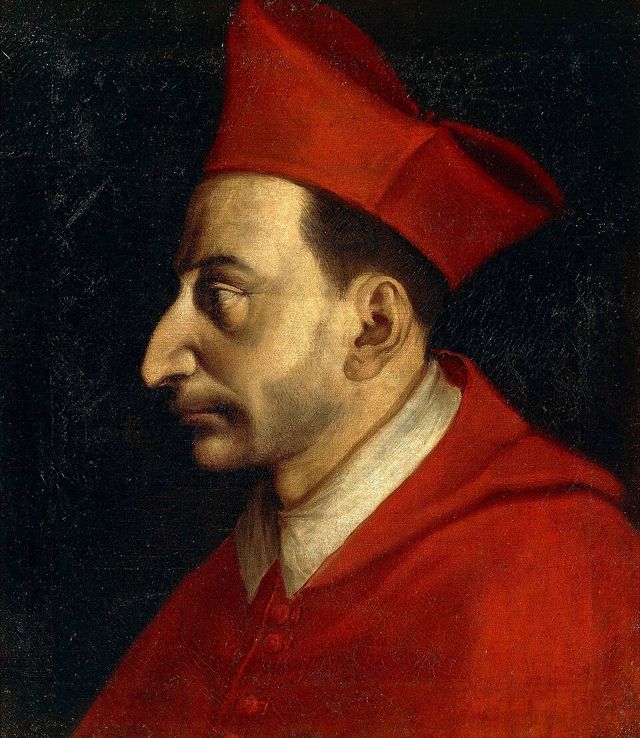
His body is preserved in a crystal shrine in a subterranean chapel under the dome of the cathedral. His personal appearance is said to have been striking. He was moderately tall, with large blue eyes, an aquiline nose, a high, but not broad, forehead, dark chestnut hair, and a pale complexion.