St. Chrysogonus

Read the essentials →
November 24 · Martyr

St. Chrysogonus

St. Chrysogonus

Traditional feast

November 24
1914 / pre-1969 calendar, per Baring-Gould (1897)

Current feast

November 24 (also listed: December 22)
Secondary source · Wikipedia

Represents

Martyr

Their story

Adapted in modern English from the Catholic Encyclopedia (1913) · original text below

Chrysogonus was a martyr at Aquileia, probably in the persecution of Diocletian (Diocletian was Roman emperor 284–305; the 'Great Persecution' of 303–311, when imperial edicts ordered churches and Scriptures destroyed and Christians forced to sacrifice to the Roman gods). He was buried there and venerated by the faithful of the region. Very early his cult spread to Rome, where a church in Trastevere, first mentioned in 499 and probably dating from the fourth century, still bears his name.

A legend arose around the sixth century that made him a Roman, probably to explain that church. The source calls it a legend. In it Chrysogonus is the Christian teacher of the noble Roman lady Anastasia. Imprisoned in Diocletian's persecution, he comforted her by letter in her sufferings. Diocletian then had him brought to Aquileia, condemned and beheaded. His body was thrown into the sea, washed ashore, and buried by an aged priest named Zoilus.

Early life

The book says little or nothing about early life. This is how the account begins.

Thin entry · the 1897 book gives only 0 words. We have not filled the gap with invented detail.

What they represent

How they teach us to live

Drawn from themes in the original account

Keep their day. Remember them on November 24 with a short prayer, and ask for their help.

From the Catholic Encyclopedia

1913 · 400 words

Martyr, suffered at Aquileia, probably during the persecution of Diocletian [Roman emperor 284–305, who began the ‘Great Persecution’ of Christians in 303], was buried there, and publicly venerated by the faithful of that region. His name is found in the so-called "Martyrologium Hieronymianum" on two different days, 31 May and 24 November, with the topographical note, "in Aquileia" ("Martyrol. Hier.", ed. De Rossi; Duchesne in "Acta SS.", Nov. II). The Weissenburg manuscript of the "Mart. Hieron." alone mentions the primitive the topographical indication on the latter date; the Echternach manuscript says, "Romae natale Crisogoni", while under 23 November Chrysogonus appear again among the Roman martyrs. Very early indeed the veneration of this martyr of Aquileia was transferred to Rome, where a titular church, in Trastevere, bears his name to this day. This church (Titulus Chrysogoni) is first mentioned in the signatures of the Roman Synod of 499 (Duchesne, "Notes sur la topographie de Rome au moyen age" in "Mélanges d'archéol. et d'histoire", VII, 227), but it probably dates from the fourth century (De Rossi, "Inscript. christ.", II, 152, N. 27, "Bulletino di archeol. crist.", 1887, 168). It is possible that the founder of the church was a certain Chrysogonus, and that, on account of the similarity of name, the church was soon devoted to the veneration of the martyr of Aquileia, it is also possible that from the beginning, for some unknown reason, it was consecrated to St. Chrysogonus and takes its name from him. In a similar way the veneration of St. Anastasia of Sirmium was translanted to Rome (see ANASTASIA, SAINT, MARTYR) about the sixth century arose a legend of the martyr that made him a Roman and brought him into relation with St. Anastasia, evidently to explain the veneration of Chrysogonus in the Roman church that bears his name. According to this legend, Chrysogonus, at first a functionary of the vicarius Urbis, was the Christian teacher of Anastasia, the daughter of the noble Roman Praetextatus. Being thrown into prison during the persecution of Diocletian, he comforted by his letters the severely afflicted Anastasia. By order of Diocletian, Chrysogonus was brought before the emperor at Aquileia, condemned to death, and beheaded. His corpse, thrown into the sea, was washed ashore and buried by the aged priest, Zoilus. In the legend the death of the saint is placed on the 23rd of November. In the actual Roman martyrology his feast is celebrated on 24 November; by the Greeks on 16 April.
Read more

The full original · 0 words

Read Baring-Gould’s full account

Baring-Gould’s sources: Roman Martyrology. Usuardus, Ado, &c. The Carthaginian Kalen dar of the 5th cent. Authority: — The not trustworthy Acts of S. Anastasia.] CHRYSOGONUS was arrested at Rome in the persecution of Diocletian, and put in prison. SAnastasia, a holy Roman lady, corresponded with him by letter, as to her conduct towards an unbelieving husband. He was conducted to Aquileja, where Diocletian then was, and was there executed. His head is shown enshrined in the church of his dedication at Rome, but his body is preserved at Venice. 1 Apocryphal, known only from the fabulous Acts of S. Marcell us.

Feast days

Feast: November 24

Nine days · Free

Pray the novena
with us.

One short email a day for nine days. The day's prayer, a line from St. Chrysogonus's story, and a nudge to keep going.

Also on November 24
A

Sts. Arethas and…

November 24 · Martyrs
F

Sts. Flora and Mary

November 24 · Virgins, Martyrs
St. John of the Cross

St. John of the Cross

November 24 · Confessor
← All 1726 saints in the library
Sources & notes

Feast-day sources

Story sources

Sources

Credits

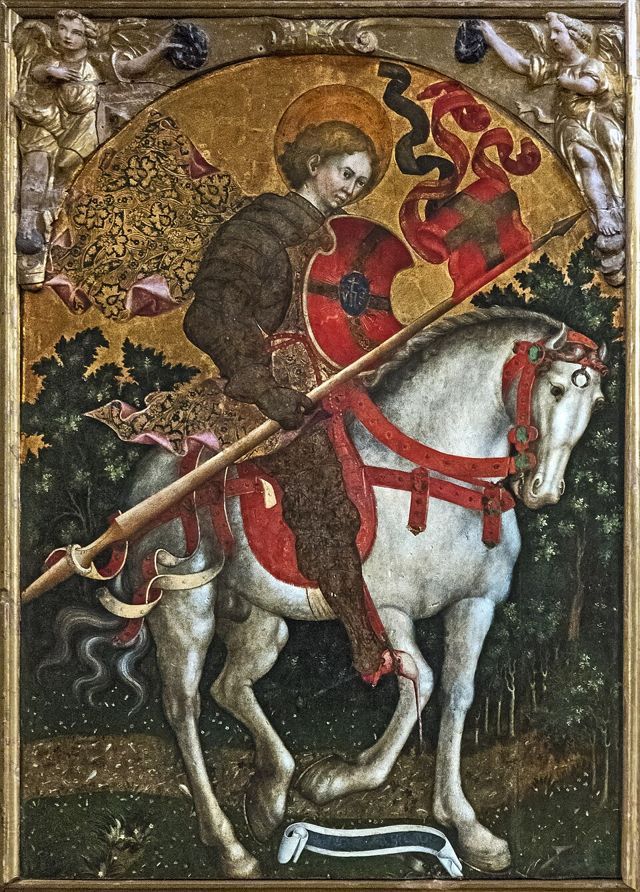
Image: San Trovaso (Venice) - San Crisógono a caballo - Michele Giambono.jpg · Didier Descouens · Public domain, via Wikimedia Commons

From Sabine Baring-Gould, The Lives of the Saints, new edition in 16 vols. (London: John C. Nimmo, 1897–98); text from the Internet Archive scan (OCR, lightly cleaned; errors possible). Public domain.

Image: Didier Descouens, Wikimedia Commons (Public domain)

From “Catholic Encyclopedia (1913)/St. Chrysogonus,” The Catholic Encyclopedia (New York: Robert Appleton Company, 1907–1914), via Wikisource. Public domain. Matched by name and feast date; text unedited except for our bracketed notes in grey.

From Sabine Baring-Gould, The Lives of the Saints, new edition in 16 vols. (London: John C. Nimmo, 1897–98); text from the Internet Archive scan (OCR, lightly cleaned; errors possible). Public domain in the United States. Reproduced unedited, except for short bracketed notes in grey that we added to explain names and terms (“S.” is the old abbreviation for Saint). Some history and judgments reflect 19th-century scholarship.