Baring-Gould’s sources: Roman and Gallican Martyrologies. Almost all the Martyrologies; not however the English or Scottish ones. Authorities: — A Life written in the 10th cent., or later; better authority is the mention by Gregory of Tours, who was almost a contemporary.] In 524, scarcely thirteen years after the death of Clovis, and the partition of his dominions amongst his four sons the second of them, Clodomir, King of Orleans, was killed in a war against the Burgundians, leaving three sons direct S. Clodoald.
…heirs of his kingdom, subject to equal partition between them. Their grandmother, S. Clothild, kept them with her at Paris; and their uncle Childebert (King of Paris), seeing that his mother bestowed all her affections upon the sons of Clodomir, grew jealous; so, fearing that by her favour they would get a share in the kingdom, he sent secretly to his brother Clothair (King of Soissons), saying, (< Our mother keepeth by her the sons of our brother, and willeth to give them the kingdom of their father. Thou must needs, therefore, come speedily to Paris, and we must take counsel together as to what shall be done with them \ whether they shall be shorn and reduced to the condition of commoners, or slain and leave their kingdom to be shared equally between us.” Clothair, overcome with joy at these words, came to Paris. Childebert had already spread abroad among the people that the two kings were to join in raising the young children to the throne. The two kings then sent a message to the queen, who at that time dwelt in the same city, saying, “Send thou the children to us, that we may place them on the throne.” Clothild, full of joy and unwitting of their craft, set meat and drink before the children, and then sent them away, saying, “ I shall seem not to have lost my son if I see ye succeed him in his kingdom.” The young princes were immediately seized and -parted from their servants and governors; and the servants and the children were kept in separate places. Then Childebert and Clothair sent to the queen their confidant, Arcadius. with a pair of shears and a naked sword. When he came to Clothild, he showed her what he bore with him, and said to her, “ Most glorious queen, thy sons, our masters, desire to know thy will touching these children. Wilt thou that they live with shorn hair, or that they be put to death ?” Clothild, astonished at the address, and overcome with indignation answered at hazard amidst the grief that overwhelmed her, and not knowing what she should say, “ If they be not set upon the throne, I would rather know that they were dead than shorn.” But Arcadius, caring little for her despair, and for what she might decide after more reflection, returned in haste to the two kings, and said, “ Finish ye your work, for the queen, favouring your plan, willeth that ye accomplish it.” Forthwith Clothair took the eldest by the arm, dashed him upon the ground, and slew him without mercy, with the thrust of a hunting-knife under the arm-pit. At the cries raised by the child his brother cast himself at the feet of Childebert, and clinging to his knees, said amidst his sobs, “ Aid me, good father, that I die not like my brother. ” Childebert, his visage bathed in tears, said to Clothair, “ Dear brother, I crave thy mercy for his life. I will give thee whatsoever thou wilt as the price of his soul; I pray thee, slay him not.” Then Clothair, with menacing and furious mien, cried out aloud, “Thrust him away, or thou diestin his stead. Thou, the instigator of all this work, art thou, then, so quick to draw back ?” At these words Childebert thrust away the child towards Clothair, who seized him, plunged a hunting-knife into his side, as he had into his brother’s, and slew him. They then put to death the slaves and governors of the children. After these murders Clothair mounted his horse and departed, taking little heed of his nephews’ death. And Childebert withdrew to the outskirts of the city. Queen Clothild had the corpses of the two children placed in a coffin, and followed them with a great parade of chanting and immense mourning, to the basilica of S. Peter (now S. Genevieve), where they were buried together. One was ten years old and the other seven. The third, named Clodoald, could not be caught, and was saved by some gallant men. He, disdaining a terrestrial kingdom, dedicated himself to the Lord, was shorn by his own hand, and became a churchman. He devoted himself to good S. Clodoald.
works, and died a priest. And the two kings divided equally between them the kingdom of Clodomir.1 Clodoald, or S. Cloud, as he is called in France, escaped into Provence, where he lived in a little cell as a hermit on the fruits of the earth. The horrors of his infancy had saddened his young spirit, and had completely alienated him from the world. He cast aside every thought of ambition, which would have led him along a pathway of blood, and sought in place of an earthly crown, one eternal, peaceful, in the heavens.
A pretty legend is related by his 1 oth century biographer. A beggar came to his cell asking alms. S. Cloud had nothing to give him save his hood, and he snatched this off, and cast it over the beggar's shoulders. And when evening came on, and the poor man in the dusk walked through the forest, the hood began to shine like a lamp; and when he came forth, all men wondered at the luminous hood, and thus they learned how great a saint was living in the woods of their neighbourhood.
After awhile he returned to the neighbourhood of Paris. His two uncles no longer dreaded him. Shorn as a monk, and living as a hermit, his life was no menace to them. They suffered him to build a monastery, where now stands the palace of S. Cloud. They even endowed it. Eusebius [Eusebius of Caesarea (d. c. 339), the first historian of the Church], Bishop of Paris, ordained him priest, and there the saintly prince spent the few years that remained of his life. He died about 560, aged not much more than thirty-five. Some relics [the bodily remains of a saint, or objects they used, kept with honor] of S. Clodoald still remain in the parish church of S. Cloud.
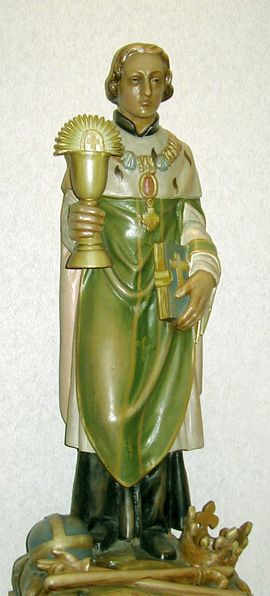
In art he is often represented with nails, as he is patron of the nail-makers, through an absurd pun on his name. 1 Greg. Turon., Hist. Franc., iii. 18.