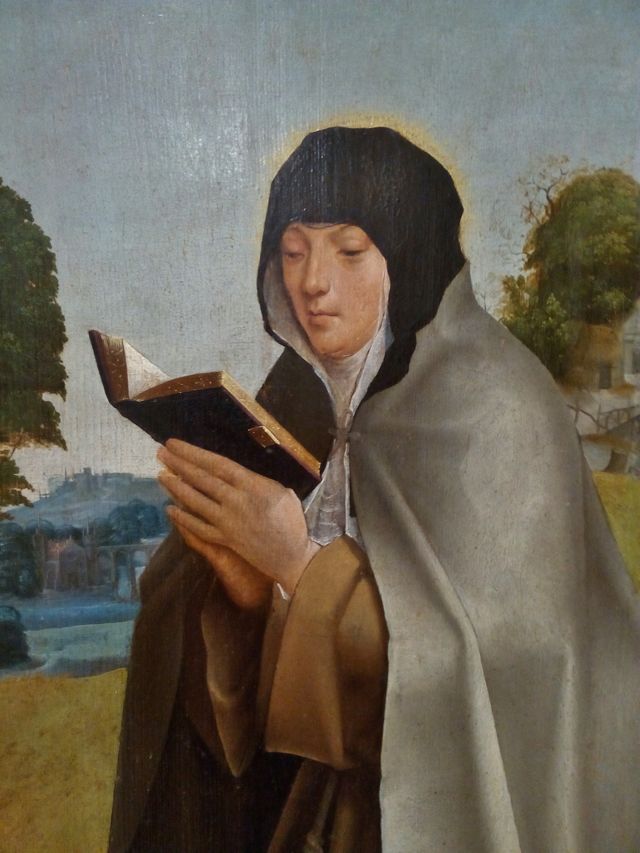
Baring-Gould’s sources: Roman Martyrology. Her festival was celebrated with proper office at her convent in Ghent, by permission of Clement VIII.; and Paul V. extended this privilege to all other convents of her order. She was canonized by Pius VII., in 1807. Her life was written by Peter à Vallisus, [or] de Rheims, for many years her confessor, in French, and it was translated by Etienne Julliac, a contemporary, into Latin; and an epitome of her life was written by Jodocus Clichthrove.
Colette Boillet, a carpenter's daughter, was born at Corbie, in Picardy, on Jan. 13th, 1380. Her parents gave her at the font the name of Nicoletta, and this has been contracted into Colette, the name by which she is now usually known. From her earliest infancy she seems to have been singled out for a special work, and her young soul, from the first, opened to divine grace, as a spring flower to the sun. At the age of seven, she yearned for a retired life, and she fashioned for herself a little oratory in the back premises of the carpenter's wood-yard, into which she retreated for prayer, and there spent many hours in communion with God. When her childish companions sought her that they might draw her into their sports and pastimes, she hid under her bed; but when anything was really wanted of her, or any of her companions were in trouble, she was at once at hand to assist and console. If a poor person came to the door whilst the family was at meals, she would rise and give him her share.
In 1402, at the age of twenty-two, Colette bade farewell to nature, to her friends, to all of life that was most lovely, and enclosed herself in an anchorite [a hermit, sometimes walled into a cell beside a church]'s cell, built against the walls of the church of Corbie. These voluntary recluses were common in the Middle Ages. Those who desired to live this life of seclusion, entered living into these tombs, which were built up, leaving only a window open, through which they were fed and communicated. Throughout all Picardy the fame of the austerities of Colette spread, and many sought her counsel and prayers. Fearing that her humility would suffer, for three years she maintained a complete silence, only opening her window to receive the Holy Sacrament. At length the call came, which it was impossible for her to resist. Henry de la Balm, her confessor [in old usage, a saint who was not martyred, or who suffered for the faith without being killed], saw in a dream a vine full of leaves, but fruitless; then came Colette and pruned the vine, and it began to yield abundantly. Shortly after this Colette saw, in vision, a great tree growing in her cell, laden with golden fruit, and numerous saplings springing up about its roots. Fearing a deception of Satan, she tore up the young plants, but there appeared more in their place. Then she thought God summoned her to reform the Order of the Poor Clares. But she still hesitated; whereupon she was struck blind for three days, and after that for three days dumb. She hesitated no longer, but came forth ready, in God's name, to undertake her mission. She left her cell with regret; turning at the door, and kissing the threshold, she sobbed forth, "Oh, dear little home, farewell! farewell my joy and repose! Oh, if men knew how much happiness I have enjoyed in thee, they would desert palaces to inhabit thy narrow walls."
It was the close of autumn in 1406. The vines were heavy with grapes, the trees had put on their many-coloured autumnal tints, and the last shocks of yellow harvest were being gathered in. For four years, in her seclusion, she had seen nothing of all this, only the golden light playing on the wall of her chamber, sometimes pale, and sometimes burning as flame, and the blue sky and the drifting clouds, now dark grey with winter rains, and then white and fleecy in summer light.
Colette had written all that she had deemed expedient for the reformation of the Franciscan Order; she placed her writings in a pouch attached to her girdle, and on foot she started for Nice, where Benedict XIII. resided, on account of the schism. The pope received Colette with honour; she made profession of the rule of S. Clare at his feet, and he appointed her superior-general of the whole order; naming Henry de la Balm, her confessor, as assistant for the reformation of the Friars of S. Francis.
This young and feeble woman now set her hand with incredible energy to the accomplishment of her task. She traversed France, Savoy, Germany, and Flanders, meeting in some places with violent opposition as a crazy fanatic, but in other succeeding in establishing a reform. The provinces of France were ravaged by war, and all the evil passions of wicked men were let loose; but Colette walked through all dangers, relying on Divine protection, and never relying in vain. She was accused of heresy, and even of unchastity, but she was not crushed by slander, despising reproach as she had defied danger.
In 1410, she founded a convent at Besançon; in 1415, she introduced a reform into the convent of the Cordeliers, at Dole, and in succession into nearly all the convents in Lorraine, Champagne, and Picardy. In 1416, she founded a house of her order at Poligny, at the foot of the Jura, and another at Auxonne. "I am dying of curiosity to see this wonderful Colette, who resuscitates the dead," wrote the Duchess of Bourbon, about this time. For the fame of the miracles and labours of the carpenter's daughter was in every mouth.
In 1422, Colette started for Moulins to meet the duchess, and to found there a religious house. The Duchess of Nevers summoned her into her duchy, and she obeyed the summons. It was on her way to Moulins that she met another maiden, also acting under a special call, though one of a very different nature. One maiden was called to wear cord and veil, the other to gird the sword and wear the casque. It was Joan of Arc, then on her way with Dunois at the head of an army to besiege Charité-sur-Loire. In Auvergne, Colette converted Isabeau de Bourbon, and at the age of nineteen the young princess exchanged her diamonds for the knotted cord of S. Clare.
After having founded the convent of Le Puy, at the request of Amadeus VII., Colette carried her reformation into Savoy. On the north shore of the Lake of Geneva, she found a still sweet spot, itself silent and secluded as a monastery, its white walls reflected in the deep blue of the lake, and looking out on a range of snowy mountains. At Vevey she rested to look around her, relax her weary soul, and breathe in the soft air, sweet from the fields of narcissus. But God had not yet called her to rest. From all sides devotees came to her,—the Duchess of Valentinois, the unfortunate Jacques de Bourbon, in turn jailor and prisoner of his wife, Jeanne of Sicily, with his children, who, having tasted the life of the cloister, found it was so sweet, that they abandoned for it the pleasures and ambitions of the world.
After having spent two years at Vevey, Colette went to Nozeroy, to the princess of Orange, and remained with her till 1430. Philip the Good, Duke of Burgundy, recalled Colette to Flanders, where she founded several houses, and glorified God by many miracles. In the memoirs of Oliver de la Marche, a Burgundian gentleman of this time, occurs the following notice of S. Colette; "En celui temps, régnoit une moult sainte et dévote femme, religieuse de Sainte-Claire, au pays de Bourgoigne, nommée soeur Colette. Cette femme allait par toute la chrétienté, menant moult sainte vie, et édifiant maisons et églises de la religion de Saint François et de Sainte Claire. Et ai été acertené, que, par son pourchas et par sa peine, elle avait édifié de son temps trois cent quatre-vingts églises."
It would seem almost as if Colette had a natural love for mountains, so generally do we find her returning to them, and laying at their feet the foundations of her dearest homes. Perhaps the mystery of their blue-veined valleys, and the wondrous changes wrought by the sun and clouds on their sides, filled her with a sense of love and awe. But it was not from among the mountains that she was summoned away. The call to the everlasting hills came to her on the flats of Flanders, in the city of Ghent. There she died on March 6th, 1447, laying herself down to repose as gladly as the weary labourer in harvest time, who returns to his home and to sleep after a day of incessant toil.
When the Emperor Joseph II. suppressed many religious houses in his dominions, in 1785, the Poor Clares of Ghent took up the body of S. Colette, and traversing France, laid it beneath the mountain shadows at Poligny. The holy relics [the bodily remains of a saint, or objects they used, kept with honor] were secreted at the time of the French Revolution, and on the return of tranquillity, they were placed in the parish church; but the Poor Clares having re-established themselves at Poligny, the bones of the saint have been restored to them.