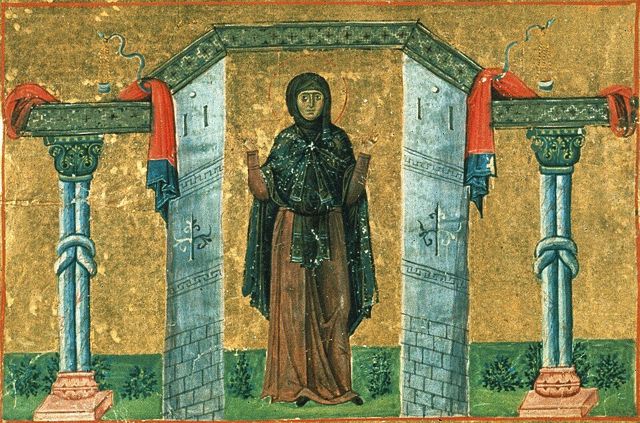
Baring-Gould’s sources: Roman and Gallican Martyrologies. Usuardus, Ado, &c. Authority: — The Acts, late and untrustworthy.] COLUMBA, a native of Spain, of royal family still heathen, illumined by Divine grace, left her home at the age of sixteen, and came into Gaul along with S. Beatus, S. Sanctianus, and S. Augustine. She was baptized at Vienne, where a baptistery is shown in the church of the nunnery of S. Benedict, called after her, and where she is supposed to have received the sacrament of regeneration. It is much more probable that the baptistery had its dedication to the Holy Ghost in the form of a dove.
In the year 274 Aurelian [Roman emperor 270–275] was in Gaul [roughly modern France and Belgium] and at Sens. He ordered the execution of S. Columba [Irish abbot of Iona (d. 597), apostle of Scotland] and her companions. 1 He died on Dec. 31, but his commemoration was moved by Clement XI. to May 24, and by Clement XIL to June x6.
The church of S. Columba the Less in Sens is said to occupy the site of her prison. But previous to the execution Columba was sent to the amphitheatre, and lodged in one of the cells near where the wild beasts were confined. Aurelian offered a young man of his court to abandon the virgin to his passions. But when the youth approached Columba, a bear came upon him, and began to hug him with an ardour which threatened to break in his ribs. The young man struggled, and the virgin bade the bear let go. Bruin obeyed with a sulky growl, and retired; and the ravisher thought it best to follow the example of the bear, and disappear likewise.
Aurelian then ordered soldiers to enter the dungeon and draw Columba forth. The bear, however, threatened them with his paws, and they contented themselves with an attempt to smoke him out. A shower came on and extinguished the flames. The bear was allowed to depart, and Columba surrendered herself to the officers, who conducted her before Aurelian, and at his command her head was struck off outside the city, on the side of the road which now leads to Meaux; where afterwards was reared the abbey of S. Columba, which served as the asylum of Becket whilst in exile at Sens.
The relics [the bodily remains of a saint, or objects they used, kept with honor] of S. Columba are still shown in the cathedral of Sens.