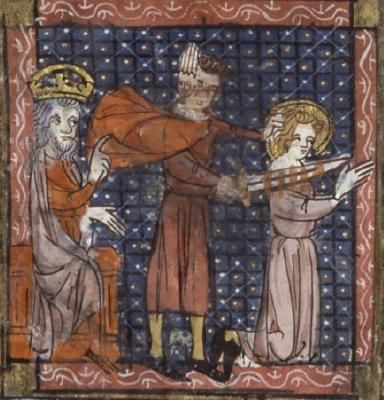
Baring-Gould’s sources: Irish Martyrologies and Aberdeen Breviary. Authority: — T wolives, the first of little importance; the second, in Irish, a valuable one.] S. Comgall, or, as he is more properly called, Coemgall (the goodly-pledge), was of a distinguished family of Dalriadha. His father's name was Sedna, and his mother's Briga. According to the annals of Ulster he was bom in the year 516. He early embraced the monastic life under a master of very relaxed morals. Comgall one night took his master's tunic, threw it into the sheep-fold and trampled it in the dung. Next morning the master asked him the reason, with some justifiable indignation. “Why care you for your gown, when your soul is more sullied even than that ?” asked the boy, and the master hid his face in shame. Then he ran away from him, and placed himself under the direction of S. Fintan at Clonenagh in Leinster. Another story told of his youth is as follows: — Much against his wish he was forced to appear in arms under his liege prince in a war. It was winter-time, and the army encamped on a bleak moor for the night. Great flakes of snow fell, and covered the shivering warriors, the wind drifting it over the temporary huts thrown up to screen them from the cold. But it was noticed that no snow fell over the unsheltered Comgall, but that in the morning a wall of snow stood round him protecting him from the northern ice-laden blast.
After having completed his instruction under S. Fintan,1 Comgall set out for his own country to found cells there. Comgall had been hitherto unwilling to enter into holy orders [ordination; “orders” means the sacrament by which deacons, priests and bishops are ordained]; but it is said that, before proceeding straight to Dalriadha, he turned aside to Clonmacnois, and was ordained priest by a Bishop Lugid. On his arrival in Ulster he retreated with several disciples to an island in Lough Erne, where they lived with such severity that seven of his companions died of hunger and cold. Bishop Lugid remonstrated with him on the plea of Christian charity, and Comgall relaxed his rule for the benefit of the monks, though he observed it in all its rigour himself. We are told that he intended to leave Ireland, and spend the remainder of his days in Britain, but was dissuaded by the pressing solicitations of Bishop Lugid. Comgall then founded the monastery of Banchor, now Bangor, on the 1 Fintan, if we are to believe what his Acts say, that he was younger than S. Columba [Irish abbot of Iona (d. 597), apostle of Scotland]. must also have been younger than his pupil Comgall. May io.] S. ComgalL shores of the Irish sea facing Britain/ in the year 559. For the direction of this monastery he drew up a rule, which was long reverenced in Ireland. The number of disciples who flocked to B anchor was so great that, as one place could not contain them, it became necessary to establish several monasteries and cells, in which, taken together, it was computed that there were three thousand monks, all observing his rule, and superintended by him. Amongst them is mentioned Cormac, king of South Leinster or Hy-Kinselagh, who in his old age retired to Banchor.
In a certain time of scarceness, says the legend, the monks were sorely in want of food. Now in the neighbourhood lived a nobleman named Croadh, who had his granaries full. And the mother of Croadh was hight Luch, which being interpreted, means “ the Mouse.” So Comgall took a silver goblet that had been given to him, and went before Croadh and said, “ Give me and my monks of your com, and I will give thee this cup.” But the chief answered scoffing, “ Not so; keep your silver, and I will keep my com. Your beggarly followers shall not devour it; I want it all for my old Mouse,” thereby meaning his venerable mother. Then said Comgall, “ As thou hast said, so shall it be,” and he went away. Then came a legion of mice into the granary of the hard-hearted chief, and devoured all his com.1 2 1 It is now only a village on the shore of the Bay of Belfast, without the slightest vestige of the famous monastery.
2 An Irish version of the Bishop Hatto myth. Here is another story Quadam die cum ibi esset S. Comgall us in quodam loco solus, expandebat manus suas ad ccelum, post jejunium trium dierum lassus et sitiens, et salivas in pavimentum projiciehat: vir enim miras abstinentise erat S. Comgallus. Et ecce elevans sanctus vultum suum sursum in ccelum, quidam leprosus mendicus petens auxiliiim venit ad eum tacite, vidensque salivas sancti super terram, perrexit paulatim, et de pavimento eas collegit, et commiscuit eas in aqua, lavansque se inde, plenus fide, statim e lepra sua sanatus est.”
The reputation of the monastery of Banchor was much enhanced by the celebrity of some eminent men who issued from it, especially S. Columbanus [Irish monk (d. 615) who founded monasteries in France and Italy], one of the greatest men of his age, so that the fame of Banchor spread far and wide throughout all Europe. It is said that in the seventh year after the foundation of Banchor, i.e.} in 566, Comgall went to Britain and established a monastery at a place called Heth.1 It is not unlikely that it was on this occasion that he paid a visit, together with S. Brendan, to S. Columba, in the Western Isles. He is said to have contributed to the conversion of Brideus, king of the Northern Piets. Having returned to Ireland, he continued to govern his monastery and its dependencies till his death, which occurred on the 10th of May, a.d. 6or, after he had received the holy viaticum from S. Fiachra, abbot of Congbail and afterwards of Clonard.
A few of the strange and grotesque stories which have attached themselves to this saint may be read with amusement. One day S. Columba was dining with S. Comgall, when the former, pointing to a seat at the board, asked whose it was. “ That is onr cook’s place,” said Comgall. “ But a devil is now occupying it,5' said Columba. “ Wait till the cook returns and finds some one in his chair, and see what he does.5' Presently in came the cook, and finding his seat occupied, rushed up to the intruder, and knowing him at once to be a demon, with flaming eyes exclaimed, “You wretch of a devil, what are you doing here? Be off on the spot (alioquin tu profer modo) !” Then he banished him to the bottom of the sea. “And all were highly edified.”
Comgall sent a bell to his nephews at a distance by the hand of an angel. We have already heard of one marvel 1 Probably Hythe, but not any place so called now. Hytbe means in Keltic a bank or shore; and many places may have borne that name in the 6th cent. May io.] S. Solangia.
wrought by his saliva. Here are others. A beggar once importuned the saint, then Comgall spat into his pocket, and the saliva was instantly converted into a gold ring. A king was very hard of heart, and no exhortations of the saint could melt him. Then Comgall spat at a great stone, and split it into quarters; thereupon the king burst into tears of penitence.
One story alone is pretty. He and some of his monks were walking by the side of a lake, when they saw swans floating on the mere, singing. “ O, father ! may we coax the swans ? ” asked the monks. He gave them leave. Then they felt for some crusts of bread; but not finding them, knew not how to entice the birds. But Comgall called, and the swans sailed up to the bank, and one fluttered into the old man’s lap, and let him stroke its white feathers.