A shepherd who carried a whole region through hard times.
Read the essentials →A shepherd who carried a whole region through hard times.
Read the essentials →A shepherd who carried a whole region through hard times.
November 12
November 12
Archbishop
Trajectensi (d. 917), in Surius, Vib SS. Nov. Liafwin, whose name has been Latinized into Lebuinus, was by birth an Anglo-Saxon. He left his country and his father's house to carry the light of the Gospel to the Frisians and Westphalians.
Learn from the kind of life it was. A shepherd who carried a whole region through hard times.
Keep their day. Remember them on November 12 with a short prayer, and ask for their help.
Sigebert, king of Austrasia, was much under the influence of S. Cunibert. The saint founded at Cologne an institute called “ The Twelve Weepers,” one of the offices of which Nov. ia.] S. Lebuinus.
was to watch by the body of the defunct bishop of Cologne till its funeral. S. Cunibert is said to have discovered the sepulchre of S. Ursula by seeing a white dove perch on a stone, but as has been stated in the Life of that mythical saint, her name is not mentioned in connection with the circumstances, and the biography of S. Cunibert is too late to be of any value in giving evidence to the cultus of S. Ursula as early as the 7th century. He founded a church outside the walls of Cologne, which he dedicated to S. Clement He was afterwards buried in it, and it now bears his name.
LEBUINUS, P.C. [Gallican, German, and Belgian Martyrologies.1 The deposition on Nov. 12, the translation at Deventer on June 25. Authority: — A Life by Hucbald of S. Amand (918-76), “ An important source of history for the earliest condition of the Saxons, in earlier bibliographical works wrongly attributed to S. Boniface [English missionary to Germany, martyred 754]. A beautiful production.” — Potihast. Pertz, Mon. ii. pp. 361-4. Ecloga et Sermo de S. Lebuino Presb. auctore S. Radbodo Ep. Trajectensi (d. 917), in Surius, Vib SS. Nov. Liafwin, whose name has been Latinized into Lebuinus, was by birth an Anglo-Saxon. He left his country and his father's house to carry the light of the Gospel to the Frisians and Westphalians. He came to Utrecht, where he was warmly greeted by S. Gregory, whom S. Boniface had left in charge of that see. This saint sent him with Marchelm, a disciple of S. Willibrord, to carry the glad tidings of salvation into the country now called Ober-Yssel. S. Lebuinus was received as an angel of God by a lady named Abachahild.
apocryphal Liafwin, “ Livinus of Ghent, Abp. M.,” is. Hearing that there was to be a great gathering of the Saxons at Marklo on the Weser, Lebuinus arrayed himself in full canonicals, and with an uplifted cross in one hand and a volume of the Gospels in the other, he presented himself before the assembly, as they were engaged in sacrifice to their national gods.
“ Hearken unto me,” he thundered forth; “ and yet not to me, but to Him that speaketh by me. I declare unto you the command of Him whom all things serve and obey.” Struck dumb with astonishment, the warriors listened as he went on, “ Hearken, all ye, and know that God is the Creator of heaven and earth, the sea and all things that are therein. He is the one only true God. He made us, and not we ourselves. The images, which ye call gods, and which, beguiled by the Evil One, ye worship, what are they but gold, or silver, or brass, or stone, or wood? They neither live, nor move, nor feel They are but the work of men's hands, and can neither help themselves nor any one else. God, the only good and righteous Being, whose mercy and truth remain for ever, moved with pity that ye should be thus seduced by doctrines of demons, has charged me, his ambassador, to beseech you to lay aside your present errors, and to turn with sincere and true faith to Him, by Whose goodness ye were created, and in Whom we live and move and have our being. If ye will acknowledge Him, and repent and be baptized in the name of the Father, and of the Son, and of the Holy Ghost, and will keep His commandments, then will He preserve you from all evil, He will vouchsafe unto you the blessings of peace, and in the world to come, life everlasting.
“ But if ye despise and reject His counsels, and persist in your present errors, know that ye shall suffer terrible punishment for scorning His most merciful warning. Behold I, His ambassador, declare unto you the sentence which has Nov. za.] 5. Lebuinus.
gone forth from His mouth, and which cannot change. If ye do not obey his commands, then will sudden destruction come upon you. For the King of kings and Lord of lords hath appointed a brave, prudent, and terrible prince, who is not afar off but near at hand. He like a swift and roaring torrent will burst upon you and subdue the ferocity of your hearts and crush your stiff-necked obstinacy. He will invade your land with a mighty host, and ravage it with fire and sword, with desolation and destruction. As the avenging wrath of that God, whom ye have ever provoked, he will slay some of you with the sword, others he will cause to waste away in poverty and want, others he will lead into perpetual captivity. Your wives and children he will sell into slavery, and the residue of you he will reduce to ignominious subjection, that in you may be justly fulfilled what has been long ago predicted, * They were made a handful, and scattered and tormented with the tribulation and anguish of the wicked.’ ”
The effect of these words can easily be imagined. The warriors, who had listened at first with awe-struck reverence, were seized with ungovernable fury. “ Here is that seducer,” they cried, “that enemy of our sacred rites and of our country. Away with him from the earth, and let him suffer the just penalty of his crimes.” Thereupon the whole assembly was in a ferment. Stakes were cut from the adjoining thickets, stones were taken up, and Lebuinus would have atoned for his temerity with his life had it not been for the intervention of an aged chief named Buto, who, standing on an eminence, thus addressed the excited throng: — “ Men and heroes all, listen to my words. Many a time have ambassadors come to us from the Normans, Sclaves, and Frisians. As is ever our custom, we have listened attentively to their words, received them peaceably, and dismissed them to their homes loaded with suitable presents. [Not. ia.
But now an ambassador from a powerful deity hath not only been despised, but struck and stoned, and almost deprived of life. That the God whose messenger he is hath power and majesty, is plain from the fact that He has delivered His servant out of our hands. Be assured, then, that what he has threatened will surely come to pass, and those judgments he has denounced will be fulfilled by a deity whom we know and see to be great, powerful, and mighty.” With these words the old chief calmed the storm, and so Lebuinus escaped.
In the troubles that ensued, the Saxons burnt the oratory of Lebuinus at Deventer. After they had gone he rebuilt it, and remained ministering in it till his death, which took place about the year 773, when he was buried in the church he had erected. His body, and the book of the Gospels he had, and which was perhaps written by him, are preserved at Deventer, in the church that bears his name. In art he is represented as a priest in chasuble, holding up cross and book, and treading on a spiked club. The church of Deventer, besides preserving the body of its apostle, enjoys the possession of a portion of the shift of the Blessed Virgin Mary, a fragment of Aaron’s rod, an arm of S. Margaret, a tooth of S. Mary Magdalen, a rib cf S. Lawrence, and a finger of S. Andrew.
Googl nov. 13.1.S'.S. Antoninus [Antoninus Pius, Roman emperor 138–161], Zebinas, Others. 3 1 1
Feast: November 12
One short email a day for nine days. The day's prayer, a line from St. Cunibert of Cologne's story, and a nudge to keep going.
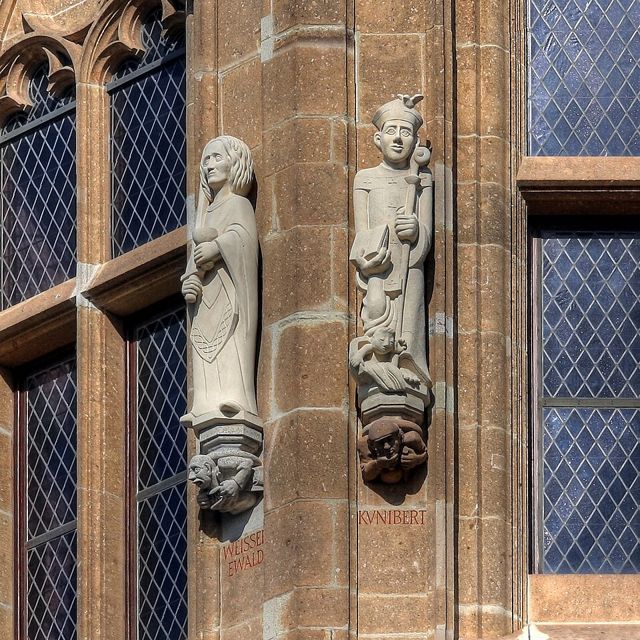
Image: Rathausturm Köln - Weisser Ewald - Kunibert (5949-51).jpg · Raimond Spekking · CC BY-SA 4.0, via Wikimedia Commons
From Sabine Baring-Gould, The Lives of the Saints, new edition in 16 vols. (London: John C. Nimmo, 1897–98); text from the Internet Archive scan (OCR, lightly cleaned; errors possible). Public domain.
Image: Raimond Spekking, Wikimedia Commons (CC BY-SA 4.0)
From Sabine Baring-Gould, The Lives of the Saints, new edition in 16 vols. (London: John C. Nimmo, 1897–98); text from the Internet Archive scan (OCR, lightly cleaned; errors possible). Public domain in the United States. Reproduced unedited, except for short bracketed notes in grey that we added to explain names and terms (“S.” is the old abbreviation for Saint). Some history and judgments reflect 19th-century scholarship.