Baring-Gould’s sources: In Ancient Anglo-Saxon Kalendar belonging to the Abbey of Fécamp, and French Martyrology. Authority:—Two lives of uncertain date, by anonymous writers.
The blessed Cuthman was by birth a native of Devonshire or Cornwall, and his youth was spent in pasturing his father's sheep on the granite moors. One day, when dinner time came, he was hungry, and not having a companion to whom he could entrust his flock during his absence, he drew a circle in the heather and gorse with his staff, and then planted it in the soil, and said, "In the name of our Lord Jesus Christ, I command you sheep not to transgress the bounds I have drawn, till I return from my dinner." And, wonderful to relate, the sheep obeyed his command. Now there was a grey moorstone on which he was wont to sit; and this moorstone has been ever since regarded with singular veneration, says the ancient writer of his life.
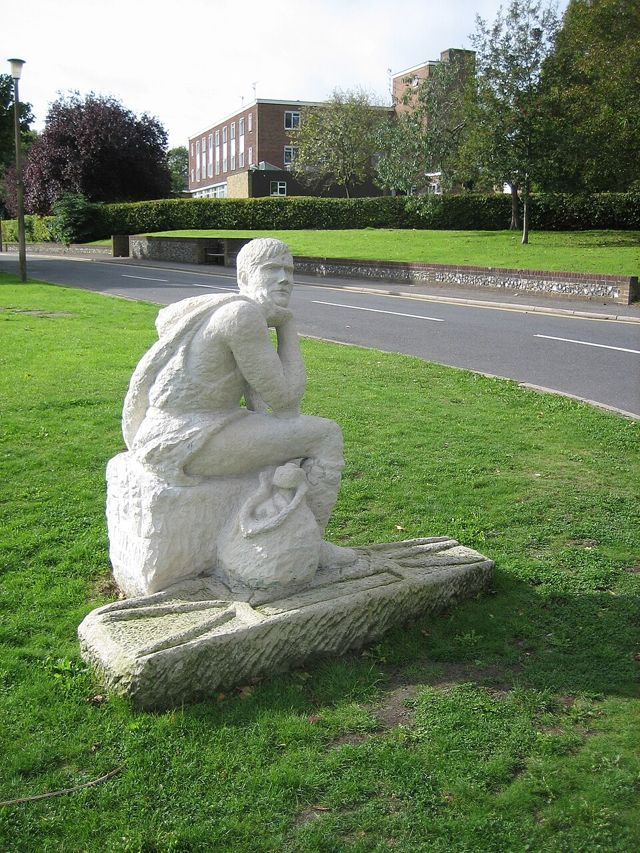
After some years his father died, and the widow was reduced to great poverty. Cuthman ministered to her with the tenderest care and filial devotion, and worked for their joint subsistence. When the poor woman fell sick, he was unable to leave her, at the same time he was so destitute that, unless he went forth to work or beg, they must starve. He, therefore, contrived a wooden truck or barrow on two wheels, and laid his mother on it, and went behind, thrusting her on with his hands, and supporting her by a rope slung round his neck, and begged from door to door, as her condition incapacitated him from working. One day, as he was thus thrusting his little cart through a field where the hay-makers were mowing the grass, the rope broke, and the holy youth stood a while hesitating what to do. Then he tore from an elder tree a bough, and twisted it, and attached it to his mother's cart, and supported it therewith. But the mowers laughed at him as a fool for endeavouring to supply the place of a rope with hollow elder wood. Their mockery was, however, soon arrested by a pelting rain, which drove them from their work, and by seeing the bough hold as firmly as a rope.
And when Cuthman saw that God assisted and avenged him, he vowed to build a church to his holy Name. But how to do so he knew not. So he continued his wanderings, ever journeying East way, and thrusting his mother before him, till he came to Steyning, in Sussex, where the rope suddenly broke, and his mother was much shaken, but, mercifully, was not injured. Then he thought that this was to be the place of his rest, and he said, "O Lord, on me has fallen to undertake the work of building Thee a house; for to do this thou didst inspire me with the will. Whither shall I fly from Thy Spirit? This is the place where I shall finish my wanderings, this shall be my habitation, in which I shall offer and pay Thee my vows, day by day. Almighty Father, who hast brought my journey to an end, bless my work of building to thee a temple. Thou knowest how poor I am, and a labourer from my youth, and of myself I can do nothing, unless thou dost succour me."
The place was still and solitary, trees surrounded it, and hard by flowed the tidal river Adur. The land was little populated; here and there only a farm, buried in a nook of the great chalk downs. He chose a spot at the foot of these downs, and there he built a hut and laid his poor mother in it, and at once began to measure out the ground for his proposed church. He found favour with the people round about, and they contributed to his sustenance and the support of his mother, as they watched him single-handed dig the foundations, cut the timber, and rear the walls of the church he had vowed to God. He was given two oxen to help him in his work of carrying stones. Now, one day, these oxen strayed into the field of a woman who had two grown up sons. The young men at once seized on the oxen, and took them into their house. Cuthman went after the oxen, and when he could not find them, asked the young men for them, but they refused to surrender them. Then he said angrily, "I need them not to do my own work, but to labour for God. See I have laded my cart with those logs, and must move them to the house of God. Come then you and draw them." And he grasped the youths, and yoked them to the wain, and made them drag the stones to their destination.
Now as the church approached completion, Cuthman was grieved one day to find that a wooden pillar he had set up, was bent with the weight imposed upon it, and he feared to remove it, lest he should bring down a part of the building. Then there came a traveller to the door, of very grave and beautiful aspect, and asked Cuthman why he was troubled. And Cuthman pointed to the bent post. Then said the stranger, "O man of little faith! to those who fear God, nothing is impossible. Stretch forth thine hand and let me help thee, and we will straighten it." And he did so, and the pillar became upright. Then Cuthman fell at the stranger's feet, and said, "My lord, tell me thy name!" And he answered, "I am Jesus, to whom thou buildest this house;" and so vanished.
Now Cuthman not only built and laboured for his old bed-ridden mother, but he also preached to the people, and stirred up the love of God, and zeal for His commandments in their hearts. And as his church approached completion, he was glad, and he worked without, and then rested for a while in prayer within. And chipping at the logs without, he wore thick gloves, and when he went within he took off his gloves, and hung them on a little ray of light that pierced through one of the small windows he had made in the walls. And there, where he worked, he died, but what was the nature of his illness, and his disposition at death is not recorded. He was buried at Steyning, and the Adur, then navigable as far as this place, long bore the name of S. Cuthman's Port. Steyning was given by Edward the Confessor, and afterwards by the Conqueror, to the abbey of Fécamp, in Normandy, from which circumstance Bollandus supposed Steyning was in Normandy, and many have been misled thereby. The church of Steyning, dedicated to S. Cuthman, was built by monks of Fécamp to replace his wooden one.
The Monasticon Anglicanum of Dugdale, (II. p. 992), Leland, Collect. I. p. 96; II. p. 409; III. p. 82; and Camden asserts plainly that S. Cuthman was buried at Steyning in Sussex. "Cella de Stening Nigrorum Monachorum in quâ sepultus Stus. Cudman;" "S. Cudmannus in Stenig prope Brambre flumen." "Stus. Caudmannus in loco qui dicitus ad Staning requiescit prope amnem Brembre;" this Brembre is Bramber; the name is no longer given to the river, but to the castle hard by, upon it.