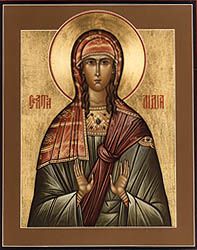
Building a community where people could actually live the Gospel.
Read the essentials →Building a community where people could actually live the Gospel.
August 3
Not verified yet
Abbot
“My son,” said Isaac, “the Lord has shown me that he has destined thee to be with me through the rest of my life.” Then Dalmatius went home, arid bade farewell to his wife and daughter, and taking his son Faustus with him, they were shorn together in the house of Isaac. He speedily became a model of a monk, fasting long, and falling into ecstasies. On the death of Isaac, he was elected hegumen in his room.
Build up the community you belong to. This life was lived with and for a community.
Learn from the kind of life it was. Building a community where people could actually live the Gospel.
“My son,” said Isaac, “the Lord has shown me that he has destined thee to be with me through the rest of my life.” Then Dalmatius went home, arid bade farewell to his wife and daughter, and taking his son Faustus with him, they were shorn together in the house of Isaac. He speedily became a model of a monk, fasting long, and falling into ecstasies. On the death of Isaac, he was elected hegumen in his room.
In 427, on the death of the patriarch [the title of the bishops of the great ancient sees: Rome, Constantinople, Alexandria, Antioch, Jerusalem] Sisinnius, the Syrian Nestorius [Nestorius (d. c. 451), whose teaching split Christ into two persons; condemned at Ephesus in 431] was elevated to the bishopric of Constantinople. He was a man oi great ability; fluent, eloquent, with a clear, pealing voice, like a silver bell. He had been a priest at Antioch, where his sermons attracted great numbers. Constantinople thought that in Nestorius she had acquired a second Chrysostom. But he was a man of another sort from the great John. Immediately on his appointment, he manifested a hot intemperate zeal against heretics. In one of his first sermons he exclaimed, turning to the Emperor Theodosius [name of Roman emperors; Theodosius I (379–395) made Christianity the state religion], “Give me, O Emperor! the land purged of heretics, and I will give thee heaven in return. Assist me in destroying heretics, and I will assist thee to combat the Persians.”1 Not long after — he had not been bishop a week — he endeavoured to deprive the Arians [followers of Arius, who taught that the Son is a created being, not fully God] of an oratory in Constantinople which they possessed, and in which they worshipped privately. In the tumult that ensued, the oratory was set on fire, and the flames communicating with the neighbouring houses, reduced several to ashes. He next assailed the Novatians, the Quartodecimans, and the Macedonians, and persuaded the Emperor to pass severe laws against these heretics.
This intolerance displeased Dalmatius and other sound minded men, and they felt instinctively that the heart of the persecutor was not right with God. It was not long before Nestorius himself began to fall under suspicion of heresy. He denied to the Blessed Virgin the title of Mother of God. She was the mother of the manhood, but in no way could she be regarded as mother of the Godhead. He went further; he asserted that “ God the Word was not 1 Socrat. Hist. Eccl., vii. 29, ■S'. Dalmatius.
bom of Mary, but that he took up his dwelling in the man bom of Mary.’' The orthodox took the alarm. The patriarch appealed to the Emperor to suppress them. A council was summoned at Ephesus. The Nestorians surrounded the place, stopping all communications with Constantinople. At length a beggar conveyed a letter from the bishops assembled at Ephesus to the monks of Constantinople, narrating their distress. The letter caused a rising of all the monks. With Dalmatius at their head, who for forty-eight years had not set foot outside his monastery, they poured in a long train to the palace. The Emperor admitted the archimandrites; and they read to him the letter they had received from Ephesus. “ Well,” said the Emperor, “ if matters are thus, why do not some of the bishops in the council come here to complain ?”
“Sire!” replied Dalmatius, “they are prevented from leaving.” “No one prevents them*” “Yes, sire, they are prevented. Those who think with Nestorius have full liberty given them to come or go, but no one is suffered to approach your Piety on behalf of the holy Synod, or inform you of what is being done.” And he added, “Will you hear six hundred bishops, or listen to one impious man ?”
The Emperor granted that messengers from the council should come to Constantinople. Then the archimandrites left, and conducting their train of monks, and the crowds that followed, into the church of S. Mocius, Dalmatius ascended the pulpit and related what had passed. When he ceased, all, with a great shout, exclaimed, “ Anathema to N estorius !”
The bishops at Ephesus sent a letter to Dalmatius thanking him for his interference on their behalf. The history of the council has been given fully elsewhere, and need not be repeated here. Immediately after this one conspicuous act of intervention in behalf of the orthodox bishops, Dalmatius returned to his monastery, and did not leave it again till his death.
Feast: August 3
One short email a day for nine days. The day's prayer, a line from St. Dalmatius's story, and a nudge to keep going.
From Sabine Baring-Gould, The Lives of the Saints, new edition in 16 vols. (London: John C. Nimmo, 1897–98); text from the Internet Archive scan (OCR, lightly cleaned; errors possible). Public domain.
From Sabine Baring-Gould, The Lives of the Saints, new edition in 16 vols. (London: John C. Nimmo, 1897–98); text from the Internet Archive scan (OCR, lightly cleaned; errors possible). Public domain in the United States. Reproduced unedited, except for short bracketed notes in grey that we added to explain names and terms (“S.” is the old abbreviation for Saint). Some history and judgments reflect 19th-century scholarship.