D

A shepherd who carried a whole region through hard times.

Read the essentials →
January 14 · Archbishop, Confessor

St. Datius of Milan

St. Datius of Milan

A shepherd who carried a whole region through hard times.

Traditional feast

January 14
1914 / pre-1969 calendar, per Baring-Gould (1914)

Current feast

Not verified yet

Represents

Archbishop
Confessor

Their story

Adapted in modern English from Baring-Gould (1914) · original text below

Datius was archbishop of Milan when the Goths overran Italy. He travelled to Rome to beg Belisarius in person to defend Milan, and Belisarius, though short of supplies from the emperor Justinian, sent troops. Then a large army of Goths and Burgundians besieged the city. Belisarius sent more men under Martin and Uliaris, but they were too timid to attack.

Datius records in his Annals that famine grew so severe a mother ate her infant. The city surrendered, but the terms were broken; it was plundered and its people massacred. What happened to Datius is uncertain; some say he was taken to Ravenna and freed through his friend Cassiodorus. Later Totila, an Arian (followers of Arius's teaching that the Son is a created being, not fully God) king (Arians denied that Christ was fully God), drove him from his see, and he fled to Constantinople.

St. Gregory the Great tells the story he is best known for. At Corinth, looking for a large house for his party, Datius found an empty mansion said to be haunted, where no one could spend the night. Saying a servant of God need not fear ghosts or devils, he had beds made there. At midnight came a din of braying, grunting, squeaking and hissing. Datius sat up and mocked Satan, who had wished to be like God (Isaiah 14:13–14) and was now reduced to braying like a jackass and grunting like a hog. Silence fell, and he was not troubled again.

Early life

The book says little or nothing about early life. This is how the account begins.

S. Datius ruled the see of Milan in a stormy time, when Italy was over-run with the Goths. When Milan was threatened, S. Datius implored Belisarius to come to its protection, or send troops to defend the city. Belisarius was then at Rome, and S. Datius made the journey to Rome, on purpose to urge upon him, in person, the protection of the city.

What they represent

How they teach us to live

Drawn from themes in the original account

Learn from the kind of life it was. A shepherd who carried a whole region through hard times.

Keep their day. Remember them on January 14 with a short prayer, and ask for their help.

Read more

The full original · 471 words

Read Baring-Gould’s full account

Baring-Gould’s sources: Roman and other Latin Martyrologies. Datius, Dacius, or Dasius, is spoken of by Procopius Cassidorus, whose letter to S. Datius is extant, and by S. Gregory the Great, who relates the incident of his reduction of the evil spirits to silence, narrated in the text, in his Dialogues, lib. iii., c. 4.

S. Datius ruled the see of Milan [a bishop’s “see” is his diocese, named from his seat (Latin sedes)] in a stormy time, when Italy was over-run with the Goths [Germanic peoples who invaded the Roman Empire, many of them Arian Christians]. When Milan was threatened, S. Datius implored Belisarius to come to its protection, or send troops to defend the city. Belisarius was then at Rome, and S. Datius made the journey to Rome, on purpose to urge upon him, in person, the protection of the city. Belisarius, though hard pressed through the deficiency of supplies afforded him by the Emperor Justinian [Byzantine emperor 527–565], detached a body of men to the defence of the Milanese, and for a time Milan was thought to be safe. Soon, however, a large army of Goths and Burgundians swooped down upon it and besieged it. Belisarius, seeing the danger to which the city was exposed, sent troops under his generals, Martin and Uliaris, to the succour. But they, through timidity, did not venture to attack the Goths. In the city famine prevailed to such an extent, that as S. Datius relates in his Annals, an unfortunate mother roasted and ate her infant, that being the first morsel she had eaten since her confinement. The city was surrendered, but the terms of surrender were not kept. It was given up to plunder, and the streets ran with the blood of the butchered citizens. What became of the Archbishop is not known; some assert that he was taken captive to Ravenna, but was liberated at the intercession of his friend Cassiodorus.

The Arian [followers of Arius, who taught that the Son is a created being, not fully God] King, Totila, drove S. Datius from his see, and he escaped to Constantinople. On his way occurred that incident recorded by S. Gregory the Great, by which he is chiefly known. Arriving at Corinth, and looking about for a large house, which would lodge him and his companions, he saw a mansion, which seemed exactly suited to his purpose, and was apparently unoccupied. Having instituted inquiries, he was told that the house was haunted, and that it was impossible for any man to spend the night in it. "Ghost and devil will not scare a servant of God!" said S. Datius, and he ordered beds to be made in the haunted house. He said his prayers as usual, and then retired to rest. About midnight he was aroused by a hideous rout, like the braying of asses, the grunting of swine, the squeaking of rats, and the hissing of serpents. Then Datius, raising himself in bed, shouted, "Oh, Satan! thou who saidst in thine heart, I will ascend into heaven, I will exalt my throne above the stars of God: I will be like the most High! (Isa. xiv. 13, 14.) Well done, I say, Satan. Thou, who wouldst be like God, art reduced to bray like a jackass, and grunt like a hog." Instantly there was dead silence, and S. Datius was no more troubled with unearthly noises.
Feast days

Feast: January 14

Nine days · Free

Pray the novena
with us.

One short email a day for nine days. The day's prayer, a line from St. Datius of Milan's story, and a nudge to keep going.

Also on January 14
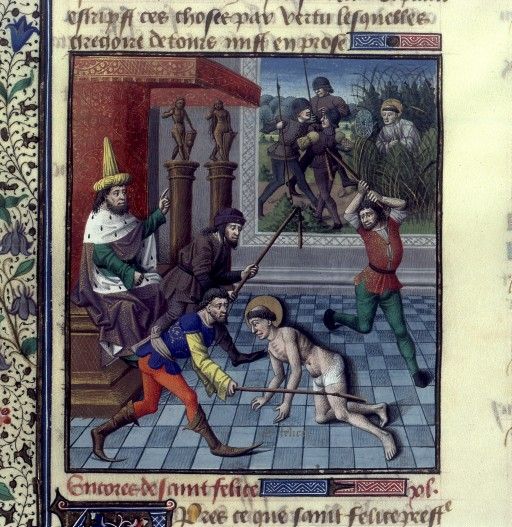
St. Felix at Nola

St. Felix at Nola

January 14 · Priest, Confessor
M

St. Macrina the Elder…

January 14 · Confessor
T

Sts. Theodulus

January 14 · Priest, Martyrs
← All 1726 saints in the library
Sources & notes

Feast-day sources

Story sources

Sources

Credits

From Sabine Baring-Gould, The Lives of the Saints, new and revised edition (Edinburgh: John Grant, 1914; first edition 1872). Public domain.

From Sabine Baring-Gould, The Lives of the Saints, new and revised edition (Edinburgh: John Grant, 1914; first edition 1872). Public domain in the United States. Reproduced unedited, except for short bracketed notes in grey that we added to explain names and terms (“S.” is the old abbreviation for Saint). Some history and judgments reflect 19th-century scholarship.