St. Deodatus

A shepherd who stayed with his people through hard times.

Read the essentials →
June 17 · Bishop

St. Deodatus

St. Deodatus

A shepherd who stayed with his people through hard times.

Traditional feast

June 17
1914 / pre-1969 calendar, per Baring-Gould (1897)

Current feast

June 19
Secondary source · Wikipedia

Represents

Bishop

Their story

Adapted in modern English from Alban Butler's Lives of the Saints · Baring-Gould original below · little is known

Die, or Deodatus, was nobly born in the west of France. In 655 he became Bishop of Nevers, but he later resigned the see and retired to live as a hermit.

Hun, lord of the Val de Galilee near Mount Vosge, gave him that land, and King Childeric II of Austrasia confirmed the gift. There he founded the monastery of Jointures under the rule of St Columban, while he himself lived in a small cell nearby. He died in the arms of St Hidulphus on 19 June, in 679 or 680, and the town of St Diei grew up around his monastery.

Early life

The book says little or nothing about early life. This is how the account begins.

Thin entry · the 1897 book gives only 207 words. We have not filled the gap with invented detail.

In 669, as many disciples surrounded him, he built there the abbey of Jointures, so called because it was at the point of junction of the Rothbach and the Meurthe. S. Hildulf, bishop of Trfeves, had left his see and retired to Moyen-Moutier, and a warm friendship sprang up between the two men. When S. Deodatus visited S. Hildulph, the latter came out to meet him with all his monks, took his hand and led him into the church, where they prayed together, and having entered the monastery, spent the night in heavenly converse and in singing the praises of God.

What they represent

How they teach us to live

Drawn from themes in the original account

Make time for silence. Solitude and withdrawal to pray shape this life.

Pray a little every day. Prayer runs all through this account.

Build up the community you belong to. This life was lived with and for a community.

Learn from the kind of life it was. A shepherd who stayed with his people through hard times.

Read more

The full original · 207 words

Read Baring-Gould’s full account

Baring-Gould’s sources: GalUcan Martyrology. Authority A life written by a monk of S. Die in the qth or 9th cent., which was afterwards amplified by the abbot of Mayenne, in the nth cent. This life was approved by Leo IX., in 1049, and he allowed it to be read in church for lections on the festival of S. Deodatus. Deodatus in French is Didier% DU or DicudonniS\ S. Deodatus was a member of an illustrious family of Western France. After the death cf Eucherius, he was elected bishop of Nevers, about the year 655, and in the year 657 was present at the Council of Sens, where he met S. Ouen, bishop of Rouen, S. Faro of Meaux, S. Eligius of Noyon, S. Amandus of Maestricht, S. Palladius of Auxfcrre, and S. Leuco of Troyes. S. Deodatus occupied the see of Nevers only three years, and then, drawn to solitude, he resigned the see, and retired into the forest of Hagenau among the Vosges, with S. Arbogast, and lived an eremitical life with him, till S. Arbogast was elected bishop of Strasburg. Then Deodatus moved to the island of Ebersheim, where, in 661, he associated with some solitaries who had settled there to be at peace. He was chosen their superior, and as his virtue attracted many others, he founded there, with the assistance of Childeric H., king of Austrasia, the abbey of SS. Peter and Paui. Then he went away from the crowd of monks, and found a lone place at Ongiville in the diocese of Basle, where he built an hermitage, but was unable to remain there on account of that country being a prey to marauders and petty warfare. He therefore retired to the Vosges mountains, and settled in the valley called after him Val S. Didier.

In 669, as many disciples surrounded him, he built there the abbey of Jointures, so called because it was at the point of junction of the Rothbach and the Meurthe. S. Hildulf, bishop of Trfeves, had left his see and retired to Moyen-Moutier, and a warm friendship sprang up between the two men. When S. Deodatus visited S. Hildulph, the latter came out to meet him with all his monks, took his hand and led him into the church, where they prayed together, and having entered the monastery, spent the night in heavenly converse and in singing the praises of God. It was the same when S. Hildulph came to Jointures. When S. Deodatus grew very old, he retired from his abbey to a little cell, near a chapel he had built and dedicated to S. Martin [St. Martin of Tours (d. 397), soldier turned bishop]. S. Hildulph came to see him in his last sickness, and administered to him the last sacraments, and closed his eyes.

A town formed in time round the abbey of Jointures, which took the name of the saint, and is called after him, S. Di£, to this day. It was erected into the seat of a bishop in 1771. The bishopric was suppressed in 1801, but was re-established in 1817.
Feast days

Feast: June 19
Traditional: June 17

Nine days · Free

Pray the novena
with us.

One short email a day for nine days. The day's prayer, a line from St. Deodatus's story, and a nudge to keep going.

Also on June 17
N

Sts. Nicander and Marcian

June 17 · Martyrs
M

Sts. Manuel

June 17 · Martyrs
P

St. Pior

June 17 · Hermit
← All 1726 saints in the library
Sources & notes

Feast-day sources

Story sources

Sources

Credits

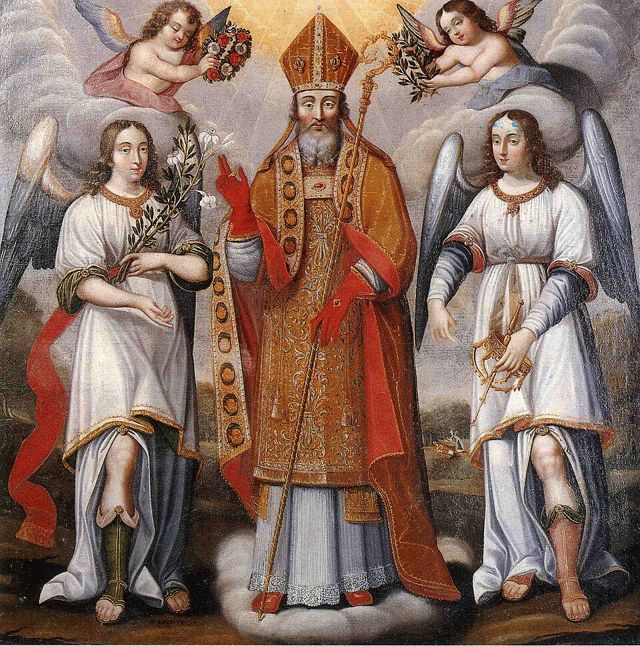
Image: GlorificationDéodat.jpg · (photographer) B. Prot · Public domain, via Wikimedia Commons

From Sabine Baring-Gould, The Lives of the Saints, new edition in 16 vols. (London: John C. Nimmo, 1897–98); text from the Internet Archive scan (OCR, lightly cleaned; errors possible). Public domain.

Image: (photographer) B. Prot, Wikimedia Commons (Public domain)

From Sabine Baring-Gould, The Lives of the Saints, new edition in 16 vols. (London: John C. Nimmo, 1897–98); text from the Internet Archive scan (OCR, lightly cleaned; errors possible). Public domain in the United States. Reproduced unedited, except for short bracketed notes in grey that we added to explain names and terms (“S.” is the old abbreviation for Saint). Some history and judgments reflect 19th-century scholarship.