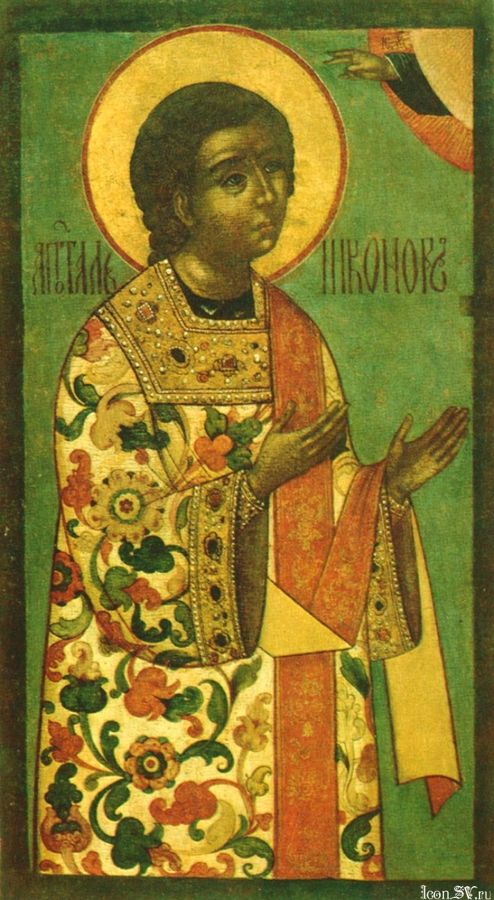
A shepherd who stayed with his people through hard times.
January 10
Not verified yet
Bishop
Confessor
Thin entry · the 1914 book gives only 247 words. We have not filled the gap with invented detail.
S. Domitian was the son of pious parents, Theodore and Eudoxia by name. On the murder of Hormisdas, the Persian King, his son Chosroës II., succeeded him (592), but the General Varam having revolted against him, and being deserted by many of his soldiers, Chosroës fled with his wife, and two newly-born children, to Circesium.
Welcome guests and strangers. Hospitality shows up in this account.
Stay faithful when it costs you. This account is about holding firm under pressure.
Look after people who are sick or suffering. The sick come up again and again in this story.
Learn from the kind of life it was. A shepherd who stayed with his people through hard times.
S. Domitian [Roman emperor 81–96] was the son of pious parents, Theodore and Eudoxia by name. He was an intimate friend, if not, as Evagrius says, "a kinsman of the Emperor Maurice." He was married for a few years, but his wife dying, he devoted himself to the services of the Church, and was consecrated Bishop of Melitene, in Armenia, at the age of thirty.
On the murder of Hormisdas, the Persian King, his son Chosroës II., succeeded him (592), but the General Varam having revolted against him, and being deserted by many of his soldiers, Chosroës fled with his wife, and two newly-born children, to Circesium. Thence he sent an embassy to the Emperor Maurice, desiring peace; for at that time war was being waged between the Persians and the Roman emperors. At the persuasion of S. Domitian, Maurice admitted his suit, and treated Chosroës as his guest, instead of as an exile, welcomed him with royal gifts, and placed the whole of his body-guards, and the entire Roman army, at his disposal. Moreover, by way of still greater distinction, he sent Domitian, Bishop of Melitene, to attend him. The Roman army defeated Varam, and Chosroës was reinstated on the throne of Persia.
Domitian was liberally recompensed for his share in this transaction, but he kept nothing for himself. Every gift made him, he offered to the Church, or to the poor; restoring churches, and supporting hospitals. He died at Constantinople, whither he had been summoned by the Emperor.
Feast: January 10
One short email a day for nine days. The day's prayer, a line from St. Domitian's story, and a nudge to keep going.
From Sabine Baring-Gould, The Lives of the Saints, new and revised edition (Edinburgh: John Grant, 1914; first edition 1872). Public domain.
From Sabine Baring-Gould, The Lives of the Saints, new and revised edition (Edinburgh: John Grant, 1914; first edition 1872). Public domain in the United States. Reproduced unedited, except for short bracketed notes in grey that we added to explain names and terms (“S.” is the old abbreviation for Saint). Some history and judgments reflect 19th-century scholarship.