St. Ebrulfus

Building a community where people could actually live the Gospel.

Read the essentials →
December 29 · Abbot

St. Ebrulfus

St. Ebrulfus

Building a community where people could actually live the Gospel.

Traditional feast

December 29
1914 / pre-1969 calendar, per Baring-Gould (1897)

Current feast

December 29 (also listed: August 30)
Secondary source · Wikipedia

Represents

Abbot

Early life

The book says little or nothing about early life. This is how the account begins.

Thin entry · the 1897 book gives only 25 words. We have not filled the gap with invented detail.

…clear the hearth before the oven, and lay your loaves in order, and you will find them bake without fire/ ” And it was so.

What they represent

How they teach us to live

Drawn from themes in the original account

Learn from the kind of life it was. Building a community where people could actually live the Gospel.

Keep their day. Remember them on December 29 with a short prayer, and ask for their help.

Read more

The full original · 25 words

Read Baring-Gould’s full account

Baring-Gould’s sources: Roman, Gallican, and Benedictine Martyrologies. Authority: — A Life by an anonymous writer in Mabillon, Acta SS. O.S.B. ssec. i.; Ordericus Vitalis, Hist. EccL Norm. lib. vi. c. 9.] S. Ebrulfus, or, as he is called in France, S. Evroul, was born of honourable parents at Bayeux. He went to the court of Clothair, and married a wife of rank equal to his own. But he soon wearied of life in the world, and persuaded his wife to let him go into a monastery, and live as a monk, and to enter herself into a convent He probably learned the rudiments of the religious life in the abbey of the Deux Jumeaux, founded by S. Martin of Vertou (see October 24). After a while he left the monastery with three companions and went to Montfort — now S. Evroult de Montfort, north of Gacd They were too much interrupted there to obtain the peace they desired, and therefore buried themselves in the forest of Ouche and there established themselves. By degrees others placed themselves under the rule of the saint, and the solitude became populated by monks. Ebrulfus was visited there by King Childebert, who richly endowed the monastery. His queen also built a church there, dedicated to our Lady, now called Notre-Dame-duBois, and placed a marble altar in it, probably an old sarcophagus. One day the devil was caught by S. Ebrulf at Echaufour, “ who threw him into a fiery oven heated in readiness for baking bread, and closed it with an iron plug that he chanced to find. The women who had brought their loaves to be baked, seeing what was done, said, * What, sir, shall we do with our loaves?1 To which he replied, ‘ God is able to bake your loaves without corporeal fire; » tcjOOQle S. Thomas d Becket.

…clear the hearth before the oven, and lay your loaves in order, and you will find them bake without fire/ ” And it was so.

Feast days

Feast: December 29

Nine days · Free

Pray the novena
with us.

One short email a day for nine days. The day's prayer, a line from St. Ebrulfus's story, and a nudge to keep going.

Also on December 29
St. Trophimus

St. Trophimus

December 29 · Bishop
St. Crescens

St. Crescens

December 29 · Bishop
St. Thomas A Becket

St. Thomas A Becket

December 29 · Archbishop, Martyr
← All 1726 saints in the library
Sources & notes

Feast-day sources

Sources

Credits

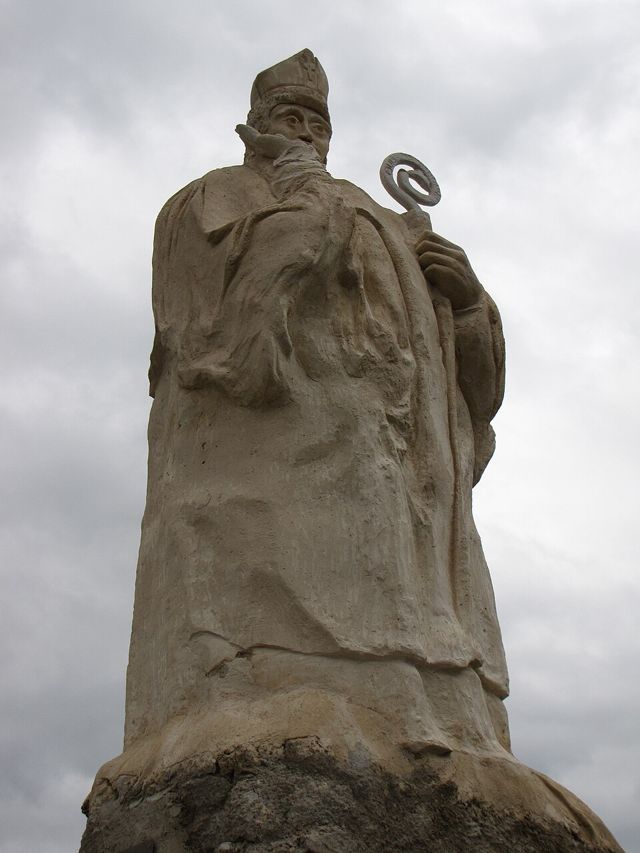
Image: Statue de Saint Évroult abbatiale de Thiron-Gardais Eure-et-Loir France.jpg · Le Passant · CC BY-SA 4.0, via Wikimedia Commons

From Sabine Baring-Gould, The Lives of the Saints, new edition in 16 vols. (London: John C. Nimmo, 1897–98); text from the Internet Archive scan (OCR, lightly cleaned; errors possible). Public domain.

Image: Le Passant, Wikimedia Commons (CC BY-SA 4.0)

From Sabine Baring-Gould, The Lives of the Saints, new edition in 16 vols. (London: John C. Nimmo, 1897–98); text from the Internet Archive scan (OCR, lightly cleaned; errors possible). Public domain in the United States. Reproduced unedited, except for short bracketed notes in grey that we added to explain names and terms (“S.” is the old abbreviation for Saint). Some history and judgments reflect 19th-century scholarship.