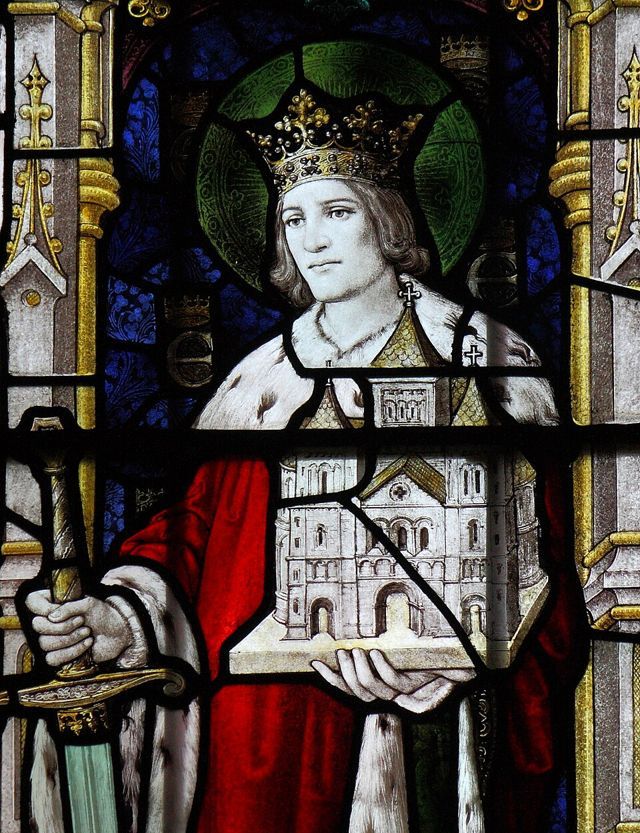
St. Edwin

Faithfulness to Christ when it cost everything.

Read the essentials →
October 12 · King, Martyr

St. Edwin

St. Edwin

Faithfulness to Christ when it cost everything.

Traditional feast

October 12
1914 / pre-1969 calendar, per Baring-Gould (1897)

Current feast

October 12
Secondary source · Wikipedia

Represents

King
Martyr

Their story

Adapted in modern English from the Catholic Encyclopedia (1913) · original text below

Edwin was born around 585, the son of Aella, King of Deira. When Aella died in 588, Ethelfrid of Bernicia seized all Northumbria, and until he was thirty Edwin wandered from one friendly prince to another, always in danger of Ethelfrid's plots against his life. While he was staying with King Redwald of East Anglia, Ethelfrid repeatedly tried to bribe Redwald to kill him. Redwald refused, and in 616 a battle was fought on the River Idle in which Ethelfrid was killed. Edwin was invited to take the throne of Northumbria.

After his first wife died, Edwin asked in 625 for the hand of Ethelburga, sister of the Christian King of Kent, promising to consider becoming Christian. St Paulinus came north with her, and in 627 he baptized Edwin at York. The king worked zealously to convert his people. Bede (the English monk-historian, d. 735) tells how he and the queen hosted Paulinus at Yeavering for five weeks while Paulinus taught and baptized from morning to night. Edwin also persuaded Eorpwald, King of East Anglia, to become a Christian. His law was so respected that, Bede says, it became a proverb that a woman with a baby at her breast could cross the island without fear.

On 12 October 633 Edwin was killed fighting off an invasion by Penda, the pagan King of Mercia, and the Welsh prince Cadwallon. Because he died fighting enemies of the faith he was regarded as a martyr. His head was taken to St Peter's at York, the church he had begun, and his body to Whitby.

Early life

The book says little or nothing about early life. This is how the account begins.

Thin entry · the 1897 book gives only 0 words. We have not filled the gap with invented detail.

What they represent

How they teach us to live

Drawn from themes in the original account

Learn from the kind of life it was. Faithfulness to Christ when it cost everything.

Keep their day. Remember them on October 12 with a short prayer, and ask for their help.

From the Catholic Encyclopedia

1913 · 468 words

Edwin (Aeduini), Saint.—the first Christian King of Northumbria [the Anglo-Saxon kingdom of northern England and south-east Scotland], (b. about 585, son of Aella, King of Deira, the southern division of Northumbria; d. October 12, 633. Upon Aella's death in 588, the sovereignty over both divisions of Northumbria was usurped by Ethebric of Bernicia, and retained at his death by his son Ethelfrid; Edwin, Aella's infant son, being compelled until his thirtieth year to wander from one friendly prince to another, in continual danger from Ethelfrd's attempts upon his life. Thus when he was residing with King Redwald of East Anglia, Ethelfrid repeatedly endeavored to bribe the latter to destroy him. Finally, however, Redwald's refusal to betray his guest led in 616 to a battle, fought upon the river Idle, in which Ethelfrid himself was slain, and Edwin was invited to the throne of Northumbria. On the death of his first wife, Edwin, in 625, asked for the hand of Ethelburga, sister to Eadbald, the Christian King of Kent, expressing his own readiness to embrace Christianity, if upon examination he should find it superior to his own religion. Ethelburga was accompanied to Northumbria by St. Paulinus, one of St. Augustine's fellow missionaries, who thus became its first apostle. By him Edwin was baptized at York in 627, and thenceforth showed himself most zealous for the conversion of his people. In instance of this, Venerable Bede [English monk and historian (d. 735)] tells how, at their royal villa of Yeverin in Northumberland, the king and queen entertained Paulinus for five weeks, whilst he was occupied from morning to night in instructing and baptizing the crowds that flocked to him. By Edwin's persuasion, moreover, Eorpwald, King of East Anglia, son of his old friend Redwald, was led to become a Christian. In token of his authority over the other kings as Bretwalda, Edwin used to have the tufa (a tuft of feathers on a spear, a military ensign of Roman origin) borne publicly before him, and he received tribute from the Welsh princes. Under him the law was so respected, that it became, as the Venerable Bede attests, a proverb that "a woman might travel through the island with a babe at her breast without fear of insult". St. Edwin was slain on October 12, 633, in repelling an attack made on him by Penda, the pagan King of Mercia [the Anglo-Saxon kingdom of the English Midlands], who, together with the Welsh prince Cadwallon (a Christian only in name), had invaded his dominion. Perishing thus in conflict with the enemies of the Faith, he was regarded as a martyr and as such was allowed by Gregory XIII to be depicted in the English College church at Rome. His head was taken to St. Peter's church at York, which he had begun. His body was conveyed to Whitby. Churches are said to have been dedicated to him at London and at Breve in Somerset.

Read more

The full original · 0 words

Read Baring-Gould’s full account

Baring-Gould’s sources: By error in Wilson’s Anglican Marty rology on Oct. 4 (iv. Octobris, instead of iv. Id. Octobris). Not in other martyrologies. But several churches in England dedicated to him.] The life of Edwin, King of Northumbria, is so intimately mixed up with that of S. Paulinus of York, that the reader is referred for it to the life of this latter saint, on Oct 10th.

Feast days

Feast: October 12

Nine days · Free

Pray the novena
with us.

One short email a day for nine days. The day's prayer, a line from St. Edwin's story, and a nudge to keep going.

Also on October 12
D

St. Domnina

October 12 · Martyr
P

St. Pantalus

October 12 · Bishop, Martyr
C

Sts. Cyprian and Felix

October 12 · Martyrs
← All 1727 saints in the library
Sources & notes

Feast-day sources

Story sources

Sources

Credits

Image: Saint King Edwin of Northumbria.jpg · DaveWebster14 · CC BY 2.0, via Wikimedia Commons

From Sabine Baring-Gould, The Lives of the Saints, new edition in 16 vols. (London: John C. Nimmo, 1897–98); text from the Internet Archive scan (OCR, lightly cleaned; errors possible). Public domain.

Image: DaveWebster14, Wikimedia Commons (CC BY 2.0)

From “Catholic Encyclopedia (1913)/St. Edwin,” The Catholic Encyclopedia (New York: Robert Appleton Company, 1907–1914), via Wikisource. Public domain. Matched by name and feast date; text unedited except for our bracketed notes in grey.

From Sabine Baring-Gould, The Lives of the Saints, new edition in 16 vols. (London: John C. Nimmo, 1897–98); text from the Internet Archive scan (OCR, lightly cleaned; errors possible). Public domain in the United States. Reproduced unedited, except for short bracketed notes in grey that we added to explain names and terms (“S.” is the old abbreviation for Saint). Some history and judgments reflect 19th-century scholarship.