Baring-Gould’s sources: The life of S. Egwin was written by his contemporary, S. Brithwald, Archbishop of Canterbury. This original has not descended to us, but a fragment of a somewhat later recension of this life exists; and a still later life, probably an amplification of that by Brithwald. Moreover, S. Egwin is mentioned by Matthew of Westminster, Florence of Worcester; William of Malmesbury also speaks of him in his Acts of the English Bishops.
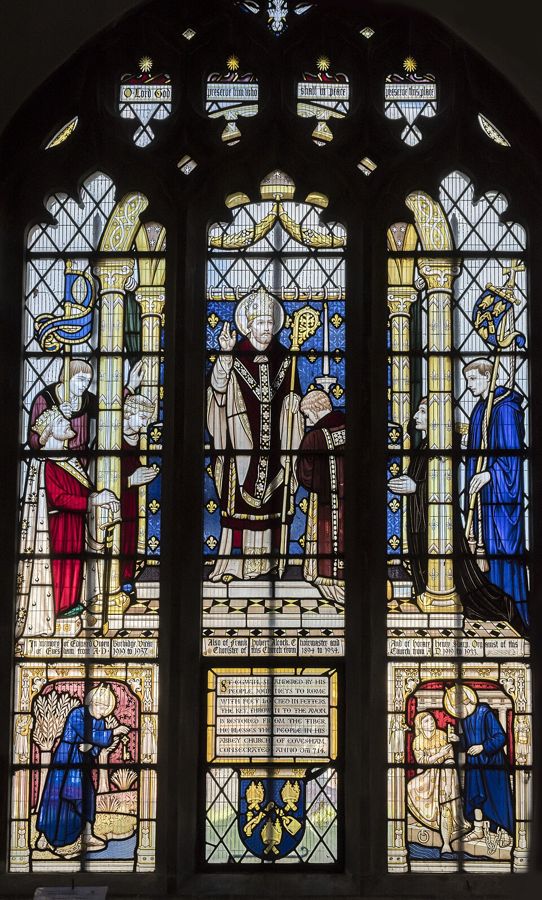
S. Egwin was of the royal blood of the Mercian kings, and was born at Worcester, in the reign of Ethelred and Kenred. He was elected Bishop in 692. By his zeal in rebuking the illicit connexions formed by some of the great men in his diocese, and vehemence in reforming the corrupt morals of all, he stirred up a party against him, and with the connivance of the King, he was expelled his diocese. Egwin, meekly bending to his fate, determined to make a pilgrimage to Rome. According to a popular mediæval legend, he also resolved to expiate at the same time certain sins of his youth, by putting iron fetters on his feet, which were fastened with a lock, and he cast the key into the Avon. As he neared Italy, on a ship from Marseilles, a huge fish floundered upon deck, and was killed and cut open; when, to the surprise of the Saint, in its belly was found the key to his fetters. He accepted this as an expression of the will of heaven, and released his limbs. According to another version of the story, the fish was caught in the Tiber, after S. Egwin had appeared before the Pope in Rome; but William of Malmesbury doubts the whole story as an idle legend.
After his return, with the assistance of Kenred, King of Mercia [the Anglo-Saxon kingdom of the English Midlands], S. Egwin founded the famous abbey of Evesham, under the invocation of the Blessed Virgin. After this he undertook a second journey to Rome, in company with Kenred, and Offa, King of the East Saxons. S. Egwin died on the 30th December, 717, and was buried in the monastery of Evesham. The translation [the solemn moving of a saint’s relics to a new shrine] of his relics [the bodily remains of a saint, or objects they used, kept with honor] probably took place on Jan. 11th, on which day many English Martyrologies mark his festival.
FOOTNOTES:
[38] Theodoret, lib. i. c. 11.
S. Arcadius , M., in Africa, circ. a.d. 260. SS. Satyrus , Cyriacus , Mosentius , MM. SS. Tigris , P., and Eutropius , MM. , a.d. 404. S. John , B. C. of Ravenna, circ. a.d. 495. S. Cæsaria , V., at Arles, circ. a.d. 530. S. Victorinus , Ab., in Spain , a.d. 560. S. Benedict [father of Western monks (d. c. 547), author of the Rule] Biscop , in England , a.d. 703. SS. XXXVIII, Monks , MM., in Ionia, circ. a.d. 750. S. Aelred , Ab. of Rievaulx, in Yorkshire , a.d. 1166.