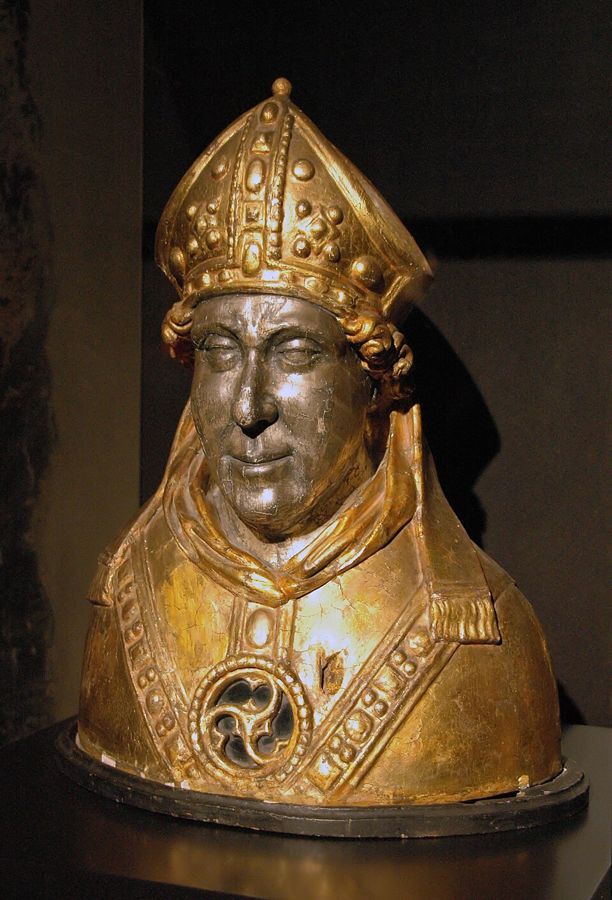
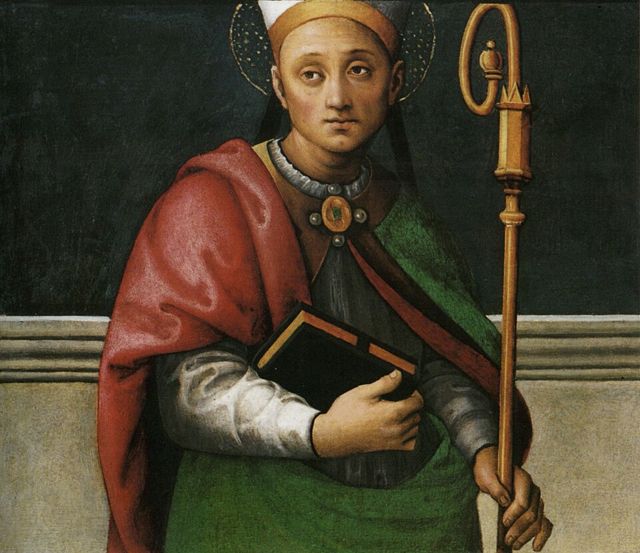
Baring-Gould’s sources: Roman and German Marty rologies. Authority: — A Life by Caesaritis of Heisterbach (d. 1240), “ One of the latest Ecclesiastical Biographies which still possess historical value. Full of warm sympathy. A work of old Catholic art.” — Potthast. Ed. by Surius, Vit. Sanct. Nov. 7; Bohmer Fontes, II. pp. 296-329, without the third book, containing miracles.] The traveller who has visited Cologne will remember in the chapel where repose the bones of the Three Kings, a tomb of the thirteenth century on which reposes a sculptured figure of an archbishop in full pontificals, a work of rare artistic merit The face is of almost angelic beauty; the spirituality, nobility, and refinement of the real man breathe through the lineaments traced in stone. This is the tomb of S. Engelbert or Engelbrecht I., archbishop of Cologne. Among all the ecclesiastical princes of his age, Engelbert of Cologne, Count of Berg, stood pre-eminent for his wisdom, virtue, and influence. Every quality that could make 1 Reinsberg-DOringsfeld: '* Traditions et Legend es de la Belgique,** Brux. 1870 tNor. 7.
La prince beloved and respected seemed combined in him in a lofty degree; and Fortune appeared also to have selected him for showering her benefits on his head; for political circumstances combined with his natural abilities to bring him into prominence, and indeed pre-eminence. When, in 1216,1 Engelbert was elevated to the archiepiscopal throne of Cologne, the archdiocese had been increased by the annexation of the duchy of Westphalia, through the fall of Henry the Lion. There was much organization needed in the newly-acquired territory, and reformation was required in many parts of the old ecclesiastical principality. Engelbert ordered and improved, with such prudence that he became famous for his wisdom and moderation. His virtue was unimpeachable; his manner fascinating, through his sweetness of disposition and earnestness of purpose. Added to this he was tall, possessed a stately carriage, a noble and beautiful countenance. His people loved him to adoration, honouring him not only as their prince but already as a saint. Ladies fell under the charm of his influence, and offered largely to all good works he founded. The Countess Mathilda von Wied even made the archbishop her heir to the county of Wied. Engelbert rendered himself as useful to the empire as he was to his principality. He and his warm friend Dietrich, archbishop of Trfeves, with whom he was “ but one soul,” were firm supporters of Frederick II., and their voice was always for peace. Otto of Brunswick met with resolute opposition from the archbishop of Cologne, and it was to a great extent due to the determination of Engelbert, and of the archbishops of Treves [Trier in Germany] and Hamburg, that the claims of Frederick II. prevailed over those of his rival. In the Diet of Frankfort, in April, 1220, before Frederick 1 Archbishop Dietrich, also Count of Berg, had been deposed in 121a. The see remained vacant till xax6.
S. Engelbert. prepared for his crusade, he had his son Henry elected by the German princes to be his successor, and Engelbert was appointed regent of Germany during the absence of the emperor and the infancy of his son. Engelbert proved himself worthy of the trust imposed upon him. He held the reins of government with a firm hand. The German empire was then in a pitiable condition. Feuds between the nobles had become general; during the long contest for the crown, the lawless and law-breakers had been able to secure protection for themselves by adhering to one party or the other, so that the whole country was a prey to rapine and violence. Engelbert maintained peace with determination. The robber knights were at once proceeded against, taken, executed, and their castles destroyed. In order to curb the disorder in north-west Germany, he organized the Holy Vehme, which, conducting its judgments in secret, afterwards became such a fearful and dangerous power, but which then, under the circumstances, was necessary, and accomplished its purpose. Engelbert occupied the seat of presiding judge at this dreaded tribunal. The resolute and energetic conduct of the archbishop in suppressing disorders, soon produced a marked change. Acts of violence became less frequent, property became secure, and the German empire began to manifest signs of growing prosperity. No doubt the deeply rooted evil was not eradicated, but unquestionably an unwonted tranquillity and wellbeing would have ensued, had not the rule of Engelbert been cut short by a tragical catastrophe.
The firmness which he had exhibited in restraining all who had lived by pillage, had gained him their implacable hatred. Amongst these was Count Frederick of Isenburg, a kinsman of the archbishop. Frederick was protector ( Schirmvogt ) of the convent of Essen, and took occasion to plunder the territory of the nuns and maltreat their farmers. The abbess appealed to Engelbert, who at once ordered the count to respect the property of the nunnery. Frederick of Isenburg, thinking, perhaps, that his relationship would secure him from punishment, disregarded the orders of the archbishop, and continued his depredations. Archbishop Engelbert, to avoid the appearance of partisanship one way or the other, placed the matter before a diet of Westphalian bishops at Soest, and the Count of Isenburg was summoned to appear in person. He did so, and was required to make good to the nunnery all that he had plundered it of; and the archbishop threatened him with the ban of the empire if he disobeyed. Frederick was exasperated to the last degree. Hemet other Westphalian counts at Soest, who had also been hindered in their course of robbery by the archbishop, and a threatening conspiracy was formed against him. Engelbert was warned of this, but as he did not for an instant suppose that they would dare to proceed to assassination, and not seeing how they could shake his authority as regent, he gave no heed to their machinations. Frederick disguised the rage which consumed his heart, and promised to appear before the diet of Niimberg, and compose his differences with the convent of Essen. Then he joined the retinue of the archbishop, and accompanied him as far as Westhofen, where he excused himself, and withdrew, on the plea, of having to visit his castle of Nienbriige. Archbishop Engelbert had received the Blessed Sacrament from the Bishop of Munster before he left Soest, but was then without suspicion. The departure of the Count of Isenburg caused him alarm, and he ordered his armed retainers to remain behind at the bridge over the Rhur to prevent the passage of the count with an armed force. Frederick, however, crossed the river at another point during the night, with some other conspirators and fifty-two men-atarms, hastened in advance of the archbishop, and remained concealed on the Gevelsbexg, four miles from Schwelm. S. Engelbert.
The archbishop came on with a few clergy, two noble pages, and two armed retainers, and fell into the ambush. Frederick of Isenburg and his men suddenly burst out of the thicket upon him and surrounded his party. Engelbert could offer no resistance. The clerks fled, the pages and the retainers were speedily flung from their horses and cudgelled, and the archbishop was left alone in the hands of his murderers. His horse was wounded at the outset, but he spurred it forward, and might have escaped, had not Herbert of Riickenrode, a bitter enemy, caught the bridle. He flung the archbishop down; but Engelbert sprang to his feet, and attempted to run for his life. Then Frederick of Isenburg bade his menat-arms cut him down. The archbishop defended himself with desperate courage. He was already wounded in the head, and one hand was cut off; but still he maintained his defence. Then a servant of Frederick's cut open his head, and Riickenrode ran his sword through his body. The other murderers fell on him and drove their weapons into him, or hacked at him with their axes. He bled to death from forty-seven wounds. Riickenrode, not content, would have smitten off his head, but Frederick cried out, “ Let be, we have done too much already 1 ” He then violently wrested the corpse from the murderer who would have mutilated it further, and fled.
The pages came to themselves. One raised the head of the dying man and laid it on his own breast, till he breathed his last. Then they placed the body on a cart that they obtained from a peasant who was passing by, and brought it to Schwelm.
The people assembled in crowds, with loud lamentations. body was brought to Cologne; and on the 15th November the chapter elected Henry of Mohlenmark as their new archbishop. He boiled down his predecessor, till the bones were left clean, and then having wired the joints together, he clothed them in the bloody garments in which Engelbert had fallen, and went to the diet of Niimberg in solemn pomp, taking the skeleton with him. He exposed it before the assembled electors, and appealed for vengeance on the murderers.
The ban of the empire was proclaimed on Frederick of Isenburg and the other conspirators. The new archbishop had already attacked the castles of Isenburg and levelled them with the ground. Frederick was given up for a bribe of two thousand marks, brought to Cologne, broken on the wheel and quartered. King Henry shed many tears over one whom he looked upon as his father. The loss of the good archbishop was a terrible blow to the Emperor Frederick; his son from that time was abandoned to the guidance of wicked counsellors, who led on the unhappy boy to his ruin.
One of the most shocking matters connected with the murder was that Dietrich, bishop of Munster, and Engelbert, bishop of Osnabriick, the two brothers of Count Frederick of Isenburg, were in the plot. The archbishop of Cologne spoke to them at Soest of the conspiracy that he heard was formed against him, but they succeeded in allaying his suspicions; the bishop of Munster received his confession, and gave him the communion, and then sent him on to his death. It is remarkable that the bishop of Munster died within eight months; and the bishop of Osnabriick was deposed within five. The latter, however, recovered his episcopal throne again in 1239.