E

Serving the poor and the altar.

Read the essentials →
February 1 · Deacon, Confessor

St. Ephraem the Syrian

St. Ephraem the Syrian

Serving the poor and the altar.

Traditional feast

February 1
1914 / pre-1969 calendar, per Baring-Gould (1897)

Current feast

Not verified yet

Represents

Deacon
Confessor

Their story

Adapted in modern English from the Catholic Encyclopedia (1913) · original text below · little is known

Ephraem was born at Nisibis early in the fourth century, the son of a pagan priest. He was taught and baptized by St James, Bishop of Nisibis, and helped him renew the city's morals during its sieges.

When Nisibis was handed to Persia in 363, he left with its Christians and spent his last ten years at Edessa as a severe ascetic. He was probably a deacon, opposed the many heretical sects there, and wrote nearly all his sermons, hymns and commentaries there. He died in June 373 and was buried in the cemetery of the foreigners. The source warns that later biographical details are of doubtful value.

Early life

Selected sentences from the original account, unaltered.

Saint Ephraem was the son of poor parents of Nisibis, who had confessed Christ before the persecutors, under Diocletian or his successors. In his narrative of his conversion, S. Ephraem laments some of the faults of his youth. "When I was a boy," says he, "I was rather wild.

What they represent

How they teach us to live

Drawn from themes in the original account

Give to people in need. The account records care for the poor.

Feed your mind with Scripture and good books. Learning and the Scriptures matter in this life.

Practise small acts of self-denial. The account dwells on fasting and penance; a skipped snack or a phone-free hour is a start.

Learn from the kind of life it was. Serving the poor and the altar.

From the Catholic Encyclopedia

1913 · 2817 words

Ephraem (Ephrem, Ephraim), Saint, b. at Nisibis, then under Roman rule, early in the fourth century; d. June, 373. The name of his father is unknown, but he was a pagan and a priest of the goddess Abnil or Abizal. His mother was a native of Amid. Ephraem was instructed in the Christian mysteries by St. James, the famous Bishop of Nisibis, and was baptized at the age of eighteen (or twenty-eight). Thenceforth he became more intimate with the holy bishop, who availed himself of the services of Ephraem to renew the moral life of the citizens of Nisibis, especially during the sieges of 338, 346, and 350. One of his biographers relates that on a certain occasion he cursed from the city walls the Persian hosts, whereupon a cloud of flies and mosquitoes settled on the army of Sapor II and compelled it to withdraw. The adventurous campaign of Julian the Apostate [Roman emperor 361–363 who tried to restore paganism], which for a time menaced Persia, ended, as is well known, in disaster, and his successor, Jovianus, was only too happy to rescue from annihilation some remnant of the great army which his predecessor had led across the Euphrates. To accomplish even so much the emperor had to sign a disadvantageous treaty, by the terms of which Rome lost the Eastern provinces conquered at the end of the third century; among the cities retroceded to Persia was Nisibis (363). To escape the cruel persecution that was then raging in Persia, most of the Christian population abandoned Nisibis en masse. Ephraem went with his people, and settled first at Beit-Garbaya, then at Amid, finally at Edessa, the capital of Osrhoene, where he spent the remaining ten years of his life, a hermit remarkable for his severe asceticism. Nevertheless he took an interest in all matters that closely concerned the population of Edessa. Several ancient writers say that he was a deacon; as such he could well have been authorized to preach in public. At this time some ten heretical sects were active in Edessa; Ephraem contended vigorously with all of them, notably with the disciples of the illustrious philosopher Bardesanes. To this period belongs neary all his literary work; apart from some poems composed at Nisibis, the rest of his writings—sermons, hymns, exegetical treatises—date from his sojourn at Edessa. It is not improbable that he is one of the chief founders of the theological "School of the Persians", so called because its first students and original masters were Persian Christian refugees of 363. At his death St. Ephraem was borne without pomp to the cemetery "of the foreigners". The Armenian monks of the monastery of St. Sergius at Edessa claim to possess his body.

The aforesaid facts represent all that is historically certain concerning the career of Ephraem (see Bouvy, "Les sources historiques de la vie de S. Ephrem" in "Revue Augustinienne", 1903, 155-64). All details added later by Syrian biographers are at best of doubtful value. To this class belong not only the legendary and occasionally puerile traits so dear to Oriental writers, but also others seemingly reliable, e.g. an alleged journey to Egypt with a sojourn of eight years, during which he is said to have confuted publicly certain spokesmen of the Arian [followers of Arius, who taught that the Son is a created being, not fully God] heretics. The relations of St. Ephraem and St. Basil are narrated by very reliable authors, e.g. St. Gregory of Nyssa (the Pseudo?) and Sozomen, according to whom the hermit of Edessa, attracted by the great reputation of St. Basil, resolved to visit him at Caesarea. He was warmly received and was ordained deacon by St. Basil; four years later he refused both the priesthood and the episcopate that St. Basil offered him through delegates sent for that purpose to Edessa. Though Ephraem seems to have been quite ignorant of Greek, this meeting with St. Basil is not improbable; some good critics, however, hold the evidence insufficient, and therefore reject it, or at least withhold their adhesion. The life of St. Ephraem, therefore, offers not a few obscure problems; only the general outline of his career is known to us. It is certain, however, that while he lived he was very influential among the Syrian Christians of Edessa, and that his memory was revered by all, Orthodox, Monophysites, and Nestorians [Nestorius (d. c. 451), whose teaching split Christ into two persons; condemned at Ephesus in 431]. They call him the "sun of the Syrians," the "column of the Church", the "harp of the Holy Spirit". More extraordinary still is the homage paid by Greeks who rarely mention Syrian writers. Among the works of St Gregory of Nyssa (P.G., XLVI, 819) is a sermon (though not acknowledged by some) which is a real panegyric of St. Ephraem. Twenty years after the latter's death St. Jerome mentions him as follows in his catalogue of illustrious Christians: "Ephraem, deacon of the Church of Edessa, wrote many works [opuscula] in Syriac, and became so famous that his writings are publicly read in some churches after the Sacred Scriptures. I have read in Greek a volume of his on the Holy Spirit; though it was only a translation, I recognized therein the sublime genius of the man" (De viris illustr., c. cxv). Theodoret of Cyrus also praised his poetic genius and theological knowledge (Hist. Eccl., IV, xxvi). Sozomen pretends that Ephraem wrote 3,000,000 verses, and gives the names of some of his disciples, some of whom remained orthodox, while others fell into heresy (Hist. Eccl., III, xvi). From the Syrian and Byzantine Churches the fame of Ephraem spread among all Christians. The Roman Martyrology mentions him on February 1. In their menologies and synaxaria Greeks and Russians, Jacobites, Chaldeans, Copts, and Armenians honor the holy deacon of Edessa.

WORKS OF ST. EPHRAEM.—The works of this saint are so numerous and important that it is impossible to treat them here in detail. Let it suffice to consider briefly: (I) the text and the principal versions and editions of his writings; (2) his exegetical writings; (3) his poetical writings.

Read the rest of the article

(I) Texts and Principal Versions and Editions.—The Syriac original of Ephraem's writings is preserved in many manuscripts, one of which dates from the fifth century. Through much transcription, however, his writings, particularly those used in the various liturgies, have suffered no little interpolation. Moreover, many of his exegetical works have perished, or at least have not yet been found in the libraries of the Orient. Numerous versions, however, console us for the loss of the originals. He was still living, or at least not long dead, when the translation [the solemn moving of a saint’s relics to a new shrine] of his writings into Greek was begun. Armenian writers seem to have undertaken the translation of his Biblical commentaries. The Mechitarists have edited in part these commentaries and hold the Armenian version as very ancient (fifth century). The Monophysites, it is well known, were wont from an early date to translate or adapt many Syriac works. The writings of Ephraem were eventually translated into Arabic and Ethiopian (translations as yet unedited). In medieval times some of his minor works were translated from the Greek into Slavonic and Latin. From these versions were eventually made French, German, Italian, and English adaptations of the ascetic writings of St. Ephraem. The first printed (Latin) edition was based on a translation from the Greek done by Ambrogio Traversari (St. Ambrose of Camaldoli), and issued from the press of Bartholomew Guldenbeek of Sultz, in 1475. A far better edition was executed by Gerhard Vossius (1589-1619), the learned provost of Tongres, at the request of Gregory XIII. In 1709 Edward Thwaites edited, from manuscripts in the Bodleian Library, the Greek text, hitherto known only in fragments. The Syriac original was unknown in Europe until the fruitful Oriental voyage (1706-07) of the Maronites Gabriel Eva, Elias, and especially Joseph Simeon Assemani (1716-17), which resulted in the discovery of a precious collection of manuscripts in the Nitrian (Egypt) monastery of Our Lady. These manuscripts found their way at once to the Vatican Library. In the first half of the nineteenth century the British Museum was notably enriched by similar fortunate discoveries of Lord Prudhol (1828), Curzon (1832), and Tattam (1839, 1841). All recent editions of the Syriac original of Ephraem's writings are based on these manuscripts. In the Bibliotheque Nationale (Paris) and the Bodleian (Oxford) are a few Syriac fragments of minor importance. Joseph Simeon Assemani hastened to make the best use of his newly found manuscripts and proposed at once to Clement XII a complete edition of the writings of Ephraem in the Syriac original and the Greek versions, with a new Latin version of the entire material. He took for his own share the edition of the Greek text. The Syriac text was entrusted to the Jesuit Peter Mobarak (Benedictus), a native Maronite. After the death of Mobarak, his labors were continued by Stephanus Evodius Assemani. Finally this monumental edition of the works of Ephraem appeared at Rome (1732-46) in six folio volumes. It was completed by the labors of Overbeck (Oxford, 1865) and Bickell (Carmina Nisibena, 1866), while other savants edited newly found fragments (Zingerle, P. Martin, Rubens Duval). A splendid edition (Mechlin, 1882-1902) of the hymns and sermons of St. Ephraem is owing to the late Monsignor T. J. Lamy. However, a complete edition of the vast works of the great Syriac doctor is yet to be executed.

(2) Exegetical Writings.—Ephraem wrote commentaries on the entire Scriptures, both the Old and the New Testament, but much of his work has been lost. There is extant in Syriac his commentary on Genesis and on a large portion of Exodus; for the other books of the Old Testament we have a Syriac abridgment, handed down in a catena of the ninth century by the Syriac monk Severus (851-61). The commentaries on Ruth, Esdras, Nehemias, Esther, the Psalms, Proverbs, the Canticle of Canticles, and Ecclesiasticus are lost. Of his commentaries on the New Testament there has survived only an Armenian version. The Scriptural canon of Ephraem resembles our own very closely. It seems doubtful that he accepted the deuterocanonical writings; at least no commentary of his on these books has reached us. On the other hand he accepted as canonical the apocryphal Third Epistle to the Corinthians, and wrote a commentary on it. The Scriptural text used by Ephraem is the Syriac Peshito, slightly differing, however, from the printed text of that very ancient version. The New Testament was known to him, as to all Syrians, both Eastern and Western, before the time of Rabulas, in the harmonized "Diatessaron" of Tatian; it is also this text which serves as the basis of his commentary. His text of the Acts of the Apostles appears to have been one closely related to that called the "Occidental". (J. R. Harris," Fragments of the Commentary of Ephrem Syrus upon the Diatessaron", London, 1905; J. H. Hill, "A Dissertation on the Gospel Commentary of St. Ephraem the Syrian", Edinburgh, 1896; F. C. Burkitt, "St. Ephraim's Quotations from the Gospel, Corrected and Arranged", in "Texts and Studies", Cambridge, 1901, VII, 2.) The exegesis of Ephraem is that of the Syriac writers generally, whether hellenized or not, and is closely related to that of Aphraates, being, like the latter, quite respectful of Jewish traditions and often based on them. As an exegete, Ephraem is sober, exhibits a preference for the literal sense, is discreet in his use of allegory; in a word, he inclines strongly to the Antiochene School, and reminds us in particular of Theodoret. He admits in Scripture but few Messianic passages in the literal sense, many more, however, prophetic of Christ in the typological sense, which here is to be carefully distinguished from the allegorical sense. It is not improbable that most of his commentaries were written for the Christian Persian school (Schola Persarum) at Nisibis; as seen above, he was one of its founders, also one of its most distinguished teachers.

(3) Poetical Writings.—Most of Ephraem's sermons and exhortations are in verse, though a few sermons in prose have been preserved. If we put aside his exegetical writings, the rest of his works may be divided into homilies and hymns. The homilies (Syriac memrè, i.e. discourses) are written in seven-syllable verse, often divided into two parts of three and four syllables respectively. He celebrates in them the feasts of Our Lord and of the saints; sometimes he expounds a Scriptural narrative or takes up a spiritual or edifying theme. In the East the Lessons for the ecclesiastical services (see Divine Office; Breviary) were often taken from the homilies of Ephraem. The hymns (Syriac madrashè, i.e. instructions) offer a greater variety both of style and rhythm. They were written for the choir service of nuns, and were destined to be chanted by them; hence the division into strophes, the last verses of each strophe being repeated in a kind of refrain. This refrain is indicated at the beginning of each hymn, after the manner of an antiphon; there is also an indication of the musical key in which the hymn should be sung. The following may serve as an illustration. It is taken from an Epiphany hymn (ed. Lamy, I, p. 4).—Air: Behold the month. Refrain: Glory to Thee from Thy flock on the day of Thy manifestation. Strophe: He has renewed the heavens, because the foolish ones had adored all the stars ◊Ä He has renewed the earth which had lost its vigor through Adam= A new creation was made by His spittle ◊Ä And He Who is all-powerful made straight both bodies and minds= Refrain: Glory to Thee etc.—Msgr. Lamy, the learned editor of the hymns, noted seventy-five different rhythms and airs. Some hymns are acrostic, i.e., sometimes each strophe begins with a letter of the alphabet, as is the case with several (Hebrew) metrical pieces in the Bible, or again the first letters of a number of verses or strophes form a given word. In the latter way Ephraem signed several of his hymns. In Syriac poetry St. Ephraem is a pioneer of genius, the master often imitated but never equalled. He is not, however, the inventor of Syriac poetry; this honor seems due to the aforesaid heretic Bardesanes of Edessa. Ephraem himself tells us that in the neighborhood of Nisibis and Edessa the poems of this Gnostic and his son Harmonius contributed efficaciously to the success of their false teachings. Indeed, if Ephraem entered the same field, it was with the hope of vanquishing heresy with its own weapons perfected by himself. The Western reader of the hymns of Ephraem is inclined to wonder at the enthusiasm of his admirers in the ancient Syriac Church. His "lyricism" is by no means what we understand by that term. His poetry seems to us prolix, tiresome, colorless, lacking in the personal note, and in general devoid of charm. To be just, however, it must be remembered that his poems are known to most readers only in versions, from which of course the original rhythm has disappeared—precisely the charm and most striking feature of this poetry. These hymns, moreover, were not written for private reading, but were meant to be sung by alternating choirs. We have only to compare the Latin psalms as sung in the choir of a Benedictine [monks following the Rule of St. Benedict] monastery with the private reading of them by the priest in the recitation of his Breviary. Nor must we forget that literary taste is not everywhere and at all times the same. We are influenced by Greek thought more deeply than we are aware or like to admit. In literature we admire most the qualities of lucidity, sobriety, and varied action.

Orientals, on the other hand, never weary of endless repetition of the same thought in slightly altered form; they delight in pretty verbal niceties, in the manifold play of rhythm and accent, rhyme and assonance, and acrostic. In this respect it is scarcely necessary to remind the reader of the well-known peculiarities and qualities of Arabic poetry.

As stated above there is no complete edition of the works of St. Ephraem; nor is there any satisfactory life of the great doctor. Mention has been made of the Assemani edition of his works: Opera omnia quae extant graece syriace latine in sex tomos distributa (Rome, 1732-46). It is considered imperfect from the textual standpoint, while the Latin translation is rather a paraphrase. OVERBECK, S. Ephraemi Syri opera sclecta (Oxford, 1865); BICKELL, Carmina Nisibena (Leipzig, 1866); LAMY, Hymni et Sermones (Mechlin, 1882-86 and 1902). Among the versions it may suffice to mention the Armenian version edited by the MECHITARISTS (Venice, 1856, 1893). See also BICKELL, Conspectus rei Syrorum literariae (Munster, 1871); WRIGHT, A Short History of Syriac Literature (London, 1894); Zingerle in Kirchenlex., s.v. Ephraem; especially BARDENHEWER, Patrology, tr. SHAHAN (Freiburg im Br., 1908), 387-93, excellent appreciation and extensive bibliography; RODIGER-NESTLE in Realencyk. F. prof. Theol. und Kirche, s.v. Ephram; DUVAL, Hist. de la litt. Syriaque (3d. ed., Paris, 1906); IDEM, Histoire d' Edesse, 150-61; LAMY, Prolegomena to Vols. I and II of the Hymni et Sermones.

Read more

The full original · 1651 words

Read Baring-Gould’s full account

Baring-Gould’s sources: Roman and all Latin Martyrologies, except that of Bede, which gives July 9th. Commemorated by the Greeks on Jan. 28th. His death took place in summer or autumn. Authorities:—His own narration to his monks of his conversion, his confession and testament; also the oration upon him by S. Gregory Nyssen; an account of him in the Life of S. Basil, attributed to S. Amphilochius, Sozomen, etc.

Saint Ephraem was the son of poor parents of Nisibis, who had confessed Christ before the persecutors, under Diocletian [Roman emperor 284–305, who began the ‘Great Persecution’ of Christians in 303] or his successors. In his narrative of his conversion, S. Ephraem laments some of the faults of his youth. "When I was a boy," says he, "I was rather wild. One day my parents sent me out of the town, and I found a cow that was in calf feeding in the road leading to the wood. This cow belonged to very poor people. I took up stones, and began pelting the cow, and driving it before me into the wood, and I drove the beast on till in the evening, it fell down dead, and during the night wild beasts ate it. On my way back I met the poor man who owned it, and he asked me, 'My son, have you been driving away my cow?' Then I not only denied, but heaped abuse and insult upon him." Some few days after he was sent out of the town by his parents again, and he wandered in the wood, idling with some shepherds, till night fell. Then, as it was too late to return, he remained the night with the shepherds. That night the fold was broken into, and some of the sheep were carried off. Then the shepherds, thinking the boy had been in league with the robbers, dragged him before the magistrate, and he was cast into prison, where he found two men in chains, charged, one with homicide, the other with adultery, though they protested their innocence. In a dream an angel appeared to Ephraem, and asked him why he was there. The boy began at once to declare himself guiltless. "Yes," said the angel, "guiltless thou art of the crime imputed to you, but hast thou forgotten the poor man's cow? Listen to the conversation of the men who are with thee, and thou wilt learn that none suffer without cause."

In the morning, the two men began to speak, and one said, "The other day, as I was going over a bridge, I saw two fellows quarrelling, and one flung the other over into the water; and I did not put forth my hand to save him, as I might have done, and so he was drowned."

Presently the other man said, "I am not guilty of this adultery of which I am charged, but nevertheless I have done a very wicked thing. Two brothers and a sister were left an inheritance by their father, and the two young men wished to deprive their sister of what was her due, and they bribed me to give false evidence whereby the will was upset, and the property divided between them, to the exclusion of the poor girl."

After an imprisonment of forty days, Ephraem was brought before the magistrate along with his fellow prisoners. He says, that when he saw the two men stripped, and stretched on the rack, "An awful terror came over me, and I trembled, thinking I was sure to be subjected to the same treatment as they. Therefore I cried, and shivered, and my heart altogether failed me. Then the people and the apparitors began to laugh at my tears and fright, and asked me what I was crying for? 'You ought to have considered this before, boy! but now tears are of no avail. You shall soon have a taste of the rack too, never doubt it.' Then, at these words, my soul melted clean away."

However, he was spared this time, and the innocence of his companions having been proved, they were set free. Ephraem was taken back to prison, where he spent forty more days; and whilst he was there, the two men who had defrauded their sister of her inheritance, and the man who had flung his adversary into the river, were caught and chained in the dungeon with him. These men and Ephraem were brought forth to trial together, and the men were sentenced, after they had been racked, and had confessed their crime, to lose their right hands. Ephraem, in another paroxysm of fear, made a vow that he would become a monk, if God would spare him the suffering of the rack. To his extreme terror the magistrate ordered him to be stripped, and the question to be applied. Then Ephraem stood naked and trembling beside the rack, when fortunately the servant came up to the magistrate to tell him that dinner was ready. "Very well," said the magistrate, "then I will examine this boy another day." And he ordered him back to prison. On his next appearance, the magistrate, thinking Ephraem had been punished enough, dismissed him, and he ran off instantly to the mountains, to an old hermit, and asked him to make of him a monk. [4]

He was eighteen years old when he was baptized, and immediately after he had received the Sacrament of Regeneration, he began to discipline his body and soul with great severity. He lay on the bare ground, often fasted whole days, and spent a considerable part of the night in prayer. He exercised the handicraft of a sail-maker. He was naturally a very passionate man, but he learned so completely to subdue his temper, that the opposite virtue of meekness became conspicuous, so that he received the title of the "Peaceable man of God." Sozomen relates that once, after Ephraem had fasted several days, the brother, who was bringing him a mess of pottage, let the dish fall and broke it, and strewed the food upon the floor. The saint seeing his confusion, said cheerfully, "Never mind, if the supper won't come to me, I will go to the supper." Then, sitting down on the ground by the broken dish, he picked up the pottage as well as he could.

"He devoted his life to monastic philosophy," says Sozomen; "and although he had received no education, he became, contrary to all expectation, so proficient in the learning and language of the Syrians, that he comprehended with ease the most abstruse problems of philosophy. His style of writing was so full of glowing oratory and sublimity of thought, that he surpassed all the writers of Greece. The productions of Ephraem were translated into Greek during his life, and translations are even now being made, and yet they preserve much of their original force, so that his works are not less admired in Greek than in Syriac. Basil, who was subsequently bishop of the metropolis of Cappadocia [a region of central Turkey], was a great admirer of Ephraem, and was astonished at his condition. The opinion of Basil, who was the most learned and eloquent man of his age, is a stronger testimony I think, to the merit of Ephraem, than anything that could be indicted in his praise." [5]

S. Gregory Nyssen gives the following testimony to the eloquence of S. Ephraem: "Who that is proud would not become the humblest of men, reading his discourse on Humility? Who would not be inflamed with a divine fire, reading his treatise on Charity? Who would not wish to be chaste in heart and soul, by reading the praises he has lavished on Virginity? Who would not be frightened by hearing his discourse on the Last Judgment, wherein he has depicted it so vividly, that nothing can be added thereto? God gave him so profound a wisdom, that, though he had a wonderful facility of speech, yet he could not find expression for the multitude of thoughts which poured from his mind." At Edessa, S. Ephraem was ordained deacon; it has been asserted that he afterwards received the priesthood from the hands of S. Basil, but this is contradicted by most ancient writers, who affirm that he died a deacon. He was elected bishop of one town, but hearing it, he comported himself so strangely, that the people and clergy, supposing him to have lost his mind, chose another in his place; and he maintained the same appearance of derangement till the other candidate was consecrated. The city of Edessa having been severely visited by famine, he quitted the solitary cell in which he dwelt, and entering the city, rebuked the rich for permitting the poor to die around them, instead of imparting to them of their superfluities; and he represented to them that the wealth which they were treasuring up so carefully would turn to their own condemnation, and to the ruin of their souls, which were of more value than all the wealth of earth. The rich men replied, "We are not intent on hoarding our wealth, but we know of no one whom we may trust to distribute our goods with equity." "Then," said Ephraem, "entrust me with that office."

As soon as he had received their money, he fitted up three hundred beds in the public galleries, and there tended those who were suffering from the effects of the famine. On the cessation of the scarcity, he returned to his cell; and after the lapse of a few days expired.

S. Ephraem was a valiant champion of the orthodox faith. Finding that the Syrians were fond of singing the heretical hymns of Bardasanes, he composed a great number of orthodox poems which he set to the same tunes, and by introducing these, gradually displaced those which were obnoxious. One instance of his zeal against heresy is curious, though hardly to be commended. The heretic Apollinarius had composed two reference books of quotations from Scripture, and arguments he intended to use in favour of his doctrines, at a public conference with a Catholic, and these books he lent to a lady. Ephraem borrowed the books, and glued the pages together, and then returned them. Apollinarius, nothing doubting, took his volumes to the discussion, but when he tried to use them, found the pages fast, and retired from the conference in confusion.
Feast days

Feast: February 1

Nine days · Free

Pray the novena
with us.

One short email a day for nine days. The day's prayer, a line from St. Ephraem the Syrian's story, and a nudge to keep going.

Also on February 1
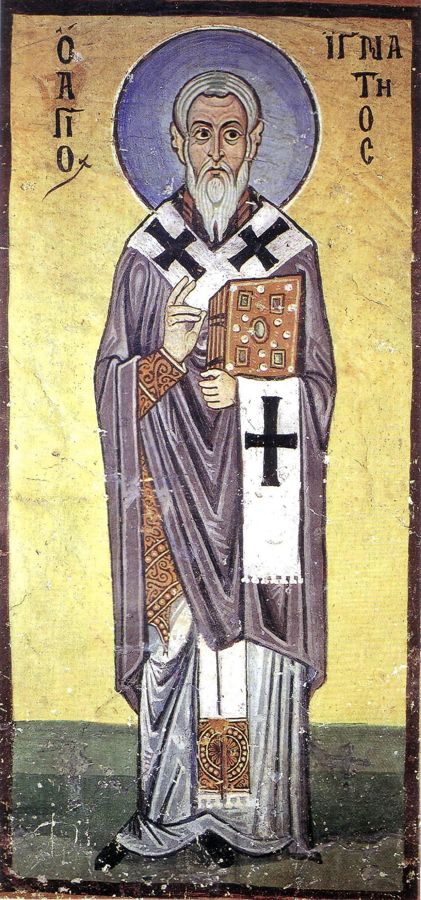
St. Ignatius

St. Ignatius

February 1 · Bishop, Martyr
P

Sts. Pionius and…

February 1 · Priest, Martyrs
S

St. Severus of Ravenna

February 1 · Bishop, Confessor
← All 1727 saints in the library
Sources & notes

Feast-day sources

Story sources

Sources

Credits

From Sabine Baring-Gould, The Lives of the Saints, new edition in 16 vols. (London: John C. Nimmo, 1897), digitized text from Project Gutenberg. Public domain.

From “Catholic Encyclopedia (1913)/St. Ephraem,” The Catholic Encyclopedia (New York: Robert Appleton Company, 1907–1914), via Wikisource. Public domain. Matched by name and feast date; text unedited except for our bracketed notes in grey.

From Sabine Baring-Gould, The Lives of the Saints, new edition in 16 vols. (London: John C. Nimmo, 1897), digitized text from Project Gutenberg. Public domain in the United States. Reproduced unedited, except for short bracketed notes in grey that we added to explain names and terms (“S.” is the old abbreviation for Saint). Some history and judgments reflect 19th-century scholarship.