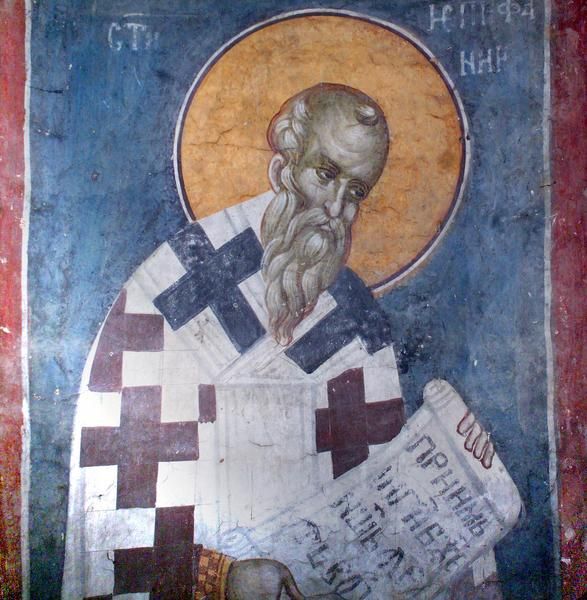
Baring-Gould’s sources: Greek Mensea, Russian Kalendar, Roman Martyrology, Ado, Bede, Usuardus, &c, Authorities: — Sozomen, Socrates, and his own writings’!1] S. Epiphanius was born at Besanduc, in the territory of Eleutheropolis, in Palestine. From early childhood he embraced the religious life, and became a disciple of S. Hilarion. He visited Egypt, where he was thrown among Gnostics, and became acquainted with their peculiar tenets and rites. He was ordained bishop of Salamis, the metropolis of Cyprus. In 374 he composed his Anchor, a treatise on the doctrine of the Holy Trinity, and in 376 he began his great work on heresies. He was at Rome at the council in 382, with Paulinus of Antioch and S. Jerome. He lodged in the house of S. Paula, the illustrious widow, who afterwards went to Bethlehem to be near her spiritual father, S. Jerome. Having spent the winter in Rome, he returned the following spring to his diocese, in company with Paulinus. S. Jerome remained in Rome till after the death of Pope Damasus, in 385, when he left for the East, and was warmly received on his way by S. Epiphanius. S. Paula, on her way to Bethlehem, also landed in Cyprus, 1 There Is a life pretending to be written by three disciples of S. Epiphanius, but it is a forgery and unworthy of the smallest reliance May ia.] vS". Epiphcmius.
Land the Bishop of Salamis was able to return her hospitality. He insisted on her spending ten days with him, to repose after her voyage; but she spent the time in visiting the monasteries in his diocese.
Apollinarianism was a heresy which at this time troubled the Church. It was about 369 that this error assumed its most definite form. It started from the idea of the true Divinity of Christ; and professing exceeding reverence for Him, argued that if He had had a true human nature, He must have had sinful instincts, but as this was not to be believed, then the nature of Christ was not truly human. The Incarnation was only a converse of God with man. Christ’s body was not really bom of Mary, but was a fresh and pure creation of the Godhead. And as Apollinaris had denied the Blessed Virgin to be the real Mother of the Word Incarnate, some were led on to a denial of her perpetual virginity, and others, by reaction, made her the object of an idolatrous homage. First in Thrace, and then among the women in Arabia, there grew up a custom of placing cakes (collyrides) on a stool covered with linen, offering them up to S. Mary, and then eating them as sacrificial food. S. Epiphanius severely condemned these two extremes. He denounced those who denied Christ’s Mother to be ever-virgin as “ Antidicomarians,” adversaries of Mary, who deprived her of the honour due to her; but he insisted that worship, in the true acceptation of the word, was due to the Trinity alone.
He undertook a journey to Antioch in 376 to endeavour to convert the Apollinarian bishop, Vitalis; but in that he was not successful.
The contest about Origenism now broke out. The writings of Origen certainly contained daring conjectures, and in the midst of much that was admirable, the critical eye could detect heretical speculations. The notion that [May i a.
the reign of Christ was finite was rather an inference from his writings than a tenet of Origen. He thought that all bodies would be finally annihilated, and if so, the humanity of Christ, and consequently His personal reign, would cease also. The possibility that the devil might, after long purification, be saved, and that the risen body might, after a period again, fall into corruption, were doctrines unquestionably repugnant to Catholic orthodox belief, if seriously maintained.
The most intimate friend of S. Jerome [translator of the Bible into Latin (d. 420)] was Ruffinus of Aquileia, now living as a priest under John, Bishop of Jerusalem, who had succeeded S. Cyril in 386. Rnffinus was a great admirer of the writings of Origen; and Jerome, nine years before, had told Paula that the charge of heresy brought against them was got up by the jealousy of inferior minds,1 But when, in 393, a pilgrim from the West, named Aterbius, denounced Ruffinus and Jerome as Origenists, S. Jerome at once disclaimed all sympathy with Origen, while Ruffinus kept within doors, in order to avoid the sight of his denouncer. John of Jerusalem was inclined to Origenism, or at least was an admirer of his writings, and in the inflamed and irritable temper of the religious world at that moment, to admire the excellencies of Origen’s writings, even though his errors were rejected, was regarded with mistrust.
S. Epiphanius, who looked on Origenism with horror, visited Jerusalem in the Lent [the forty days of fasting before Easter] of 394. John received the old prelate into his house, and invited him to preach in the church of the Resurrection. S. Epiphanius took the opportunity of denouncing Origenism, in such a way as to shew what he thought of his host,2 the archbishop then present, 1 In his peculiar style, he says that the impugners of Origen's orthodoxy were S. Jerome admits this, Cont. Joan n. “You and your company,” he adds, ‘ sneered, rubbed your heads, and nodded to each other, as much as to say, * the old man is in his dotage.**1 May 12. who exhibited his impatience and contempt by signs equally unmistakeable, and sent his archdeacon to bid him be silent John preached in his turn, and reprobated the “Anthropomorphists,” who took literally the texts which ascribed to God “ a body, parts, and passions.” While he spoke, he looked hard at S. Epiphanius, who afterwards quietly rose and said, “ I too condemn the Anthropomorphists, but we must also condemn Origenism.” A shout of laughter from the congregation exhibited their enjoyment 0 1 this retort.
On another occasion, when on his way to celebrate service with John at Bethel, Epiphanius found on a village church-door a curtain, on which was painted a figure of Christ, or of a saint. The sight offended his rigid scruples; and being wont to take his own course, with small regard for circumstances, he forthwith tore the curtain, and advised that it should be used as a shroud for the poor. The keepers of the church naturally observed, “If he tears our curtain, he is bound to provide us with another.” “So I will,” said Epiphanius; and he did in fact send them the best he could procure.
Finding John estranged from him, he withdrew to Bethlehem, where he received a cordial welcome. One of the monks at Bethlehem was Paulinianus, the brother of S. Jerome. The monastery needed a priest, for Jerome's morbid humility would not allow him to officiate, and Epiphanius contrived to seize Paulinianus at Eleutheropolis, which was not within the diocese of Jerusalem, and ordained him there. But the act was unjustifiable, for he -sent him to minister in the diocese of another bishop, and John indignandy complained. S. Epiphanius wrote a letter in which he endeavoured to defend the ordination, and charged the bishop of Jerusalem with Origenist heretical tenets. Of these the chief were, that souis had existed and sinned before they came into bodies; and that the salvation of Satan was a possibility. However, he seems to have felt that he had acted inconsiderately, and had laid himself open to blame, for he took Paulinianus back with him to Cyprus to minister there. In the strife between John and Epiphanius, Ruffinus and Jerome naturally took opposite sides. Theophilus of Alexandria had put down Paganism by force of arms. He suppressed Arianism [followers of Arius, who taught that the Son is a created being, not fully God] by the same violent and coercive means. The tone of this prelate’s epistles is invariably harsh and criminatory. He opposed the vulgar Anthropomorphism into which certain of the monks in the neighbourhood of Alexandria were falling, and insisted on the pure scriptural nature of the Deity. Yet he condescended to appease these turbulent adversaries by an unmanly artifice. He consented to condemn Origen, who having reposed quietly in his tomb for many years, in general respect, was exhumed, so to speak, by the zeal of late times, as a dangerous heresiarch. Theophilus quarrelled with Isidore, an old priest, who fled from his persecution to theNitrian monks. Theophilus attacked the monastery, and drove the monks from their cells into exile, charging them with Origenism. Four of these monks, known as the Tall Brothers, fled to Constantinople and appealed for protection to S. John Chrysostom, who wrote gently to Theophilus to remonstrate with him for his high-handed and cruel proceedings. But Theophilus, who denied his right to interfere, called in S. Epiphanius as his ally, and held a synod against Origenism.
S. Jerome supported Theophilus unreservedly. He was now in the full tide of controversy with Ruffinus. One angry tract called forth another, until Jerome himself became sensible of the wretchedness of such a quarrel, and S, Augustine entreated him to close a scene that chilled and saddened every true friendship.
S. Epiphanius. The Tall Brothers appealed to the Emperor and Empress, who summoned Theophilus to Constantinople to shew cause for his ill-treatment of the monks. Theophilus sent Epiphanius1 to Constantinople to carry on the war against Origenism. The old man on this occasion exhibited more plainly than ever the faults of character which had marred his usefulness. One of his first acts after landing was to ordain a deacon. He spurned S. Chrysostom [St. John Chrysostom, archbishop of Constantinople (d. 407)]'s offers oi hospitality, refused to eat or to pray with him, and endeavoured to procure from the bishops then at Constantinople an assent to the decree of his own synod against Origenism. Theotimus, bishop of Scythia, answered him curtly, “Epiphanius ! I choose not to insult the memory of one who ended his life piously long ago; nor dare I condemn one whom my predecessors did not reject." At the desire of the Empress the Tall Brothers paid him a visit: “Who are ye?" “Father, we are the Tall Brothers. What do you know of our doctrine or of our writings?" “Nothing." “Why then," asked one of them, “have you condemned us as heretics unheard ? " All that the hasty old man could say was, “You were reported to be heretics." They shamed him by replying, “ We treated you far otherwise when we defended your books against a like imputation."
Soon afterwards, in May, 403, he quitted Constantinople. He was humbled by his conference with the Tall Brothers, and felt that he had been acting with a zeal not sufficiently tempered with discretion, and that charity that hopeth all things, and thinketh not evil; and he could hardly have failed to contrast his own conduct with that of S. Chrysos1 This exhibits the meanness of Theophilus. He had formerly blamed S. Epiphanius as holding Anthropomorphistic views; but now, thinking it would be advantageous to him to have the support of so holy a man, ho wrote to him to inform him that he had come round to his views, Sozamen viii. 14, Socrates vi. tom, whose admonitions cut him to the quick. a You have done many things contrary to the canons, Epiphanius; you have ordained in churches under my jurisdiction; you have ministered in them unauthorized by me; I invited you, and you rejected my invitation; and now you would in an assembly denounce me. Beware, lest you stir up a tumult and endanger yourself/' As he was mounting his boat he half acknowledged his error. “ I leave you the city and the palace/' said he to S. Chrysostom; and then with a flash of temper which spoilt the apology, “and their pleasures."