St. Epiphanius of Salamis

Epiphanius was born at Besanduk near Eleutheropolis in Judea, after 310.

Read the essentials →
May 12 · Bishop

St. Epiphanius of Salamis

St. Epiphanius of Salamis

Epiphanius was born at Besanduk near Eleutheropolis in Judea, after 310.

Traditional feast

May 12
1914 / pre-1969 calendar, per Baring-Gould (1897)

Current feast

May 12
Secondary source · Wikipedia

Represents

Bishop

Their story

Adapted in modern English from the Catholic Encyclopedia (1913) · original text below

Epiphanius was born at Besanduk near Eleutheropolis in Judea, after 310. As a young man he lived as a monk in Egypt, then returned to found a monastery at Besanduk and was ordained priest. In 367 his reputation for austerity and learning led to his choice as Bishop of Constantia (Salamis), the chief city of Cyprus, which he governed for nearly forty years.

His advice was sought far beyond the island. At his correspondents' request he wrote the 'Ancoratus' (374), defending the Trinity and the resurrection against Arians (followers of Arius's teaching that the Son is a created being, not fully God) and Origenists, and the 'Panarion', a vast survey of heresies that preserves much otherwise lost history of the early Church.

The Catholic Encyclopedia says his character showed most clearly in the Origenist controversies: real and selfless zeal, but also quickness to suspect heresy, a good faith that schemers could exploit, and an ardour that led him to ignore church law and commit real abuses of power. He died in 403.

Struggles & surrender

What they wrestled with, and how they gave it to God

  • Zeal that overreached ·
    The Catholic Encyclopedia says his quickness to suspect heresy and ardour of conviction in the Origenist disputes led him to forget the rules of canon law and commit real abuses of power.

Early life

The book says little or nothing about early life. This is how the account begins.

Land the Bishop of Salamis was able to return her hospitality. He insisted on her spending ten days with him, to repose after her voyage; but she spent the time in visiting the monasteries in his diocese. Apollinarianism was a heresy which at this time troubled the Church.

What they represent

How they teach us to live

Drawn from themes in the original account

Share your faith, in words and by example. Preaching and conversion are central here.

Build up the community you belong to. This life was lived with and for a community.

From the Catholic Encyclopedia

1913 · 1616 words

Born at Besanduk, near Eleutheropolis, in Judea, after 310; died in 403. While very young he followed the monastic life in Egypt . On his return to Judea he founded a monastery at Besanduk and was ordained to the priesthood. In 367 his reputation for asceticism and learning brought about his nomination as Bishop of Constantia (Salamis) the metropolis of the Island of Cyprus. For nearly forty years he fulfilled the duties of the episcopate, but his activity extended far beyond his island. His zeal for the monastic life, ecclesiastical learning, and orthodoxy gave him extraordinary authority; hence the numerous occasions on which his advice was sought, and his intervention in important ecclesiastical affairs. He went to Antioch, probably in 376, to investigate Apollinarianism and to intervene in the schism that divided that church. He decided in favour of Bishop Paulinus, who was supported by Rome, against Meletius, who was supported by the episcopate of the East. In 382 he assisted at the Council of Rome to uphold the cause of Paulinus of Antioch. About 394, carried away by an apparently excessive zeal, he went to Jerusalem to oppose the supposed Origenism of the bishop, John. In 402 he was at Constantinople to combat the same pretended heresy of St. John Chrysostom. He died on his return journey to Cyprus.

It was at the instance of his correspondents that Epiphanius compiled his works. The earliest (374) is the "Ancoratus", or "The Well-Anchored", i.e. the Christian firmly fixed against the agitations of error. The Trinity and the dogma of the Resurrection are particularly treated by the author, who argues especially against the Arians [followers of Arius, who taught that the Son is a created being, not fully God] and the Origenists. There are two symbols at the end of the work: the first, which is the shorter, is very important in the history of symbols, or professions of faith, being the baptismal creed of the Church of Constantia. The second is the personal work of Epiphanius, and is intended to fortify the faithful against current heresies. In the "Ancoratus" Epiphanius confines himself to a list of heresies. Some readers desired to have a detailed work on this question, and Epiphanius composed (374-7) the "Panarion" or "Medicine chest", i.e. a stock of remedies to offset the poisons of heresy. This work is divided into three books comprising in all seven volumes and treating eighty heresies. The first twenty heresies are prior to Jesus Christ; the other sixty deal with Christian doctrine. In reality the number eighty may be reduced to seventy-seven, for among the twenty heresies prior to Christ only seventeen count. Three are generic names, namely Hellenism, Samaritanism, and Judaism. In the editions of the "Panarion" each heresy is numbered in order; hence it is customary to quote the "Panarion" as follows: Epiphanius, Haer. N (the number of the heresy). Necessarily much of the information in this great compilation varies in value. The "Panarion" reflects the character of Epiphanius and his method of working. Sometimes his ardour prevents him from inquiring carefully into the doctrines he opposes. Thus, on his own avowal (Haer., lxxi), he speaks of Apollinarianism on hearsay. At Constantinople he had to acknowledge the Origenist monks whom he opposed that he was not acquainted with either their school or their books, and that he only spoke from hearsay (Sozomen, "Hist. eccl.", VIII, xl). There is, however, in the "Panarion" much information not found elsewhere. Chapters devoted only to the doctrinal refutation of heresies are rare. As an apologist Epiphanius appeared generally weak to Photius.

The "Panarion" furnishes very valuable information concerning the religious history of the fourth century, either because the author confines himself to transcribing documents preserved by him alone or because he writes down his personal observations. With regard to Hieracas (Haer., lxvii), he makes known a curious Egyptian sect by whom asceticism and intellectual work were equally esteemed. In connection with the Meletians of Egypt (Haer., lxviii), he has preserved important fragments of contemporary Egyptian history of this movement. With regard to Arianism (Haer., lxix), if he gives an apocryphal letter of Constantine, he transcribes two letters of Arius. He is the only one to give us any information concerning the Gothic sect of the Audians (Haer., lxx). He has made use of the lost report of the discussion between Photius (Haer., lxxi), and Basil of Ancyra. He has transcribed a very important letter from Bishop Marcellus of Ancyra (Haer., lxxii) to Pope Julius and fragments of the treatise of Acaius of Caesarea against Marcellus. With regard to the Semiarians (Haer., lxxiii), he gives in the Acts of the Council of Ancyra (358) a letter from Basil of Ancyra and one from George of Laodicea, and the stenographic text of a singular sermon of Melitius at the time of his installation at Antioch. In the chapter dealing with the Anomeans (Haer., lxxvi) he has preserved a monograph of Aetius.

Read the rest of the article

For the first three centuries Epiphanius was compelled to use the only literary sources. Some of these have been preserved, such as the great anti-heretical work of St. Irenaeus of Antioch, "Contra Haereses". Other ancient sources utilized by him have been lost, which gives exceptional value to his work. Thus he made use of the "Syntagma" of Hippolytus. The precise determination of all his sources is matter of controversy. His information is especially valuable with regard to the Samaritans (Haer., x-xiii), the Jews (Haer., xiii-xx), the Ebionites (Haer., xxx), and their Gospel; with regard to the Gnostics Valentius (Haer., xxxi) and Ptolemaeus (Haer., xxxiii), whose letter to Flora he quotes; and with regard to the Scriptural criticism of Marcion. The work ends with a long exposition of the Catholic faith. A summary of the "Penarion" is perhaps the work of Epiphanius. A work entitled "Of Measures and Weights" (De mensuribus et ponderibus) has a more general interest than might be imagined from the title. For the time it is a real "Introduction" to the Holy Scripture, containing the history of Biblical texts and Sacred archaeology. The treatise "On the Twelve Precious Stones" is an explanation of the ornaments of the high-priest's breastplate (Ex., xxviii, 17). Mention must finally be made of two letters of Epiphanius preserved in a Latin translation.

In theological matters Epiphanius teaches the doctrine of the Catholic theologians of his time. In the vocabulary of Trinitarian theology he conforms to the language of the Greek Church. He speaks of three hypostases in the Trinity, whereas the Latins and the Paulicians of Antioch speak of one hypostasis in three persons. At bottom it was a mere matter of words, but for some time it occasioned theological dissensions. Ephiphanius clearly teaches that the Holy Ghost proceeds from the Father and the Son. The doctrine that the Holy Ghost proceeds from the Father only prevailed later in the Greek Church. This teaching cannot be traced to Epiphanius (Ancoratus, 8). With regard to the constitution of the Church, he is one of the most explicit of the Greek theologians concerning the primacy of St. Peter ("Ancoratus", 9; "Haer.", lix, 7). Two passages on the Eucharist are famous because they are among those which most clearly affirm the "Discipline of the Secret". The "Secret" was purely pedagogical and often neglected, consisting in grading the doctrinal initiation of catechumens and in not speaking before them of the Christian mysteries save in deliberately vague expressions. Hence the necessity of explaining the words of Epiphanius on the Eucharist ("Ancoratus", 57; "Haer.", xlii, 61). In these two passages, instead of quoting the words of the institution of the Eucharist, the author gives these: "Hoc meum est, hoc." Epiphanius is one of the chief authorities of the fourth century for the devotion to the Blessed Virgin. He expresses himself on the subject in connection with two heresies, of which one diminished, while the other exaggerated, this devotion (Haer." lxxviii, lxxix). A circumstance of his life is well known in the history of images, namely the destruction of an image in the church of Bethel ("Letter to John of Jerusalem" in P.G., XLIII, 390).

His character is most clearly shown by the Origenist controversies, which demonstrated his disinterested zeal but also his quickness to suspect heresy, a good faith which was easily taken advantage of by the intriguing, and an ardour of conviction which caused him to forget the rules of canon law and to commit real abuses of power. He saw in Origen the chief cause of the heresies of his time, and especially of Arianism. He was particularly opposed to his allegorical method, his doctrines concerning the Son, in which he saw the subordination of the Son to the Father, his doctrines concerning the pre-existence of souls and the resurrection ("Ancoratus", 54, 62; "Haer.", lxiv). He did not confine himself to this condemnation of Origen. He reproached the monks and bishops of his time with accepting the Origenist errors. Thence resulted at the end of his life the conflict with John of Jerusalem and with St. John Chrysostom. Apart from the injustice of the controversy, he encroached on the jurisdiction of these bishops. He was made use of by Theophilus of Alexandria, the irreconcilable enemy of Chrysostom. The chief sources relative to this controversy are: St. Jerome, "Contra Joannem Hierosolymitanum" in P.L., XXIII, 355; Idem, "Ad Theophilum" in Pl L., XXII, 736; Epiphanius, "Ad Joannem Hierosolymitanum" in P.G., XLIII, 379; Socrates, "Hist. eccl.", VI, x-xiv; Sozomen, "Hist. eccl.", VIII, xiv-xv. The chief editions of Epiphanius's works are those of Petavius (Paris, 1622); Greek text, Latin tr., and notes reproduced with additions in P.G., XLI-XLIII; and of Dindorf (Leipzig, 1859-62), 5 vols., giving only the Greek text, improved in some parts.

BARDENHEWER, Patrology, tr. SHAHAN (St. Louis, 1903); ZARUCKE, Literarischer Zentralblatt, LXI, no. 16.

Read more

The full original · 1715 words

Read Baring-Gould’s full account

Baring-Gould’s sources: Greek Mensea, Russian Kalendar, Roman Martyrology, Ado, Bede, Usuardus, &c, Authorities: — Sozomen, Socrates, and his own writings’!1] S. Epiphanius was born at Besanduc, in the territory of Eleutheropolis, in Palestine. From early childhood he embraced the religious life, and became a disciple of S. Hilarion. He visited Egypt, where he was thrown among Gnostics, and became acquainted with their peculiar tenets and rites. He was ordained bishop of Salamis, the metropolis of Cyprus. In 374 he composed his Anchor, a treatise on the doctrine of the Holy Trinity, and in 376 he began his great work on heresies. He was at Rome at the council in 382, with Paulinus of Antioch and S. Jerome. He lodged in the house of S. Paula, the illustrious widow, who afterwards went to Bethlehem to be near her spiritual father, S. Jerome. Having spent the winter in Rome, he returned the following spring to his diocese, in company with Paulinus. S. Jerome remained in Rome till after the death of Pope Damasus, in 385, when he left for the East, and was warmly received on his way by S. Epiphanius. S. Paula, on her way to Bethlehem, also landed in Cyprus, 1 There Is a life pretending to be written by three disciples of S. Epiphanius, but it is a forgery and unworthy of the smallest reliance May ia.] vS". Epiphcmius.

Land the Bishop of Salamis was able to return her hospitality. He insisted on her spending ten days with him, to repose after her voyage; but she spent the time in visiting the monasteries in his diocese.

Apollinarianism was a heresy which at this time troubled the Church. It was about 369 that this error assumed its most definite form. It started from the idea of the true Divinity of Christ; and professing exceeding reverence for Him, argued that if He had had a true human nature, He must have had sinful instincts, but as this was not to be believed, then the nature of Christ was not truly human. The Incarnation was only a converse of God with man. Christ’s body was not really bom of Mary, but was a fresh and pure creation of the Godhead. And as Apollinaris had denied the Blessed Virgin to be the real Mother of the Word Incarnate, some were led on to a denial of her perpetual virginity, and others, by reaction, made her the object of an idolatrous homage. First in Thrace, and then among the women in Arabia, there grew up a custom of placing cakes (collyrides) on a stool covered with linen, offering them up to S. Mary, and then eating them as sacrificial food. S. Epiphanius severely condemned these two extremes. He denounced those who denied Christ’s Mother to be ever-virgin as “ Antidicomarians,” adversaries of Mary, who deprived her of the honour due to her; but he insisted that worship, in the true acceptation of the word, was due to the Trinity alone.

He undertook a journey to Antioch in 376 to endeavour to convert the Apollinarian bishop, Vitalis; but in that he was not successful.

The contest about Origenism now broke out. The writings of Origen certainly contained daring conjectures, and in the midst of much that was admirable, the critical eye could detect heretical speculations. The notion that [May i a.

the reign of Christ was finite was rather an inference from his writings than a tenet of Origen. He thought that all bodies would be finally annihilated, and if so, the humanity of Christ, and consequently His personal reign, would cease also. The possibility that the devil might, after long purification, be saved, and that the risen body might, after a period again, fall into corruption, were doctrines unquestionably repugnant to Catholic orthodox belief, if seriously maintained.

The most intimate friend of S. Jerome [translator of the Bible into Latin (d. 420)] was Ruffinus of Aquileia, now living as a priest under John, Bishop of Jerusalem, who had succeeded S. Cyril in 386. Rnffinus was a great admirer of the writings of Origen; and Jerome, nine years before, had told Paula that the charge of heresy brought against them was got up by the jealousy of inferior minds,1 But when, in 393, a pilgrim from the West, named Aterbius, denounced Ruffinus and Jerome as Origenists, S. Jerome at once disclaimed all sympathy with Origen, while Ruffinus kept within doors, in order to avoid the sight of his denouncer. John of Jerusalem was inclined to Origenism, or at least was an admirer of his writings, and in the inflamed and irritable temper of the religious world at that moment, to admire the excellencies of Origen’s writings, even though his errors were rejected, was regarded with mistrust.

S. Epiphanius, who looked on Origenism with horror, visited Jerusalem in the Lent [the forty days of fasting before Easter] of 394. John received the old prelate into his house, and invited him to preach in the church of the Resurrection. S. Epiphanius took the opportunity of denouncing Origenism, in such a way as to shew what he thought of his host,2 the archbishop then present, 1 In his peculiar style, he says that the impugners of Origen's orthodoxy were S. Jerome admits this, Cont. Joan n. “You and your company,” he adds, ‘ sneered, rubbed your heads, and nodded to each other, as much as to say, * the old man is in his dotage.**1 May 12. who exhibited his impatience and contempt by signs equally unmistakeable, and sent his archdeacon to bid him be silent John preached in his turn, and reprobated the “Anthropomorphists,” who took literally the texts which ascribed to God “ a body, parts, and passions.” While he spoke, he looked hard at S. Epiphanius, who afterwards quietly rose and said, “ I too condemn the Anthropomorphists, but we must also condemn Origenism.” A shout of laughter from the congregation exhibited their enjoyment 0 1 this retort.

On another occasion, when on his way to celebrate service with John at Bethel, Epiphanius found on a village church-door a curtain, on which was painted a figure of Christ, or of a saint. The sight offended his rigid scruples; and being wont to take his own course, with small regard for circumstances, he forthwith tore the curtain, and advised that it should be used as a shroud for the poor. The keepers of the church naturally observed, “If he tears our curtain, he is bound to provide us with another.” “So I will,” said Epiphanius; and he did in fact send them the best he could procure.

Finding John estranged from him, he withdrew to Bethlehem, where he received a cordial welcome. One of the monks at Bethlehem was Paulinianus, the brother of S. Jerome. The monastery needed a priest, for Jerome's morbid humility would not allow him to officiate, and Epiphanius contrived to seize Paulinianus at Eleutheropolis, which was not within the diocese of Jerusalem, and ordained him there. But the act was unjustifiable, for he -sent him to minister in the diocese of another bishop, and John indignandy complained. S. Epiphanius wrote a letter in which he endeavoured to defend the ordination, and charged the bishop of Jerusalem with Origenist heretical tenets. Of these the chief were, that souis had existed and sinned before they came into bodies; and that the salvation of Satan was a possibility. However, he seems to have felt that he had acted inconsiderately, and had laid himself open to blame, for he took Paulinianus back with him to Cyprus to minister there. In the strife between John and Epiphanius, Ruffinus and Jerome naturally took opposite sides. Theophilus of Alexandria had put down Paganism by force of arms. He suppressed Arianism [followers of Arius, who taught that the Son is a created being, not fully God] by the same violent and coercive means. The tone of this prelate’s epistles is invariably harsh and criminatory. He opposed the vulgar Anthropomorphism into which certain of the monks in the neighbourhood of Alexandria were falling, and insisted on the pure scriptural nature of the Deity. Yet he condescended to appease these turbulent adversaries by an unmanly artifice. He consented to condemn Origen, who having reposed quietly in his tomb for many years, in general respect, was exhumed, so to speak, by the zeal of late times, as a dangerous heresiarch. Theophilus quarrelled with Isidore, an old priest, who fled from his persecution to theNitrian monks. Theophilus attacked the monastery, and drove the monks from their cells into exile, charging them with Origenism. Four of these monks, known as the Tall Brothers, fled to Constantinople and appealed for protection to S. John Chrysostom, who wrote gently to Theophilus to remonstrate with him for his high-handed and cruel proceedings. But Theophilus, who denied his right to interfere, called in S. Epiphanius as his ally, and held a synod against Origenism.

S. Jerome supported Theophilus unreservedly. He was now in the full tide of controversy with Ruffinus. One angry tract called forth another, until Jerome himself became sensible of the wretchedness of such a quarrel, and S, Augustine entreated him to close a scene that chilled and saddened every true friendship.

S. Epiphanius. The Tall Brothers appealed to the Emperor and Empress, who summoned Theophilus to Constantinople to shew cause for his ill-treatment of the monks. Theophilus sent Epiphanius1 to Constantinople to carry on the war against Origenism. The old man on this occasion exhibited more plainly than ever the faults of character which had marred his usefulness. One of his first acts after landing was to ordain a deacon. He spurned S. Chrysostom [St. John Chrysostom, archbishop of Constantinople (d. 407)]'s offers oi hospitality, refused to eat or to pray with him, and endeavoured to procure from the bishops then at Constantinople an assent to the decree of his own synod against Origenism. Theotimus, bishop of Scythia, answered him curtly, “Epiphanius ! I choose not to insult the memory of one who ended his life piously long ago; nor dare I condemn one whom my predecessors did not reject." At the desire of the Empress the Tall Brothers paid him a visit: “Who are ye?" “Father, we are the Tall Brothers. What do you know of our doctrine or of our writings?" “Nothing." “Why then," asked one of them, “have you condemned us as heretics unheard ? " All that the hasty old man could say was, “You were reported to be heretics." They shamed him by replying, “ We treated you far otherwise when we defended your books against a like imputation."

Soon afterwards, in May, 403, he quitted Constantinople. He was humbled by his conference with the Tall Brothers, and felt that he had been acting with a zeal not sufficiently tempered with discretion, and that charity that hopeth all things, and thinketh not evil; and he could hardly have failed to contrast his own conduct with that of S. Chrysos1 This exhibits the meanness of Theophilus. He had formerly blamed S. Epiphanius as holding Anthropomorphistic views; but now, thinking it would be advantageous to him to have the support of so holy a man, ho wrote to him to inform him that he had come round to his views, Sozamen viii. 14, Socrates vi. tom, whose admonitions cut him to the quick. a You have done many things contrary to the canons, Epiphanius; you have ordained in churches under my jurisdiction; you have ministered in them unauthorized by me; I invited you, and you rejected my invitation; and now you would in an assembly denounce me. Beware, lest you stir up a tumult and endanger yourself/' As he was mounting his boat he half acknowledged his error. “ I leave you the city and the palace/' said he to S. Chrysostom; and then with a flash of temper which spoilt the apology, “and their pleasures."
Feast days

Feast: May 12

Nine days · Free

Pray the novena
with us.

One short email a day for nine days. The day's prayer, a line from St. Epiphanius of Salamis's story, and a nudge to keep going.

Also on May 12
F

St. Francis of Girolamo

May 12 · Feast
Sts. Nereus, Achilles and Fla Via

Sts. Nereus

May 12 · Feast
St. Pancras

St. Pancras

May 12 · Martyr
← All 1726 saints in the library
Sources & notes

Feast-day sources

Story sources

Sources

Credits

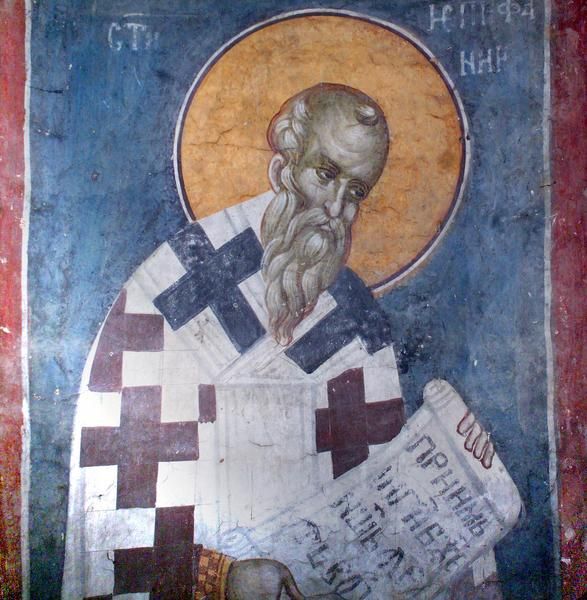
Image: Epiphanius-Kosovo.jpg · Unknown authorUnknown author · Public domain, via Wikimedia Commons

From Sabine Baring-Gould, The Lives of the Saints, new edition in 16 vols. (London: John C. Nimmo, 1897–98); text from the Internet Archive scan (OCR, lightly cleaned; errors possible). Public domain.

Image: Unknown authorUnknown author, Wikimedia Commons (Public domain)

From “Catholic Encyclopedia (1913)/Epiphanius of Salamis,” The Catholic Encyclopedia (New York: Robert Appleton Company, 1907–1914), via Wikisource. Public domain. Matched by name and feast date; text unedited except for our bracketed notes in grey.

From Sabine Baring-Gould, The Lives of the Saints, new edition in 16 vols. (London: John C. Nimmo, 1897–98); text from the Internet Archive scan (OCR, lightly cleaned; errors possible). Public domain in the United States. Reproduced unedited, except for short bracketed notes in grey that we added to explain names and terms (“S.” is the old abbreviation for Saint). Some history and judgments reflect 19th-century scholarship.