St. Erminold of Prufening

Faithfulness to Christ when it cost everything.

Read the essentials →
January 6 · Abbot, Martyr

St. Erminold of Prufening

St. Erminold of Prufening

Faithfulness to Christ when it cost everything.

Traditional feast

January 6
1914 / pre-1969 calendar, per Baring-Gould (1914)

Current feast

January 6
Secondary source · Wikipedia

Represents

Abbot
Martyr

Their story

Adapted in modern English from Baring-Gould (1914) · original text below

Erminold came from a leading Swabian family and was handed as a boy to William, the learned and holy abbot of Hirsau, to be educated. He made fast progress and took monastic vows.

In 1110 Emperor Henry V appointed him abbot of Lorsch (a famous Benedictine abbey near Worms, Germany). When Erminold learned the post had been given as a favor to his brother, he resigned it rather than incur the least suspicion of simony (buying or selling church offices), and went back to Hirsau. Later the bishop of Bamberg founded the abbey of Prüfening near Regensburg and invited him to be its first abbot. He went with a few brethren. His insistence on strict discipline made enemies, and in 1121 a monk named Aaron struck him with a knife. He died of the wound, forgiving his murderer.

Early life

Selected sentences from the original account, unaltered.

S. Erminold sprang from one of the first families in Swabia, and was given in early life to William, abbot of Hirschau, to be educated.

What they represent

How they teach us to live

Drawn from themes in the original account

Feed your mind with Scripture and good books. Learning and the Scriptures matter in this life.

Learn from the kind of life it was. Faithfulness to Christ when it cost everything.

Read more

The full original · 300 words

Read Baring-Gould’s full account

Baring-Gould’s sources: Mentioned in the German Martyrologies. His life was written by a monk of Prufening, about the year 1290.

S. Erminold sprang from one of the first families in Swabia, and was given in early life to William, abbot of Hirschau, to be educated. A better tutor could not have been found for him, for William was one of the most learned and pious men of the age. The youthful Erminold made rapid progress in his studies, and he grew up in favour with God and man. When his pupilage was ended, he took the vows of monastic life upon him. In 1110, he was appointed by the Emperor Henry V., to the abbey of Lorch, on the Rhine; but hearing that this had been given him at the request of his brother, as a return for something his brother had done for the Emperor, Erminold threw up the office, so as not to incur the least suspicion of simony, and returned to Hirschau. But the Bishop of Bamberg, having founded an abbey at Prufening, near Ratisbon [Regensburg in Bavaria], he was invited to colonize it, and be its first father. He accordingly betook himself thither, with a few brethren. Having incurred the hostility of some of his monks, by insisting on strict discipline, one, named Aaron, struck him with a knife and mortally wounded him. He died, forgiving his murderer.

Worshippers at the Shrine of a Saint.

S. Lucian , P. M., at Antioch, circ. a.d. 312. S. Nicetas , B. C., circ. a.d. 402. S. Valentine , B. of Passau, circ. a.d. 440. S. Cedd , B. of London , a.d. 664. S. Tyllo , Monk in Gaul [roughly modern France and Belgium], circ. 700. B. Wittekind , Duke of Westphalia , a.d. 800. S. Rainold , Monk and M., of Dortmund, in Westphalia. S. Aldric , B. of Le Mans, in France, circ. a.d. 855. S. Canute , Duke of Schleswig , a.d. 1133.
Feast days

Feast: January 6

Nine days · Free

Pray the novena
with us.

One short email a day for nine days. The day's prayer, a line from St. Erminold of Prufening's story, and a nudge to keep going.

Also on January 6
E

The Epiphany

January 6 · Feast
M

St. Macra

January 6 · Virgin, Martyr
M

St. Melanius of Rennes

January 6 · Bishop
← All 1726 saints in the library
Sources & notes

Feast-day sources

Story sources

Sources

Credits

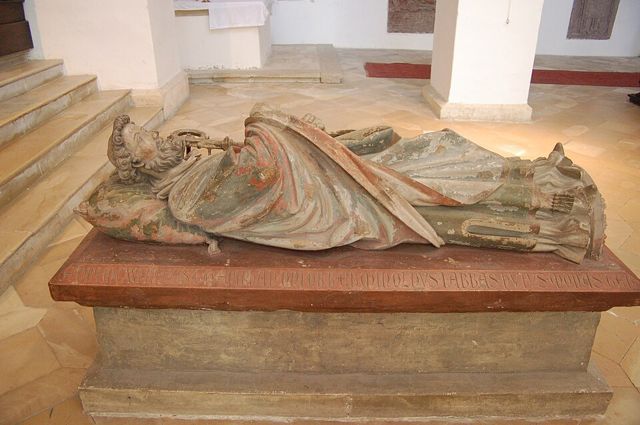
Image: St. Erminold.jpg · Sebastian Fischer · CC BY-SA 2.5, via Wikimedia Commons

From Sabine Baring-Gould, The Lives of the Saints, new and revised edition (Edinburgh: John Grant, 1914; first edition 1872). Public domain.

Image: Sebastian Fischer, Wikimedia Commons (CC BY-SA 2.5)

From Sabine Baring-Gould, The Lives of the Saints, new and revised edition (Edinburgh: John Grant, 1914; first edition 1872). Public domain in the United States. Reproduced unedited, except for short bracketed notes in grey that we added to explain names and terms (“S.” is the old abbreviation for Saint). Some history and judgments reflect 19th-century scholarship.