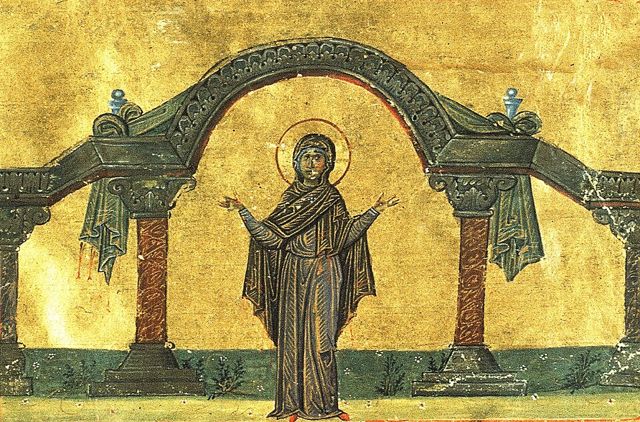
Baring-Gould’s sources: Greek Menæa, and Roman Martyrology. This saint does not occur in any of the ancient Latin Martyrologies. Her name was inserted in the Roman Martyrology by Baronius. She is called Eudoxia or Eudocia. Authority:—An ancient Greek Life which, however, from its using the word homo-ousios , and calling the Prætor, Count , proves to be later than the times of Constantine. The story has a foundation of fact, no doubt; but a large amount of addition to it has been made of fabulous matter, to convert it into a religious romance.
There was a Samaritan woman named Eudocia, of great beauty, who lived as a harlot, in the city of Heliopolis, in Phœnicia. She had amassed much wealth by her shameful mode of life, and she thought only of how she might gratify the lust of the flesh, the lust of the eye, and the pride of life. But the word of God is like a hammer that breaketh the rocks in pieces.
There was a monk, named Germanus, passing through the city, and he lodged with an acquaintance next door to the house of Eudocia. And in the middle of the night he arose, as was his wont, and sang his Psalms, and, opening a book began, by the light of his lamp, to read a spiritual lecture with a loud voice. And this happened to be its subject,—the coming of Jesus Christ on the clouds of heaven to judge all men according to their works, when they that have done well shall enter into life, and they that have done evil shall be cast into eternal fire. Now, it fell out that there was only a lath and plaster wall between the room where the monk was and that in which Eudocia lay. And when he began to sing she awoke, wondering, and listened, annoyed at first at the disturbance, but afterwards interested and alarmed. Then, when she heard him read the sentence of God on sinners, she was filled with remorse for the past, present shame, and fear for the future. And when morning dawned, she sent for the monk, and she asked him if that was true which he had read during the night. He answered that it was so. Then looking round, and wondering at the costly furniture and luxuries that abounded, he said simply, "What a rich man thy husband must be!" Then she reddened with shame, and said, in a low voice, "I have many lovers, but no husband." "Oh, my daughter," cried Germanus, "Would'st thou rather be poor now, and live in joy and glory hereafter, or be wealthy now and perish miserably in everlasting death?" Then Eudocia said, "How hard thy God must be to hate riches." "God forbid," exclaimed the monk, "it is not riches that He abhors, but goods unjustly gotten." Then he declared to her in order what she must do and believe to be saved. "And first, send for a priest of the city who may give thee proper instruction, that thou mayest be baptized, for baptism is the beginning and the foundation of the whole Christian life. And now, prepare thyself with fasting and prayer."
So Eudocia bade her servants close the house, as though she had gone into her country villa, and should any one come to the door, refuse him admission. And she sent for a priest, and when he came she said, "Oh, sir! I am a grievous sinner, a sea of guilt." "Be of good cheer, my daughter," was his salutation. "The sea of guilt may be changed into a port of salvation, and the waves tossing with passion sink into an ineffable calm." Then he instructed her on the nature of repentance, and bade her wear a mean dress, putting away her trinkets and silk gown, and fast for seven days; and he diligently taught her what she must believe and do. And before he went on his way, Germanus visited her once again, to confirm the good work that was begun in her. Then she asked him why he lived in the desert, and in the practice of severe mortification. "Oh, my daughter," he said; "We monks labour incessantly to cleanse from every spot of sin the garments of our souls." And she said, "I have now fasted and eaten nothing for seven days. And I will declare to thee what befel me last night. In my exhaustion I sank into a trance, and saw, and lo! an angel took me by the hand, and led me into Heaven, where was unspeakable light, and there I saw the blessed ones in white, with shining faces, and all their countenances lit up as I approached, and they came running towards me, and greeted me, even me , as a sister. Then there came up a shadow, horrible and black, and it shrieked, saying, 'This woman is mine. I have used her to destroy many, she has worked for me as a bond slave, and shall she be saved? I, for one little disobedience, was cast out of heaven, and here is this beast, steeped from head to foot in pollution, admitted to the company of the elect! Have done with this; take them all, scrape all the rascals and harlots on earth together, and admit them into your society. I will off into my Hell, and grovel there in fire for ever.' And then I heard a voice from the ineffable light answer and say, 'God willeth not the death of a sinner, but rather that he should be converted and live.' And after that the angel took me by the hand and led me home again, and saying to me, 'There is joy in heaven over one sinner that repenteth,' signed me thrice with the cross, and vanished."
Then Germanus rejoiced, and bade Eudocia be of good courage, and continue in the good path she had elected to walk in.
Now, when the time of her preparation was over, Eudocia was baptized by the bishop, Theodotus, and when the sacrament of illumination had been administered, she went home and made an inventory of all that she had, and sent it to the bishop. And when Theodotus had looked at it he went to her house, and said, "What is this little book that thou hast sent me?" And she answered, "This is the list of all my precious things, which I pray thy holiness to order the steward of the Church to receive of me, and distribute, as seemeth fitting, to those that have need." Then the bishop did as he was desired, and the Church treasurer came, and collected, and disposed of all her costly things. It may interest some to know what these were. Besides money, and jewels, and pearls, of which there was great store, he carried off two hundred and seventy-five boxes of silk dresses, and four hundred and ten chests of linen, one hundred and sixty boxes of gowns embroidered with gold, one hundred and fifty cases of dresses with jewelled work, one hundred and twenty-three large chests of various garments, twelve boxes of musk, thirty-three of Indian storax, a large number of silver vessels, several silk curtains ornamented with gold bullion, satin curtains, and many other things too numerous to mention.
Now, as soon as all her valuables had been distributed to the most needy, Eudocia, still in her white baptismal robe, departed into the desert to a convent of thirty nuns directed by Germanus, the monk, who had been the means of converting her. And never did she change the colour or character of her garment till her dying day; only in winter she put over it a sackcloth gown to her ankles, and a hooded cloak of the same material.
Thirteen months after her admission, the superior of the convent died, and Germanus appointed the penitent Eudocia to be superior in her room.
There was a young man, who had been a lover of Eudocia, who was greatly vexed at her conversion, and resolved, partly out of passion, and partly out of love of adventure, to seek her out in her seclusion, and entice her back into the world of pleasure. To accomplish his object he assumed a monastic habit, and went to the convent, and tapped at the door. The portress partly opened the window, and, peeping through it, asked who was there. Then the man answered, after the manner of monks, "I am a sinner, and seek to communicate in your prayers and benedictions." Then the sister answered, "Thou art mistaken in coming here. No men are admitted into the house. But go on thy way, and thou wilt find a monastery governed by the blessed Germanus; he will take thee in." Then she shut the window in his face.
The young man, whose name was Philostratus, made his way to the monastery of Germanus, and he found the old man sitting in the porch, reading. He fell at his feet, and declared himself a sinner, who desired to amend his life. Germanus looked hard at him, and a certain wantonness of the eye made him hesitate about receiving him. "We are all old men here," said he; "and are not the proper advisers and guides of a hot-headed, fire-blooded youth. Go elsewhere my son, and get a director who is nearer thine age." "My father!" exclaimed the dissembler, "How cans't thou reject me, after that thou hast received Eudocia. She has passed through the fires of temptation such as assail youth, and could well advise me. Let her give me some counsel, and I will go my way strengthened thereby."
Germanus had acted somewhat injudiciously in appointing a reclaimed harlot to be superior of a sisterhood after only thirteen months' probation; he now committed another indiscretion in allowing the strange monk ingress into the convent. But he was guileless himself, and thought no evil of another, so he listened to the petition of Philostratus, and calling to him the monk who offered the incense in the convent, and was, therefore, allowed to enter it, bade him take with him the stranger, and give him audience of the superior. So Philostratus was led back to the convent, and the door was opened, and he was admitted into the room of Eudocia, some of the sisters standing afar off, according to the rule of the house, to witness the meeting, though out of hearing of the conversation. Then Philostratus looked at the sordid room, and the horsehair cover thrown over the pallet bed, and the haggard cheeks and sunken eyes of his former mistress, and he burst forth into entreaties that she would leave this wretched life of constant self-watching and self-denial, and return to the gaiety of city life, smart gowns, and pearl necklaces, costly feasts, and obsequious admirers. "All Heliopolis awaits thee," he urged, "ready once more to lavish on thee its gold and its adulation; return once more to the raptures and liberty of a life of pleasure."
But she had chosen that better part which was not to be taken away from her, and she resisted all his persuasion, and dismissed him, startled, humbled, and resolved to lead a better life.
So far the story of Eudocia is natural and devoid of improbabilities. But the Greek writer was not content to leave it thus deficient in marvels, and he has added several chapters of fanciful adventures, as insipid as they are untrue; and the contrast they make with the earlier portion of the history, and of the final chapter, points them out as an interpolation. In this interpolation Eudocia converts "King" Aurelian [Roman emperor 270–275] at Heliopolis, and appears before the governor, Diogenes, armed only with a particle of the Holy Eucharist, which she bears in her bosom. The king orders her to be stripped, and when she has been divested of her clothes, till the Host is exposed, then the B. Sacrament is suddenly transmuted into a blazing fire, which consumes the governor and all the bystanders, and an angel veils modestly the naked shoulders and bosom of Eudocia.
The sudden extinction of a governor could hardly have been passed over by profane history had it really occurred, and, therefore, the falsifier of the Acts found it advisable to revive him. Accordingly, Eudocia is represented as taking the charred corpses by the hand and restoring them instantly to perfect soundness.
But putting aside this absurd story, which is to be found repeated ad nauseam in almost all the forged and falsified Greek Acts of martyrdoms, with slight variations, we pass to the last chapter of the Life, which simply narrates the execution, by the sword, of Eudocia in her convent, by order of Valerius, the governor, without any sermons, inflated declamations, and theological disquisitions, such as usually accompany corrupted, interpolated acts, and are an invariable feature in forgeries.