Baring-Gould’s sources: Roman Martyrology. Authority:—An account of his life and martyrdom by his friend Alvar.
Eulogius belonged to one of the principal families of Cordova, then in the hands of the Moors [the Muslims of North Africa and Spain], who had constituted it their capital. These Mohammedans, who had ruined the Gothic kingdom in Spain, had not succeeded in trampling out Christianity. They did, indeed, suffer Christians to exercise their religion, and for this indulgence they obliged them to pay a heavy tax, but Christians were strictly forbidden, on pain of death, to make converts. Eulogius had a fellow scholar at Chute-Clar, a monastery on the north-west of Cordova, named Alvar, to whom he was warmly attached, and who became afterwards his biographer. On reaching his maturity, Eulogius taught letters in Cordova, and was ordained priest. In the year 850, the Moors began to persecute the Christians, and the metropolitan [the archbishop who heads a group of dioceses] bishop of Andalusia, Reccafred, instead of defending his flock against the wolves, basely taking the part of the king, Abderahman, arrested all the clergy of Cordova, together with their bishop, and threw them into prison. S. Eulogius, from his dungeon, wrote an exhortation to two virgins, named Flora and Mary, exhorting them to stand fast in the faith. "They threaten to sell you as slaves, and dishonour you, my daughters, but know that whatever infamy they may heap upon you, they cannot defile the virginal purity of your souls." But these holy maidens were spared this terrible humiliation, being executed with the sword. S. Eulogius and the other prisoners heard with joy of their triumph, and celebrated a mass of thanksgiving to God in their dungeon.
Six days after, S. Eulogius and the other priests were released; and he at once composed a metrical account of the passion of the virgins Flora and Mary.
Under Mohammed, the successor of Abderahman, the persecution became still more cruel, and S. Eulogius was constantly employed in encouraging timorous Christians, who, to escape death, or the irksome disabilities and petty tyranny to which they were subjected, were prepared to desert Christ.
The number of martyrs at this time was very great, and Eulogius collected all the acts of their passion into a history, in three books, entitled "The Memorial," which still exists. He then composed an "Apology" against those who disputed their title, as martyrs, because, firstly, they wrought no miracles like the ancient martyrs; secondly, they had offered themselves to death; thirdly, they had died by a stroke of the sword instead of through lingering torture; fourthly, they had not been killed by idolators, but by Mohammedans, who worshipped the One true God.
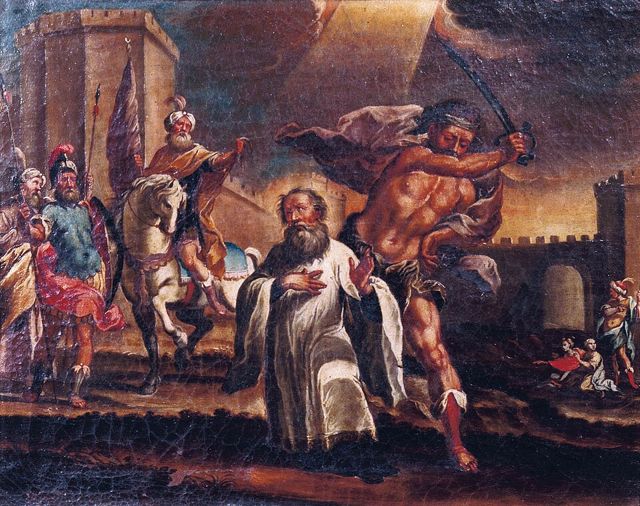
After the death of the archbishop of Toledo, the clergy and people of that city cast their eyes on Eulogius, as his successor. But God was about to crown him with martyrdom. There was in Cordova a girl named Leocritia, who had been converted from Mohammedanism to Christianity. For a Moslem to profess the religion of Christ was death. To save her, Eulogius hid her in the house of his sister, Annulona, and when the officers of justice were in pursuit of her, he conveyed her from one Christian house to another. But this could not last long. The place of her concealment was discovered, and Leocritia was taken, and Eulogius, for having secreted her, was also confined. He was ordered to execution, and was decapitated on Saturday, March 11th, 859, and Leocritia suffered the following Wednesday, and was buried in the church of S. Genes, at Cordova. Because March 11th usually falls in Lent [the forty days of fasting before Easter], the Church of Cordova transfers the feast of S. Eulogius to June 1st, the day of the first translation [the solemn moving of a saint’s relics to a new shrine] of his body, and observes it with an Octave. The body was afterwards carried to Oviedo, together with that of S. Leocritia, on Jan. 19th, 883, and a third translation took place to Camarasanta, in 1300. For Flora and Mary, see November 24.