St. Eupsychius

Faithfulness to Christ when it cost everything.

Read the essentials →
April 9 · Martyr

St. Eupsychius

St. Eupsychius

Faithfulness to Christ when it cost everything.

Traditional feast

April 9
1914 / pre-1969 calendar, per Baring-Gould (1897)

Current feast

April 9
Secondary source · Wikipedia

Represents

Martyr

Their story

Adapted in modern English from Alban Butler's Lives of the Saints · Baring-Gould original below · little is known

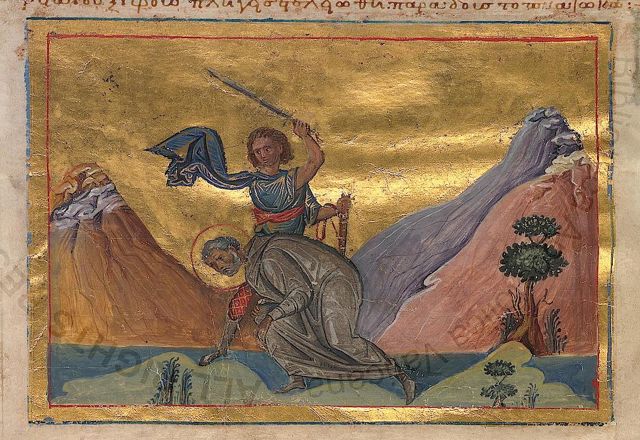
When Julian the Apostate (emperor 361–363, raised Christian, who tried to restore paganism) came to Caesarea in Cappadocia on his way to Antioch, he was angry to find most of the city Christian, and its last pagan temple, that of Fortune, recently torn down. He stripped the city of its name and the churches of their goods, enlisted the clergy in the militia and heavily taxed the laity.

Many Christians were put to death, chief among them Eupsychius, a young nobleman lately married. Instead of rebuilding the temples as ordered, the Christians built a church in his honour, where St Basil later kept his feast.
Early life

Selected sentences from the original account, unaltered.

Eupsychius was a native of Caesarea, and had just taken to himself a wife, when he was apprehended and executed.

What they represent

How they teach us to live

Drawn from themes in the original account

Learn from the kind of life it was. Faithfulness to Christ when it cost everything.

Keep their day. Remember them on April 9 with a short prayer, and ask for their help.

Read more

The full original · 140 words

Read Baring-Gould’s full account

Baring-Gould’s sources: Modern Roman Martyrology. Greek Menaea and Menology of the Emperor Basil the Younger. Authority: — Sozomen, Hist. Eccles., lib. This saint was one of the sufferers under the apostate 6 *. Waltrudis.

…emperor Julian, at Caesarea, the capital of Cappadocia [a region of central Turkey], where the Christians had closed all the temples and destroyed that of Fortune. Sozomen says that the emperor had long regarded the inhabitants of Caesarea with extreme aversion, because they were so zealously attached to Christianity. Eupsychius was a native of Caesarea, and had just taken to himself a wife, when he was apprehended and executed. Sozomen says, “ I believe that Eupsychius was condemned in consequence of the demolition of the temple of Fortune, which excited the anger of the emperor against all the inhabitants of Caesarea. Indeed, all the actors in this transaction were condemned, some to death, and others to banishment 11 S. Gregory Nazianzen mentions a Church dedicated to him (Ep. 26), and S. Basil the Great (Ep. 291) invited the bishops of Pontus [a region on the Black Sea coast of Turkey] to celebrate his feast

Feast days

Feast: April 9

Nine days · Free

Pray the novena
with us.

One short email a day for nine days. The day's prayer, a line from St. Eupsychius's story, and a nudge to keep going.

Also on April 9
St. Mary, the Wife of Cleopas

St. Mary

April 9 · Feast
St. Prochorus of Nicomedia

St. Prochorus of…

April 9 · Martyr, Bishop
← All 1726 saints in the library
Sources & notes

Feast-day sources

Story sources

Sources

Credits

Image: Menologion of Basil 012.jpg · Authors of Menologion of Basil II (circa 985 AC, Constantinople), Byzantine manuscript illuminators[1]: Pantoleon with G · Public domain, via Wikimedia Commons

From Sabine Baring-Gould, The Lives of the Saints, new edition in 16 vols. (London: John C. Nimmo, 1897–98); text from the Internet Archive scan (OCR, lightly cleaned; errors possible). Public domain.

Image: Authors of Menologion of Basil II (circa 985 AC, Constantinople), Byzantine manuscript illuminators[1]: Pantoleon with G, Wikimedia Commons (Public domain)

From Sabine Baring-Gould, The Lives of the Saints, new edition in 16 vols. (London: John C. Nimmo, 1897–98); text from the Internet Archive scan (OCR, lightly cleaned; errors possible). Public domain in the United States. Reproduced unedited, except for short bracketed notes in grey that we added to explain names and terms (“S.” is the old abbreviation for Saint). Some history and judgments reflect 19th-century scholarship.