E

Eusebia was the eldest daughter of St. Adalbald and St. Richtrudis.

Read the essentials →
March 16 · Abbess

St. Eusebia of Hamage

St. Eusebia of Hamage

Eusebia was the eldest daughter of St. Adalbald and St. Richtrudis.

Traditional feast

March 16
1914 / pre-1969 calendar, per Baring-Gould (1897)

Current feast

Not verified yet

Represents

Abbess

Their story

Adapted in modern English from Baring-Gould (1897) · original text below

Eusebia was the eldest daughter of St. Adalbald and St. Richtrudis. Probably after her father's murder she was sent to the convent of Hamage under her grandmother St. Gertrude, and at twelve was elected abbess, since noble abbesses could secure powerful protection. Her mother, now abbess of Marchiennes, thought her too young and ordered her and her nuns to move there.

Eusebia obeyed reluctantly, carrying St. Gertrude's body, but missed Hamage and slipped out at night barefoot to pray there. Richtrudis had her brother Maurontius punish her with a beating; dodging, she was slightly cut by his sword. A popular legend, recorded as such, says a twig from the birch rod took root and became a tree. On the bishop's advice, Richtrudis let her return, and Eusebia ruled Hamage wisely until her death. In Belgium she is called St. Isoie.

At Marchiennes the community was met by a procession with lights and incense, but Eusebia remained unhappy. She went to Hamage at night to pray over the home of her childhood, full of memories of her grandmother. She kept trying to return until her mother gave in. She was buried in the church of the Apostles at Hamage, and later moved to Marchiennes.

Struggles & surrender

What they wrestled with, and how they gave it to God

  • Conflict with her mother ·
    Source: Baring-Gould, Lives of the Saints. Made abbess at twelve, Eusebia was ordered to Marchiennes by her mother and punished when she kept slipping back to Hamage.

Early life

Selected sentences from the original account, unaltered.

S. Eusebia was the eldest daughter of S. Adalbald, of Douai (Feb. 2nd) and S. Richtrudis. Probably on the occasion of the assassination of her father, she was sent to the convent of Hamage, which was governed by her grandmother, S. Gertrude. On the death of S. Gertrude, Eusebia, at the age of twelve, was elected abbess of Hamage, according to a custom of the time, which required abbesses, if possible, to be of noble birth, so as to secure for the convent protection from powerful families in times of difficulty or war.

What they represent

How they teach us to live

Drawn from themes in the original account

Build up the community you belong to. This life was lived with and for a community.

Keep their day. Remember them on March 16 with a short prayer, and ask for their help.

Read more

The full original · 392 words

Read Baring-Gould’s full account

Baring-Gould’s sources: Molanus, Wyon, Menardus, Miræus in his 'Belgian Saints,' and Saussaye in his Gallican Martyrology. Authority:—A life, probably by Hucbald of Elnone (907), derived from various earlier accounts and traditions.

S. Eusebia was the eldest daughter of S. Adalbald, of Douai (Feb. 2nd) and S. Richtrudis. Probably on the occasion of the assassination of her father, she was sent to the convent of Hamage, which was governed by her grandmother, S. Gertrude. On the death of S. Gertrude, Eusebia, at the age of twelve, was elected abbess of Hamage, according to a custom of the time, which required abbesses, if possible, to be of noble birth, so as to secure for the convent protection from powerful families in times of difficulty or war. But S. Richtrudis, who had become abbess of Marchiennes, thinking that the girl was far too young to manage the community, and that under her light hand grave disorders might prevail, peremptorily ordered Eusebia to come with all her nuns to Marchiennes. Eusebia hesitated, but when the orders were repeated, she reluctantly obeyed, and with all the community, bearing the body of S. Gertrude, she came to Marchiennes, where they were received by a procession with lights and incense. Eusebia was not happy in her new home, and sighed for Hamage. During the night, when every one slept, she was wont to steal out, barefooted, and run to the deserted convent, to watch and pray over the home of her infancy, fragrant with memories of a beloved guide and spiritual mother. Richtrudis, hearing of these nocturnal excursions, and not approving of them, ordered the child-abbess a sound flogging, and asked her brother Maurontius to administer it. Eusebia writhed and danced about under the correction, to elude the blows, and in so doing ran against the point of the sword of Maurontius, which slightly wounded her side. According to a popular legend, which the historian records merely as such, one of the twigs of the birch with which Eusebia was corrected, rooted itself on the spot where it had fallen, and grew up into a stately tree.

Richtrudis, seeing that her child continued bent on returning to Hamage, consulted the bishop, who advised her to yield. Accordingly Eusebia and her community went back to the deserted convent, and she governed it with prudence, living in piety, till the day of her death. She was buried in the church of the Apostles, at Hamage; but the body was afterwards translated to Marchiennes.

In Belgium she is called S. Isoie, or Eusoye.
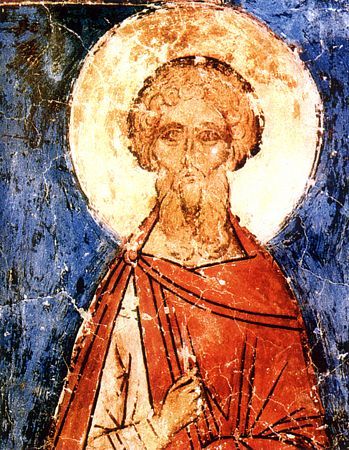
Feast days

Feast: March 16

Nine days · Free

Pray the novena
with us.

One short email a day for nine days. The day's prayer, a line from St. Eusebia of Hamage's story, and a nudge to keep going.

Also on March 16
H

Sts. Hilary

March 16 · Bishop, Martyr, Deacon, Martyrs
St. Julian of Anazarbus

St. Julian of Anazarbus

March 16 · Martyr
P

St. Papas

March 16 · Martyr
← All 1726 saints in the library
Sources & notes

Feast-day sources

Story sources

Sources

Credits

From Sabine Baring-Gould, The Lives of the Saints, new edition in 16 vols. (London: John C. Nimmo, 1897), digitized text from Project Gutenberg. Public domain.

From Sabine Baring-Gould, The Lives of the Saints, new edition in 16 vols. (London: John C. Nimmo, 1897), digitized text from Project Gutenberg. Public domain in the United States. Reproduced unedited, except for short bracketed notes in grey that we added to explain names and terms (“S.” is the old abbreviation for Saint). Some history and judgments reflect 19th-century scholarship.