Baring-Gould’s sources: Authority, a life written in the 12th century, from tradition. Like so many of these Irish lives which were handed down from generation to generation, it contains many improbabilities.
S. Fechin was abbot of Foure, in West Meath, where he governed three hundred monks. He is said to have pitied the monks engaged in grinding their corn in querns, he therefore brought water from a marsh to the monastery, by cutting a tunnel through the rock, and then established a water mill. Of this Giraldus Cambrensis relates the following:—There is a mill at Foure, which S. Fechin made most miraculously with his own hands, in the side of a certain rock. No women are allowed to enter either this mill or the church of the saint; and the mill is held in as much reverence by the natives as any of the churches dedicated to him. [98] The Saint finding a poor leper, full of sores one day, took him to the Queen, and bade her minister to him as to Christ. She bravely overcame her repugnance, and tended him with gentle care. [99] Fechin was the son of Coelcharna, descendant of Eochad Fionn, brother to the famous king Conn of the Hundred Battles, and his mother Lassair was of the royal blood of Munster. When fit to be sent to school he was placed under S. Nathy of Achonry. Having finished his studies he was ordained priest, and retired to a solitary place at Fore in Westmeath, there to live as a hermit. But he was followed by many disciples, and Fore became a monastery of three hundred monks. He also established a religious house in the island of Immagh, near the coast of Galway. The inhabitants were then pagans, but Fechin and his monks converted them. His influence was very great with the kings and princes of his age. He died of a dreadful pestilence which swept Ireland in a.d. 665.
The Peacock as a Christian Emblem
FOOTNOTES:
[91] This was the common acclamation at the election of bishops, of which we have many examples in Philostorgius, lib. ix. c. 10. And in the relation of things done at the election of Eradins (recorded in S. Augustine's Epistles), we read that they cried out twenty times, "He is worthy and just!" and five times, "He is deserving, he is worthy!"
[92] Eusebius [Eusebius of Caesarea (d. c. 339), the first historian of the Church]. lib. vi. c. 29.
[93] Ibid. c. 39.
[94] This name presents a difficulty, as it does not appear in the lists of the prefects of the city. Bollandus suggests, not very plausibly, that on account of his secession from the state religion, his name was expunged.
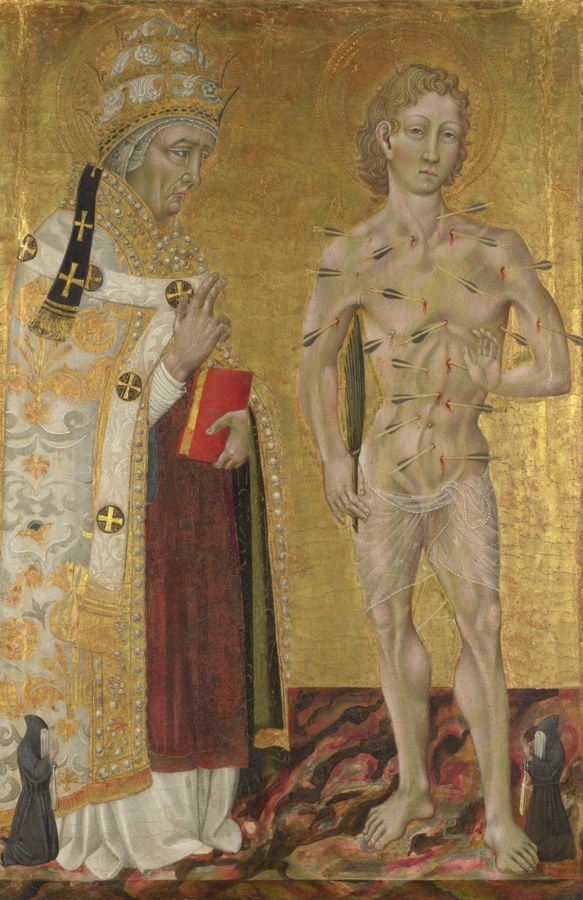
[95] This is H. E. Cardinal Wiseman's elegant description of the scene, which accords exactly with the Acts. This incident is not due to his imagination, but occurs in the Acts in these words:—"Igitur, cum hæc Beatissimus Sebastianus, indutus chlamyde, succinctus baltheo, ex suo ore proferret, subito per unam fere horam splendore nimio de cœlo veniente illuminatus est."
[96] In the version of the Acts by S. Ambrose [bishop of Milan (d. 397)], the whole lengthy exhortation is given. This can hardly, however, be original, but is the composition of the author who passes for S. Ambrose.
[97] A Laura was a colony of eremites dwelling in separate hovels or caves, and differed in this particular from a monastery, where all dwelt under one roof.
[98] Topography of Ireland, c. 52.
[99] Here occurs a very favourite incident in the lives of these Irish saints; it shall be given in Latin. The same is told of S. Mochua and others. "Leprosus ad Reginam dixit: Nares meas in ore tuo suge, et phlegma inde extrahe. At illa viriliter agens, sicut imperavit fecit, et phlegma in linteum posuit; iterum quoque ei mandavit, ut similiter faceret, et id quod extraheret, S. Fechino reservaret." When the Queen looked into the handkerchief, she found two clots of solid gold, one of which she retained, the other she gave to S. Fechin. The incident I give as characteristic, rather than edifying.
SS. Fructuosus , B.M. , Augurius, and Eulogius , DD., MM., at Tarragona, in Spain , a.d. 259. S. Patroclus , M., at Troyes, in France, circ. a.d. 272. S. Agnes , V.M., at Rome, circ. a.d. 303. S. Epiphanius , B. of Pavia, in Italy , a.d. 496. S. Meinrad , H. M., at Einsiedeln, in Switzerland , a.d. 861.