Faithfulness to Christ when it cost everything.
Read the essentials →Faithfulness to Christ when it cost everything.
June 13
June 13
Virgin
Martyr
Surely Flaccus is noble, rich* young, elegant, a count, and a friend of the emperor.1 Felicula only answered, “I am a Christian maiden dedicated to Christ” The executioner said, pitying her youth and beauty, “Say that thou art not a Christian, and I will cast thee off.”
Learn from the kind of life it was. Faithfulness to Christ when it cost everything.
Keep their day. Remember them on June 13 with a short prayer, and ask for their help.
Then Flaccus gave her to his under officer, who imprisoned her without food for seven days. The officer endeavoured to break her constancy by his words, “ Why die a wretched death? Surely Flaccus is noble, rich* young, elegant, a count, and a friend of the emperor.1 Felicula only answered, “I am a Christian maiden dedicated to Christ”
Jaw S. Aquilina. 177 Then she was taken to the vestal virgins, and left with them seven days, in hopes that they would be able to persuade her, but still in vain. So she was stretched on the rack. The executioner said, pitying her youth and beauty, “Say that thou art not a Christian, and I will cast thee off.”
But she cried out, “ I begin to see Him whom my soul loveth, who for me tasted gall, and wore the crown of thorns, and died upon the cross.” Then she was removed and thrown into one of the sewers of Rome, where she was suffocated. But Nicomede the priest, by night, penetrated to where the body was, and removed and buried it in a cemetery on the Via Ardeatina.
There is much uncertainty as to where her genuine relics [the bodily remains of a saint, or objects they used, kept with honor] repose, two churches in Rome dispute the possession of her body, S. Praxedes, and S. Lorenzo in Lucina, but so does also the church of S. Paul at Parma, to which it was translated in 1427. Also, a body at Pavia, and some portions of the relics at Fulda. The confusion has arisen probably from there having been several martyrs of the same name. Two others, Roman martyrs, are commemorated on Feb. 14th and June 5th.
Feast: June 13
One short email a day for nine days. The day's prayer, a line from St. Felicula's story, and a nudge to keep going.
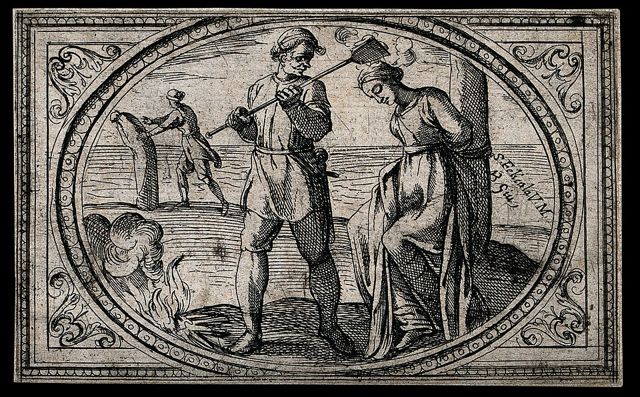
Image: Saint Felicula tied to a pole and burnt, and later being Wellcome V0031952.jpg · Unknown · CC BY 4.0, via Wikimedia Commons
From Sabine Baring-Gould, The Lives of the Saints, new edition in 16 vols. (London: John C. Nimmo, 1897–98); text from the Internet Archive scan (OCR, lightly cleaned; errors possible). Public domain.
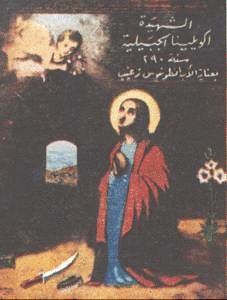
Image: Unknown, Wikimedia Commons (CC BY 4.0)
From Sabine Baring-Gould, The Lives of the Saints, new edition in 16 vols. (London: John C. Nimmo, 1897–98); text from the Internet Archive scan (OCR, lightly cleaned; errors possible). Public domain in the United States. Reproduced unedited, except for short bracketed notes in grey that we added to explain names and terms (“S.” is the old abbreviation for Saint). Some history and judgments reflect 19th-century scholarship.