Baring-Gould’s sources: Beatified by Pope Urban VIII. in 1625; canonized by Clement XI. in 1712; but the bull of canonization was not published till 1724, by Benedict XIII. Authorities: — A life by Fr. Sancti, Guardian of the Capuchin Convent at Rome, in which he lived and died; and another contemporary life by Matthias Salodiensis.] This good Capuchin was bom at Cantalice, at the foot of the Apennines, on the confines of the Duchy of Spoleto, in the year 1513. His parents were very poor, and worked for their daily bread. His father’s name was Sante, or Saint, and he was a good man, and had even a sort of prophetic power, for it is told of him that as he watched the death of a little grandson, he said, “ Go forth in peace, my little saint, with God’s blessing and thy grandfather’s, on Saturday next we shall meet again.” And though he was hale when he spoke, on the day he had named the old man died. Felix was the third of four children. Even from his childhood he showed a marked leaning towards religion, so that the children used to point him out as “ Felix the little saint.” His childhood was passed keeping sheep. He was wont to take his rest in the heat of noon, and say his prayers under a great oak, in the bark of which he cut a cross. When sufficiently old, he was placed at the plough. His conduct was always unimpeachable, always quiet, self-contained, seeking peace and ensuing it. When any of his companions ill-treated or abused him, his usual soft answer to turn away wrath was, “ May God make a saint of thee, my friend ! ”
One day he heard read the lives of some of the Egyptian hermits, and he felt a great longing to embrace the life of a recluse; but, on further consideration, he thought himself not equal to such a life, and he preferred entering a religious house. Yet he postponed the day from year to May x8.] vS. Felix of Cantcdice. 259 year, till an accident made him resolve to delay his renunciation of the world no longer. He was driving two bullocks in a plough, when his master suddenly opened the gate into the field and entered in a black dress. This scared the oxen, and they dashed over Felix, trampling him under foot, and drew the plough over him. Providentially he was unhurt, though his clothes were cut and torn. He delayed no longer, but went to the nearest convent of Capuchins, and asked to be admitted as a lay novice. The superior took him by the hand, led him before a crucifix, and said, “ Look up, Jesus Christ suffered for thee. Hast thou courage to follow His traces ? ” The tears rolled down the ploughman’s cheeks, and he expressed his desire to take up his cross in such fervent words, that the superior gave him a letter of introduction, and sent him to the provincial at Rome. He was then thirty years old. He passed his noviciate in the convent of Anticola. Four years after he was sent to Rome, and there spent the rest of his life. As his deficiency in education prevented him from aspiring to be a choir brother, he was employed in going about begging for food and money for the convent. When given anything he at once responded Deo gratias, “ Thanks be to God.” And this expression became so familiar to his lips that he uttered it on every occasion. Once he came upon two gentlemen fighting a duel, he rushed between them, beat down their swords, crying, “Deo gratias; my brethren, say Deo gratias, each of you.” And there he stood grasping their swords in his firm hands, and looking from one to the other. At last the gentlemen said the required words. “ Now your battle is done,” said the Capuchin; “ let me hear the occasion of your quarrel and reconcile you.” And he succeeded in sending them away friends. “ Oh, how fair is creation ! ” he would exclaim on issuing from the convent gates, “Deo gratias ! All the creatures of God serve only to raise our hearts to the giver of all good things, and make us cry out in love and thankfulness, Deo gratias ! ”
And when he came on little children playing with flowers, or plucking fruit, or full of merriment over some innocent toy, he would stop, point up to the blue sky, as recalling to them the source of all beauty, pleasure, and happiness, and say “Deo gratias!” He became so well known by this expression that the little ones used to call him Brother Deo gratias; and from a distance, when they saw the old white-bearded Capuchin coming along in his snuff-coloured habit, they would cry out, “ Deo gratias ! brother Felix, Deo gratias ! ” Then the old man’s eyes would fill with tears, and a smile would light up his rugged features, and he would exclaim, “My dear children, yes, Deo gratias ! God bless you all ! ”
When he returned from his begging expeditions, he loved to retire to the church and kneel before the Blessed Sacrament in a rapture of love and thankfulness, and pour forth his prayer. He was watched once, and was seen standing before the altar, with outspread arms, supplicating, “ Lord, I recommend to Thee my poor people; I recommend to Thee the kind persons who have been our benefactors. Great God, have mercy on them all.” It was a short, simple prayer, but it expressed all the charily of his heart.
He was asked once why he walked barefoot instead of wearing sandals like the other friars. “ Only because it is easier for my feet,” said he, though in reality he had rejected sandals out of humility. In his old age the guardian once said something about his being loo aged to carry the sack of food he had begged. “Nay, nay,” said S. Felix, “let the old ass carry its load till it falls under it.” ft ft S. Felix of Cantalice.
When he was very ill and confined to his bed, if not closely watched, he would crawl to the church and faint away before the altar. In his last agony he was as though engaged in conflict with the enemy of souls, for he rose partly in bed, on one elbow, and waving the other arm in the air, as his dim eyes looked into vacancy, he said, “No, I cannot despair; it is my own Saviour Who will judge me, and I will not doubt His mercy.5' Then he laid himself down again and sighed forth his innocent and happy soul.
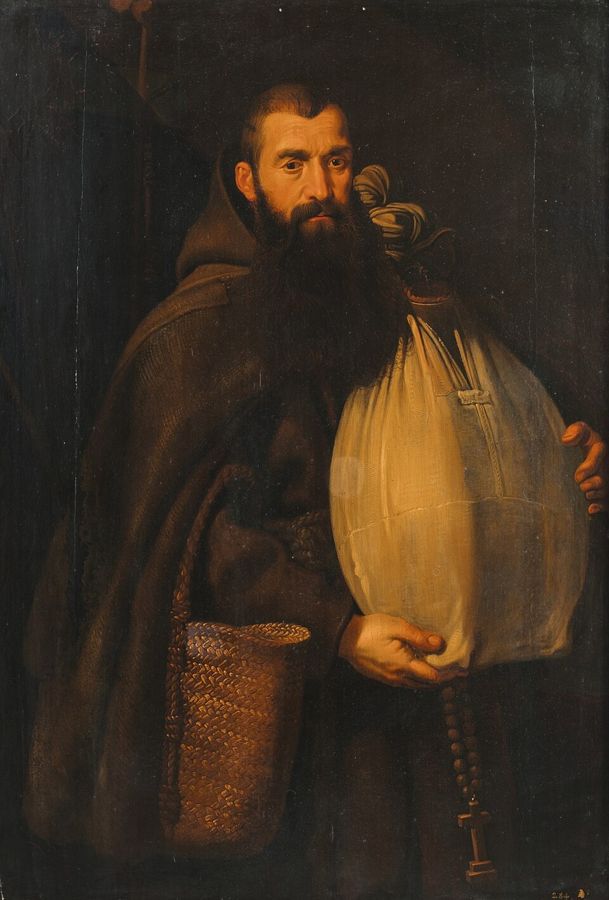
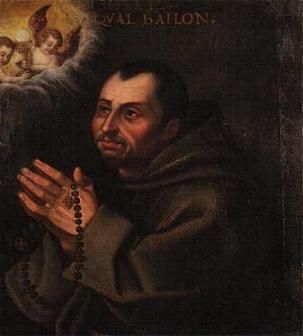
His body is in the church of his Order in Rome. He is represented with a sack over his shoulder, on which is written Deo gratias, or leading an ass laden with the sack; sometimes giving S. Philip Neri to drink out of a bottle in the midst of a street, this incident being related of him.