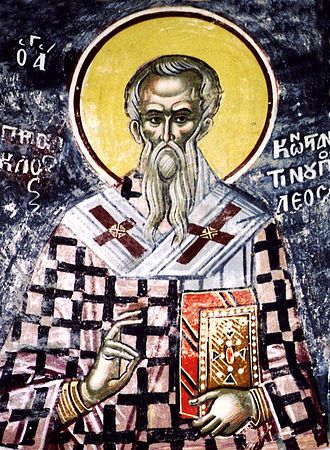
Baring-Gould’s sources: In the 9th cent. Neapolitan Martyrology cut on marble,* on Aug. 30. In some copies of the Old Roman Martyrology, wrongly attributed to S. Jerome. Greek Mensea and Modern Roman Martyrology. Ado, Bede, Hrabanus, &c., generally on Oct. 24. Authorities There are several versions of the Acts; that in Ruinart is the briefest and best, and is perfectly trustworthy.] N 303 an edict was issued by Diocletian and Maximian for the destruction of Christian churches, the burning of the sacred books of the Christians, and ordering, in the event of any persons refusing to surrender their books, that they should be punished capitally. Theodoret speaks of all the chinches being destroyed on Good Friday, and this was perhaps the case in that part of Syria with which he was acquainted. The Acts of S. Felix, Bishop of Tubzacene, in Africa, say that the edict reached that city on June the 5th. “Thereupon the curator, Magnilianus, ordered the elders of the people to be led See Nov. 34.
7 Mai, Script vett. V. p. 63. before him. That same day, Felix the bishop was on his way from Carthage. The magistrate therefore summoned before him Asser the priest, and Gyrus and Vitalis the lectors. To them Magnilianus said, ‘Have you sacred books ? ’ Asser said, ‘ We have/ Magnilianus the curator said, ‘ Give them up to be burnt/ Then Asser said, ‘ Our bishop has them with him/ Magnilianus asked, ‘ Where is he ? 9 Asser answered, ‘ I know not/ Magnilianus said, ‘ You shall be in charge till you give an account of them to the proconsul, Anulinus/ “On the following day, Felix the bishop arrived at Tubzacene from Carthage. Then Magnilianus ordered him to be arrested and brought before him. To him he said, ‘ Bishop Felix, give up the books or parchments which you have/ Felix said, ‘ I have them, but I will not surrender them/ Magnilianus said, ‘ The law is before everything, and must be obeyed. * Felix answered, ‘ The law of God is before the commandments of men/ Magnilianus said, ‘ Consider this well/ “ On the third day the curator ordered Felix the bishop to be led before him, and he said to him, ‘ Hast thou considered the matter?* Felix said, ‘What I said before I am ready to repeat to the proconsul/ Magnilianus said, ‘ Very well, to the proconsul shalt thou give an account/ Then he assigned to him Vincentius Celsus, decurion of the city of Tubzacene, as his guard.
“After that, Felix left Tubzacene on June the 24th. He was led bound to Carthage; and he was ordered to be cast bound into prison. On the next day, Felix the bishop was brought out, and the proconsul said to him, ‘ Why have you not surrendered the superfluous scriptures ? * Felix said, ‘ I have such, but I will not give them up/ Then the proconsul ordered him to be cast bound into the inmost prison.1 1 See S. Ferreolu*, Sept. x8.
S. Felix of Tubzacene. " After sixteen days, Felix the bishop was brought forth in chains at the fourth hour of the night, and led before Anulinus the pro-consul. Anulinus said to him, 4 Why have you not given up the superfluous scriptures ? 9 Felix replied, proconsul ordered him to be sent to Rome to the praetorian prefect, on July 15th. And the prefect bade that Felix should be placed in prison and bound with greater chains. After nine days the prefect ordered him to be sent by ship after the emperors.
“ Then Felix the bishop entered the ship, and was in the hold,1 heavily chained, during four days, where he was under the legs of the horses, and without bread or water. He arrived fasting at the port, and he was received at Agrigentum by the brethren with the highest honour. Thence they went to a city called Catana. There they were similarly received. Thence they went to Messana, and thence to Taurominium, where they were received in like manner. Afterwards they crossed the straits and came into the parts of Lucania, to the city of Rhegium. And thence they went to Venusium, which is a city of Apulia. There the prefect ordered the chains to be taken off Felix, and said to him, 4 Felix, why do you not surrender the dominical scriptures ? Perhaps you have none ?' But he answered, 4 I have them, but I will not give them up/ The prefect said, 4 Slay Felix with the sword/ Felix the bishop with a loud voice cried, 4 I give thanks to Thee, Lord, who hast deigned to set me free/ “ And he was led to the place of his passion, and there the very moon shone red as blood, on the 30th day of August. Felix raising his eyes to Heaven, with a loud voice said, ‘ I give Thee thanks, Lord ! I have spent fiftysix years in this world. I have kept my virginity; I have 1 In the various editions of the Acts, “ capsa, subsaanio, subscalmo.” kept the Gospels safe; I have preached the faith and truth. Lord God of Heaven and Earth, Christ Jesus, to Thee I bow my neck as a victim, O Thou who art eternal, to whom be brightness and magnificence for ages of ages. Amen. * ” Such is the original text of the Acts, perfectly natural, simple, and trustworthy. It speedily suffered interpolation. At Nola, another S. Felix is venerated. At Rome, on August 30th, “On the Ostian way the blessed martyrs, Felix and Adauctus, who perished under Diocletian [Roman emperor 284–305, who began the ‘Great Persecution’ of Christians in 303] and Maximian [Diocletian’s co-emperor in the West, 286–305] ” This has led to confusion; in a kalendar in the Vatican, and in that of Stavelot, published by Martene, is inserted on August 30th, " In Apulia, the passion of SS. Felix and Adauctus.” Thus the scene of the martyrdom was altered.
At Venossa, where S. Felix died, are venerated also SS. Felix, Januarius, Fortunatus, and Septimius, MM., who died in the reign of Maximianus Herculius, and are commemorated at the end of August, like SS. Felix and Adauctus of Rome. In the Acts of SS. Fortunatus, Caius, and Anthes, venerated at Salerno on August 28th, we read that, “ Felix, Bishop of Buzocense (Tubzacene) and with him Donatus and Adauctus, priests, Fortunatus, Caius, and Anthes” were martyred under Diocletian and Maximian, on the 28th August; Felix and Adauctus on the Ostian road, near Rome; Fortunatus and the rest at Salerno. Donatus, however, is poached from Otranto, where he is said to have been martyred on that day with eleven of his brothers. From this it is clear that the same saints have been used over and over again, and made martyrs in different cities, and foiged acts have been provided them. A curious instance of the unscrupulous way in which the old and genuine acts were employed for the purpose of giving existence to local appropriation of martyrs, is found in anothei set of MSS. of the Acts of S. Felix, emanating S. Proclus.
from Nola. In these MSS. the old acts are amplified by the addition of more questions and answers between judge and martyr; but this is too common a trick to deserve further notice. But the name of the priest of Tubzacene, Asser, and those of the lectors, Gyrus and Vitalis, are deliberately altered into Januarius, Fortunatus, and Septimius. The name of Agrigentum, in Sicily, to which S. Felix was conveyed first from Rome, is altered into Nola, and all the subsequent account of his being conveyed to Catania, Messina, and across the straits to Rhegium, and thence to Venossa, is ex punged. Thus, with deliberate fraudulent intention, the scene of the martyrdom is transferred from Venossa to Nola.