St. Felix of Valois

Felix, born in 1127, gave up his possessions young and lived as a hermit in a forest near Meaux.

Read the essentials →
November 21 · Confessor

St. Felix of Valois

St. Felix of Valois

Felix, born in 1127, gave up his possessions young and lived as a hermit in a forest near Meaux.

Traditional feast

November 21
1914 / pre-1969 calendar, per Baring-Gould (1897)

Current feast

November 4 (also listed: November 20)
Secondary source · Wikipedia

Represents

Confessor

Their story

Adapted in modern English from the Catholic Encyclopedia (1913) · original text below · little is known

Felix, born in 1127, gave up his possessions young and lived as a hermit in a forest near Meaux. St John of Matha joined him and proposed founding an order to ransom captives. They went to Rome, where Innocent III approved the Order of the Holy Trinity, whose rule was confirmed in 1198.

Felix returned to France, where King Philip Augustus supported the order, and built its mother house at Cerfroi on the site of his hermitage. Within forty years it had six hundred houses. He died at Cerfroi on 4 November 1212.

Early life

The book says little or nothing about early life. This is how the account begins.

Thin entry · the 1897 book gives only 0 words. We have not filled the gap with invented detail.

What they represent

How they teach us to live

Drawn from themes in the original account

Keep their day. Remember them on November 21 with a short prayer, and ask for their help.

From the Catholic Encyclopedia

1913 · 461 words

Born in 1127; d. at Cerfroi, 4 November, 1212. He is commemorated 20 November. He was surnamed Valois because, according to some, he was a member of the royal branch of Valois in France, according to others, because he was a native of the province of Valois. At an early age he renounced his possessions and retired to a dense forest in the Diocese of Meaux, where he gave himself to prayer and contemplation. He was joined in his retreat by St. John of Matha, who proposed to him the project of founding an order for the redemption of captives. After fervent prayer, Felix in company with John set out for Rome and arrived there in the beginning of the pontificate of Innocent III. They had letters of recommendation from the Bishop of Paris, and the new pope received them with the utmost kindness and lodged them in his palace. The project of founding the order was considered in several solemn conclaves of cardinals and prelates, and the pope after fervent prayer decided that these holy men were inspired by God, and raised up for the good of the Church. He solemnly confirmed their order, which he named the Order of the Holy Trinity for the Redemption of Captives. The pope commissioned the Bishop of Paris and the Abbot of St. Victor to draw up for the institute a rule, which was confirmed by the pope, 17 December, 1198. Felix returned to France to establish the order. He was received with great enthusiasm, and King Philip Augustus authorized the institute France and fostered it by signal benefactions. Margaret of Blois granted the order twenty acres of the wood where Felix had built his first hermitage, and on almost the same spot he erected the famous monastery of Cerfroi, the mother-house of the institute. Within forty years the order possessed six hundred monasteries in almost every part of the world. St. Felix and St. John of Matha were forced to part, the latter went to Rome to found a house of the order, the church of which, Santa Maria in Navicella, still stands on the Caeclian Hill. St. Felix remained in France to look after the interests of the congregation. He founded a house in Paris attached to the church of St. Maturinus, which afterwards became famous under Robert Guguin, master general of the order. Though the Bull of his canonization is no longer extant, it is the constant tradition of his institute that he was canonized by Urban IV in 1262. Du Plessis tells us that his feast was kept in the Diocese of Meaux in 1215. In 1666 Alexander VII declared him a saint because of immemorial cult. His feast was transferred to 20 November by Innocent XI in 1679.

Read more

The full original · 0 words

Read Baring-Gould’s full account

Baring-Gould’s sources: Roman Martyrology on Nov. 4 and 20; also that of the Trinitarians. Declared Venerable by Alexander VII. His feast transferred from Nov. 4, the day on which he died, to Nov. 20, by Innocent XI. in 1679. The Trinitarians pretend that he and S. John of Matha were canonized by bull of Urban IV. in 1260, but the bull does not exist. Authority Francis a S. Laurentio, “ Compendium Vitae SS. Johannis et Felicis.”] Felix was born in 1127; his origin is obscure. He derived his designation from inhabiting the forest of Cerfroid, in the province of Valois. The Trinitarians have made great efforts to convince themselves and the world that he was of the royal race of Valois, but with most limited success. He was joined in his retreat by John of Matha, and together they founded an order for the redemption of captives. Felix, though seventy years old, readily fell in with the plan of his enthusiastic companion, and they started together for Rome in the winter of 1197-8 to obtain approbation of their scheme. Innocent III. lodged them in his palace, and approved the foundations of the Order, which he commended to the Holy Trinity, and of which he appointed John of Matha superior-general. Eudo de Sully, bishop of Paris, and the abbot of S. Victor were commissioned to draw up the rules for the new society, which were confirmed by the Pope on December 17, 1198. The mother house of the order was established in the wood of Cerfroid. The order grew so rapidly that in forty years six hundred monasteries are said to have belonged to it. S. Felix directed those in France, while S. John resided at Rome, or made journeys into Barbary to redeem captives. S. Felix died on November

Feast days

Feast: November 4
Traditional: November 21

Nine days · Free

Pray the novena
with us.

One short email a day for nine days. The day's prayer, a line from St. Felix of Valois's story, and a nudge to keep going.

Also on November 21
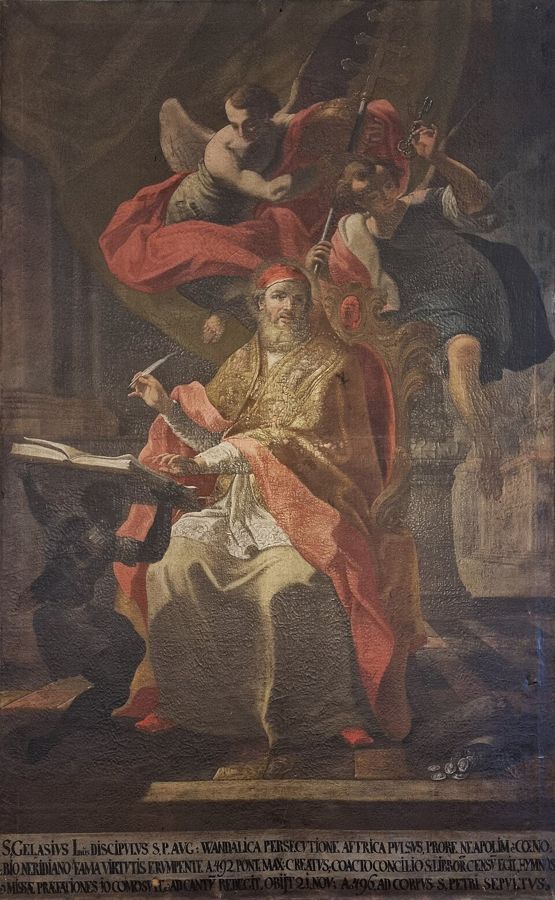
St. Gelasius, Pope

St. Gelasius

November 21 · Feast
← All 1726 saints in the library
Sources & notes

Feast-day sources

Story sources

Sources

Credits

Image: San felix valois.jpg · Unknown authorUnknown author · Public domain, via Wikimedia Commons

From Sabine Baring-Gould, The Lives of the Saints, new edition in 16 vols. (London: John C. Nimmo, 1897–98); text from the Internet Archive scan (OCR, lightly cleaned; errors possible). Public domain.

Image: Unknown authorUnknown author, Wikimedia Commons (Public domain)

From “Catholic Encyclopedia (1913)/St. Felix of Valois,” The Catholic Encyclopedia (New York: Robert Appleton Company, 1907–1914), via Wikisource. Public domain. Matched by name and feast date; text unedited except for our bracketed notes in grey.

From Sabine Baring-Gould, The Lives of the Saints, new edition in 16 vols. (London: John C. Nimmo, 1897–98); text from the Internet Archive scan (OCR, lightly cleaned; errors possible). Public domain in the United States. Reproduced unedited, except for short bracketed notes in grey that we added to explain names and terms (“S.” is the old abbreviation for Saint). Some history and judgments reflect 19th-century scholarship.