St. Fiacre

Leaving everything to pray, yet still drawing people who needed wisdom.

Read the essentials →
August 30 · Hermit, Confessor

St. Fiacre

St. Fiacre

Leaving everything to pray, yet still drawing people who needed wisdom.

Traditional feast

August 30
1914 / pre-1969 calendar, per Baring-Gould (1897)

Current feast

August 30 (also listed: September 1)
Secondary source · Wikipedia

Represents

Hermit
Confessor

Their story

Adapted in modern English from the Catholic Encyclopedia (1913) · original text below

Fiacre was born in Ireland and, after ordination, lived as a hermit on the Nore. Seeking more solitude, in 628 he came to Meaux, where Bishop Faro gave him wooded land at Breuil. There he built an oratory to Our Lady, a hospice for strangers and a cell for himself. He lived by prayer, fasting and garden work, and a monastery grew up around him.

Legend says Faro granted him as much land as he could furrow in one day, and that Fiacre turned the earth with his staff. The source notes that his exclusion of women was simply the usual rule of Irish houses. He was famed for healing. He died on 18 August 670, and cures at his tomb drew pilgrims. He is patron of gardeners, and the French cab, the fiacre, is named after a Paris inn that bore his image.

Early life

The book says little or nothing about early life. This is how the account begins.

…brought to him, whom he cured by merely laying hands on them. After his death also, the date of which cannot be fixed with precision, streams of pilgrims came to Breuil, for the privilege and gratification of sitting in the depression made by Fiacre in the solid stone. The relics of S. Fiacre were removed to the Cathedral of Meaux in 1568, for protection against the fury of the Huguenots, but the stone was left at Breuil, and escaped their notice.

What they represent

How they teach us to live

Drawn from themes in the original account

Learn from the kind of life it was. Leaving everything to pray, yet still drawing people who needed wisdom.

Keep their day. Remember them on August 30 with a short prayer, and ask for their help.

From the Catholic Encyclopedia

1913 · 541 words

Abbot, born in Ireland about the end of the sixth century; died 18 August, 670. Having been ordained priest, he retired to a hermitage on the banks of the Nore of which the townland Kilfiachra, or Kilfera, County Kilkenny, still preserves the memory. Disciples flocked to him, but, desirous of greater solitude, he left his native land and arrived, in 628, at Meaux, where St. Faro then held episcopal sway. He was generously received by Faro, whose kindly feelings were engaged to the Irish monk for blessings which he and his father's house had received from the Irish missionary Columbanus. Faro granted him out of his own patrimony a site at Brogillum (Breuil) surrounded by forests. Here Fiacre built an oratory in honour of the Blessed Virgin Mary, a hospice in which he received strangers, and a cell in which he himself lived apart. He lived a life of great mortification, in prayer, fast, vigil, and the manual labour of the garden. Disciples gathered around him and soon formed a monastery. There is a legend that St. Faro allowed him as much land as he might surround in one day with a furrow; that Fiacre turned up the earth with the point of his crosier, and that an officious woman hastened to tell Faro that he was being beguiled; that Faro coming to the wood recognized that the wonderworker was a man of God and sought his blessing, and that Fiacre henceforth excluded women, on pain of severe bodily infirmity, from the precincts of his monastery. In reality, the exclusion of women was a common rule in the Irish foundations. His fame for miracles was widespread. He cured all manner of diseases by laying on his hands; blindness, polypus, fevers are mentioned, and especially a tumour or fistula since called "le fic de S. Fiacre".

His remains were interred in the church at Breuil, where his sanctity was soon attested by the numerous cures wrought at his tomb. Many churches and oratories have been dedicated to him throughout France. His shrine at Breuil is still a resort for pilgrims with bodily ailments. In 1234 his remains were placed in a shrine by Pierre, Bishop of Meaux, his arm being encased in a separate reliquary. In 1479 the relics [the bodily remains of a saint, or objects they used, kept with honor] of Sts. Fiacre and Kilian were placed in a silver shrine, which was removed in 1568 to the cathedral church at Meaux for safety from the destructive fanaticism of the Calvinists. In 1617 the Bishop of Meaux gave part of the saint's body to the Grand Duke of Tuscany, and in 1637 the shrine was again opened and part of the vertebrae given to Cardinal Richelieu. A mystery play of the fifteenth century celebrates St. Fiacre's life and miracles. St. John of Matha, Louis XIII, and Anne of Austria were among his most famous clients. He is the patron of gardeners. The French cab derives its name from him. The Hôtel de St-Fiacre, in the Rue St-Martin, Paris, in the middle of the seventeenth century first let these coaches on hire. The sign of the inn was an image of the saint, and the coaches in time came to be called by his name. His feast is kept on the 30th of August.

Read more

The full original · 373 words

Read Baring-Gould’s full account

Baring-Gould’s sources: Roman and Gallican Martyrologies, Aberdeen Breviary on Aug. 27, 1 and 30. Authority: — A life by an anonymous writer — late, 12th cent., and not trustworthy.] S. Fiacre, or Fiachre, was of an illustrious family in Ireland. Wishing to lead a solitary life, he withdrew to France with some followers, and applied to S. Faro ot Meaux, who was fond of the Irish, for some lonesome spot that might serve him as a retreat from the bustle of the world. The bishop immediately promised him as much ground in his own patrimony of Breuil as he could dig in a day. Fiacre dug so lustily that a woman complained to the bishop he had taken an unfair advantage of him; wherefore women were not allowed to enter his chapel. “ It is said,” we are told by Hector Boece, “ All wemen that gangis in his chapell wil be othir blind or wod (mad).” The woman, finding S. Faro paid no attention to her complaint, returned to the forest, and began to abuse S. Fiacre with all that warmth, copiousness of verbiage, and bitterness of tongue of which only woman is capable. Fiacre sat very depressed under this torrent of words on a stone, and the impression of his person is left on the stone to this day. The stone, with a curved impression in the centre, was preserved in the nave of the church of S. Fiacre at Breuil, placed on a pedestal for the convenience of pilgrims, who, suffering from hsemorrhaids, sat upon it, and received miraculous healing.2 At Breuil Fiacre erected a monastery in honour of the Blessed Virgin, where he used to receive strangers and guests, living himself in a cell apart. His reputation became so great, that from all parts infirm persons used to be 1 As Fiacre B. of Autun; there never was such a bishorv. S. Fiacre.

…brought to him, whom he cured by merely laying hands on them. After his death also, the date of which cannot be fixed with precision, streams of pilgrims came to Breuil, for the privilege and gratification of sitting in the depression made by Fiacre in the solid stone. The relics [the bodily remains of a saint, or objects they used, kept with honor] of S. Fiacre were removed to the Cathedral of Meaux in 1568, for protection against the fury of the Huguenots, but the stone was left at Breuil, and escaped their notice. Access to the chapel of S. Fiacre remained for long forbidden to women. Following a peculiarity of that sex, several at various periods persisted in attempting an entrance, and a string of miracles is recorded of the manner in which this curiosity was punished. One woman put her foot in at the door, and it swelled up to elephantine proportions, and the eyes of another who peeped in dropped out.

S. Fiacre died on the 18th of August, but his festival is celebrated on the 30th. There exists a curious “ Mystere de Monsieur Saint Fiacre” of the 15th century, published by M. Jubinal and a very interesting window of the 16th century at the church of S. Maclou in Pontoise, represents his legend. Unfortunately half the window is destroyed, but what remains represents eight scenes in his life, with the following inscriptions 1. “ Comme Sainct Fiacre en son jeune age alloit h l’escole pour apprendre la foy catholique.”

2. “ Comme le pere de Saint Fiacre, due de Hybernie, le voulut marier, avec... Damoiselle, fille ” (the rest illegible).

3. S. Fiacre departing from his parents. Inscription destroyed. 4. “ Comme Sainct Fiacre arriva a. la mer et pria un marinier de le passer en France.”

1 Mys teres inedits du xv° sifccle. VOL. IX. 5. “ Comme Sainct Fiacre, aprfes avoir pass£ la mer vint k Sainct Pharon, evesque de Meaux, et lui fit priere ”

6. “ Comme Sainct Pharon donna congd k Sainct Fiacre d’allerfaireun hermitage aubois pour soy y tenir.” 7. “ Comme Sainct Fiacre abattit grand nombre de boys et a tant fachd bequenaude qui le reprint et accusa k Saint Pharon.’' 8. “Comme Sainct Pharon consola Sainct Fiacre, et le reprint de son ddcouragement,”
Feast days

Feast: August 30

Nine days · Free

Pray the novena
with us.

One short email a day for nine days. The day's prayer, a line from St. Fiacre's story, and a nudge to keep going.

Also on August 30
F

Sts. Felix and Adauctus

August 30 · Martyrs
← All 1726 saints in the library
Sources & notes

Feast-day sources

Story sources

Sources

Credits

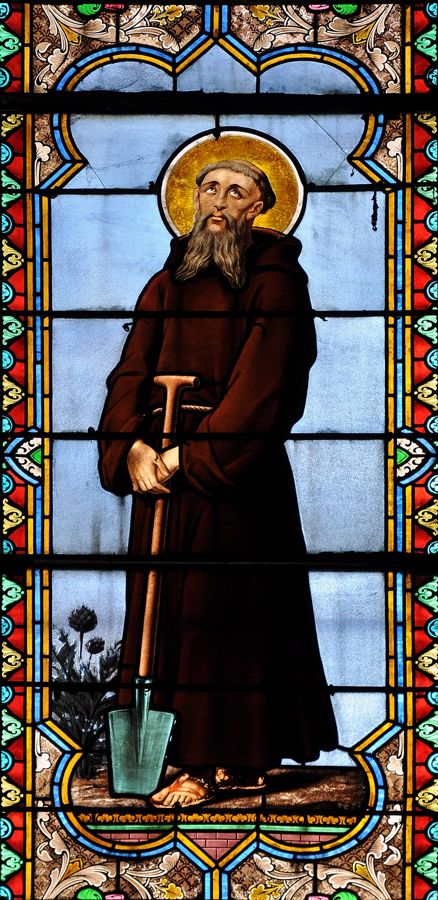
Image: Eglise Notre-Dame Bar-le-Duc Vitrail Saint Fiacre 30 04 2012.jpg · Vassil · CC0, via Wikimedia Commons

From Sabine Baring-Gould, The Lives of the Saints, new edition in 16 vols. (London: John C. Nimmo, 1897–98); text from the Internet Archive scan (OCR, lightly cleaned; errors possible). Public domain.

Image: Vassil, Wikimedia Commons (CC0)

From “Catholic Encyclopedia (1913)/St. Fiacre,” The Catholic Encyclopedia (New York: Robert Appleton Company, 1907–1914), via Wikisource. Public domain. Matched by name and feast date; text unedited except for our bracketed notes in grey.

From Sabine Baring-Gould, The Lives of the Saints, new edition in 16 vols. (London: John C. Nimmo, 1897–98); text from the Internet Archive scan (OCR, lightly cleaned; errors possible). Public domain in the United States. Reproduced unedited, except for short bracketed notes in grey that we added to explain names and terms (“S.” is the old abbreviation for Saint). Some history and judgments reflect 19th-century scholarship.