F

A shepherd who stayed with his people through hard times.

Read the essentials →
February 13 · Bishop

St. Finan of Lindisfarne

St. Finan of Lindisfarne

A shepherd who stayed with his people through hard times.

Traditional feast

February 13
1914 / pre-1969 calendar, per Baring-Gould (1897)

Current feast

Not verified yet

Represents

Bishop

Their story

Adapted in modern English from the Catholic Encyclopedia (1913) · original text below

Finan was an Irish monk trained at Iona, chosen by the Columban monks to succeed St Aidan as Bishop of Lindisfarne. Bede (the English monk-historian, d. 735) describes him as an able ruler and tells of his work converting Northumbria.

He built a cathedral at Lindisfarne in the Irish style, of hewn oak roofed with reeds. His zeal led to the founding of Gilling, Whitby and other houses. He baptised Peada, son of Penda and King of the Middle Angles, with his nobles. He gave Peada four priests, including Diuma, whom he consecrated bishop for the Middle Angles and Mercia.

In his time the different Irish and Roman dates for Easter caused real problems. One year King Oswy was keeping Easter with Finan while Queen Eanfled was still fasting and keeping Palm Sunday. The question was settled at the Synod of Whitby after Finan's death in 661.

Early life

The book says little or nothing about early life. This is how the account begins.

England was Christianized from two quarters; Kent and all the south received the Gospel from Rome through the mission of S. Augustine; but the whole of the north-east of the island, called Northumbria, including the modern Northumberland, Durham, and Yorkshire, was Christianized from Iona, the great monastery of S. Columba. The first four successors of Augustine at Canterbury were all chosen from the Italian monks who had accompanied him to England; but they all belonged to that first mission; whereas the See of Lindisfarne, as it became vacant, was filled from Iona.

What they represent

How they teach us to live

Drawn from themes in the original account

Share your faith, in words and by example. Preaching and conversion are central here.

Learn from the kind of life it was. A shepherd who stayed with his people through hard times.

From the Catholic Encyclopedia

1913 · 324 words

Second Bishop of Lindisfarne; died 9 February, 661. He was an Irish monk who had been trained in Iona, and who was specially chosen by the Columban monks to succeed the great St. Aidan (635-51). St. Bede [English monk and historian (d. 735)] describes him as an able ruler, and tells of his labours in the conversion of Northumbria [the Anglo-Saxon kingdom of northern England and south-east Scotland]. He built a cathedral "in the Irish fashion", employing "hewn oak, with an outer covering of reeds", dedicated to St. Peter. His apostolic zeal resulted in the foundation of St. Mary's at the mouth of the River Tyne; Gilling, a monastery on the sight where King Oswin had been murdered, founded by Queen Eanfled, and the great abbey of Streanaeshalch, or Whitby. St. Finan (Finn-án — little Finn) converted Peada, son of Penda, King of the Middle Angles, "with all his Nobles and Thanes", and gave him four priests, including Diuma, whom he consecrated Bishop of Middle Angles and Mercia [the Anglo-Saxon kingdom of the English Midlands], under King Oswy. The breviary of Aberdeen styles him "a man of venerable life, a bishop of great sanctity, an eloquent teacher of unbelieving races, remarkable for his training in virtue and his liberal education, surpassing all his equals in every manner of knowledge as well as in circumspection and prudence, but chiefly devoting himself to good works and presenting in his life, a most apt example of virtue".

In the mysterious ways of Providence, the Abbey of Whitby, his chief foundation, was the scene of the famous Paschal controversy, which resulted in the withdrawal of the Irish monks from Lindisfarne. The inconvenience of the two systems — Irish and Roman — of keeping Easter was specially felt when on one occasion King Oswy and his Court were celebrating Easter Sunday with St. Finan, while on the same day Queen Eanfled and her attendants were still fasting and celebrating Palm Sunday. Saint Finan was spared being present at the Synod of Whitby. His feast is celebrated on the 9th of February.

Read more

The full original · 527 words

Read Baring-Gould’s full account

Baring-Gould’s sources: Anglican Martyrology. Colgan in his Acts of the Irish Saints notes him on the same day. Same day in the Aberdeen Breviary, but Dempster says he was commemorated in Scotland on Feb. 16th. Among the Irish, Jan. 9th was regarded as a day on which S. Finan was honoured. Authority:—Bede, Hist. Eccl. lib. iii. c. 17, 21, 25, &c.

England was Christianized from two quarters; Kent and all the south received the Gospel from Rome through the mission of S. Augustine; but the whole of the north-east of the island, called Northumbria [the Anglo-Saxon kingdom of northern England and south-east Scotland], including the modern Northumberland, Durham, and Yorkshire, was Christianized from Iona, the great monastery of S. Columba [Irish abbot of Iona (d. 597), apostle of Scotland].

The first four successors of Augustine at Canterbury were all chosen from the Italian monks who had accompanied him to England; but they all belonged to that first mission; whereas the See of Lindisfarne, as it became vacant, was filled from Iona. The Scottish monks, thus placed during thirty years at the head of the Church in the North of England, showed themselves worthy of the saintly school whence they issued, and of the glorious mission to which they were consecrated.

The first monk sent from Iona to replace the noble Aidan, (Oct. 22nd), was S. Finan. His episcopate was prosperous; it lasted ten years, and was not interrupted by any melancholy event, such as those which had troubled the life of Aidan, by taking from him his two royal friends. S. Finan always lived on good terms with king Oswy, and before going to join his predecessor in heaven, he had the happiness of introducing to the Church the heads of the two great Saxon kingdoms. Sigebert, king of the East Saxons, and Peada, king of the Midland English, came to seek baptism at the gates of Lindisfarne. This made way to the conversion of their respective provinces, which this holy prelate furnished with proper missioners; and after some time, he ordained the Scot, Diuma, bishop of the Midland English, and S. Cedd (January 7th), bishop of the East Saxons. In the island sanctuary of Lindisfarne, S. Finan caused a cathedral to be built, not of stone, like that which Paulinus and Edwin had commenced at York, but according to the Keltic custom, and like the churches built by Columba and his Irish monks, it was made entirely of wood, and covered with bent, that long rough sea-grass, whose pivot-like roots bind together the sands on the seashore, and which is still found in great abundance on the island, as well as on the sandy beach which has to be crossed before the traveller can reach Lindisfarne.

Vast as was his diocese, which embraced the two great Northumbrian kingdoms, and great as must have been his influence over the other Saxon provinces, S. Finan seems to have preserved and exercised an authority not less complete over the country of his origin, the kingdom of the Dalriadian Scots. The Scotch annalists all speak of a certain king Fergus, who, by his violence and exactions, had raised the indignation of the Scottish clergy, and called down upon himself a sentence of excommunication from the bishops of Lindisfarne, Finan and his successors. Bede [English monk and historian (d. 735)], who is prejudiced against this holy prelate, because of his adhesion to the Keltic ritual, and resistance of the introduction of the Roman usages in vogue in the South of England, nevertheless admits his great virtues, his contempt of the world, love of poverty and disinterestedness, and great diligence in preaching the Word of Life. [53]
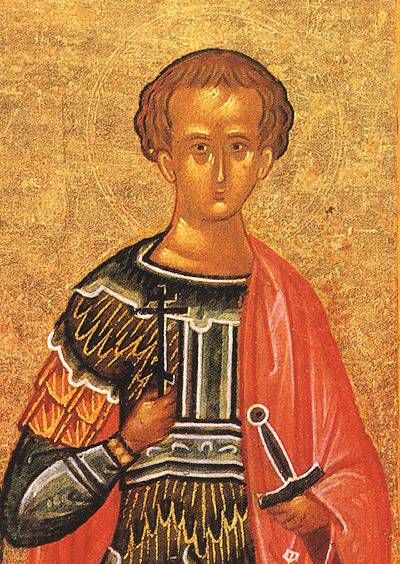
Feast days

Feast: February 13

Nine days · Free

Pray the novena
with us.

One short email a day for nine days. The day's prayer, a line from St. Finan of Lindisfarne's story, and a nudge to keep going.

Also on February 13
F

Sts. Fusca and Maura

February 13 · Martyrs
St. Polyeuctus

St. Polyeuctus

February 13 · Martyr
C

St. Castor

February 13 · Priest, Confessor
← All 1726 saints in the library
Sources & notes

Feast-day sources

Story sources

Sources

Credits

From Sabine Baring-Gould, The Lives of the Saints, new edition in 16 vols. (London: John C. Nimmo, 1897), digitized text from Project Gutenberg. Public domain.

From “Catholic Encyclopedia (1913)/St. Finan,” The Catholic Encyclopedia (New York: Robert Appleton Company, 1907–1914), via Wikisource. Public domain. Matched by name and feast date; text unedited except for our bracketed notes in grey.

From Sabine Baring-Gould, The Lives of the Saints, new edition in 16 vols. (London: John C. Nimmo, 1897), digitized text from Project Gutenberg. Public domain in the United States. Reproduced unedited, except for short bracketed notes in grey that we added to explain names and terms (“S.” is the old abbreviation for Saint). Some history and judgments reflect 19th-century scholarship.