A shepherd who stayed with his people through hard times.
Read the essentials →A shepherd who stayed with his people through hard times.
Read the essentials →A shepherd who stayed with his people through hard times.
October 14
October 14
Bishop
Fortunatus sent for their chief and begged him to restore the children to their parents.
Learn from the kind of life it was. A shepherd who stayed with his people through hard times.
Keep their day. Remember them on October 14 with a short prayer, and ask for their help.
The Goths [Germanic peoples who invaded the Roman Empire, many of them Arian Christians] carried off two little boys of the town. Fortunatus sent for their chief and begged him to restore the children to their parents. He refused. Next day the chief was riding through Todi, when his horse slipped on the pavement and fell, and threw him down. He thought his leg was broken, and this in punishment for having refused the request of the bishop. He sent to him at once, promising to restore the two boys. Fortunatus blessed water, and sent it by his deacon, who sprinkled the leg of the Goth with it, and the man got up, and though he found his leg a little stiff, to his great delight satisfied himself that no bones were broken.
Feast: October 14
One short email a day for nine days. The day's prayer, a line from St. Fortunatus of Todi's story, and a nudge to keep going.
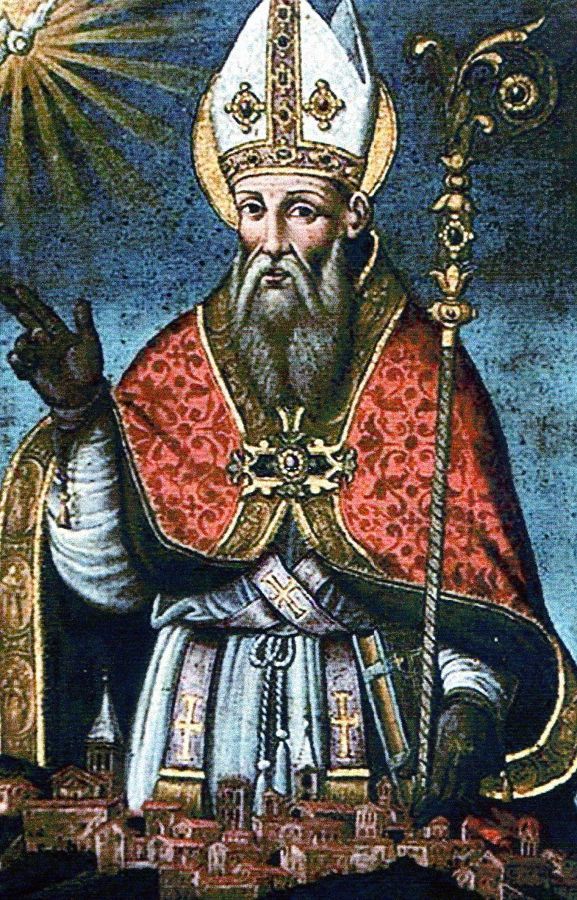
Image: San Fortunato di Todi.jpg · C. Sergio The original uploader was Darja82 at Italian Wikipedia. · Public domain, via Wikimedia Commons
From Sabine Baring-Gould, The Lives of the Saints, new edition in 16 vols. (London: John C. Nimmo, 1897–98); text from the Internet Archive scan (OCR, lightly cleaned; errors possible). Public domain.
Image: C. Sergio The original uploader was Darja82 at Italian Wikipedia., Wikimedia Commons (Public domain)
From Sabine Baring-Gould, The Lives of the Saints, new edition in 16 vols. (London: John C. Nimmo, 1897–98); text from the Internet Archive scan (OCR, lightly cleaned; errors possible). Public domain in the United States. Reproduced unedited, except for short bracketed notes in grey that we added to explain names and terms (“S.” is the old abbreviation for Saint). Some history and judgments reflect 19th-century scholarship.
