St. Francis Caracciolo, G

A life spent serving ordinary people.

Read the essentials →
June 4 · Priest

St. Francis Caracciolo

St. Francis Caracciolo, G

A life spent serving ordinary people.

Traditional feast

June 4
1914 / pre-1969 calendar, per Baring-Gould (1897)

Current feast

June 4
Secondary source · Wikipedia

Represents

Priest

Their story

Adapted in modern English from the Catholic Encyclopedia (1913) · original text below

Francis Caracciolo was born on 13 October 1563 at Villa Santa Maria in the Abruzzi and baptized Ascanio. From childhood he was known for his gentleness and honesty. At twenty-two he was cured of leprosy, and he vowed himself to the Church. He gave his goods to the poor and went to Naples in 1585 to study theology. Ordained in 1587, he joined a confraternity that helped condemned criminals to die holy deaths.

In 1588 a letter from Giovanni Agostino Adorno, inviting another man named Ascanio Caracciolo to help found a new religious institute, was delivered to him by mistake. He took it as a sign of God's will. He helped draw up the rule of the Minor Clerks Regular, which was approved that year. The congregation combined prayer and work. Its members took a fourth vow not to seek church honours, kept up adoration of the Blessed Sacrament in turns, and practised constant penance. Francis and Adorno made their profession at Naples on Low Sunday 1589.

Against his will, he was elected general in 1593. He made three journeys to Spain and opened houses at Madrid, Valladolid and Alcalá. He loved the poor, and Pope Paul V wanted to make him a bishop, but he firmly refused. His favourite saying was 'Zeal for thy house has eaten me up.' Invited to Agnone in the Abruzzi to turn the Oratorians' house there into a college, he fell ill during the talks and died there on 4 June 1608, the eve of Corpus Christi (the feast of the Body of Christ in the Eucharist). He was canonized (officially declared a saint by the pope) in 1807 and is a patron of Naples, where his body lies.

Early life

The book says little or nothing about early life. This is how the account begins.

What they represent

How they teach us to live

Drawn from themes in the original account

Learn from the kind of life it was. A life spent serving ordinary people.

Keep their day. Remember them on June 4 with a short prayer, and ask for their help.

From the Catholic Encyclopedia

1913 · 635 words

Co-founder with John Augustine Adorno of the Conregation of the Minor Clerks Regular; b. in Villa Santa Maria in the Abrusso (Italy), 13 October, 1563; d. at Agnone, 4 June, 1608. He belonged to the Pisquizio branch of the Caracciolo and received in baptism the name of Ascanio. From his infancy he was remarkable for his gentleness and uprightness. Having been cured of leprosy at the age of twenty-two he vowed himself to an ecclesiastical life, and distributing his goods to the poor, went to Naples in 1585 to study theology. In 1587 he was ordained priest and joined the contraternity of the Bianchi della Giustizia (The white robes of Justice), whose object was to assist condemned criminals to die holy deaths. A letter frorn Giovanni Agostino Adorno to another Ascanio Caracciolo, begging him to take part in founding a new religious institute, having been delivered by mistake to our saint, he saw in this circumstance an confidence of the Divine Will towards him (1588). He assisted in drawing up rules for the new congregation, which was approved by Sixtus V, 1 July, 1588, and confirmed by Gregory XIV, 18 February 1591, and by Clement VIII, 1 June, 1592.

The congregation is both contemplative and active, and to the three usual vows a fourth is added, namely, that its members must not aspire to ecclesiastical dignities outside the order nor seek them within it. Adoration of the Blessed Sacrament is kept up by rotation, and mortification is continually practised. The motto of the order "Ad majorem Dei Resurgentis gloriam" was chosen from the fact that Francis and Adorno made their profession at Naples on Low Sunday, 9 April, 1589. In spite of his refusal he was chosen general, 9 March, 1593, in the first house of the congregation in Naples, called St. Mary Major's or Pietrasanta, given to them by Sixtus V. He made three journeys into Spain to establish foundations under the protection of Philip II and Philip III. He opened the house of the Holy Ghost at Madrid on 20 January, 1599, that of Our Lady of the Annunciation at Valladolid on 9 September, 1601, and that of St. Joseph at Alcala sometime in 1601, for teaching science. In Rome he obtained possession of St. Leonard's church, which he afterwards exchanged for that of St. Agnes in the Piazza Navona (18 September, 1598), and later he secured for the institute the church of San Lorenso in Lucina (11 June, 1606) which was made over to him by a bull of Pope Paul X, and which was, however, annulled by the Bull "Susceptum" of Pope Pius X (9 November, 1906).

St. Francis Caracciolo was the author of a valuable work, "Le sette stazioni sopra la Passione di N.S. Gesù Christo", which was printed in Rome in 1710. He loved the poor. Like St. Thomas Aquinas, a relative on his mother's side, his purity was angelic. Pope Paul V desired to confer an important bishopric on him, but he steadfastly refused it. His frequent motto was "Zelus domus tuae comedit me". Invited by the Oratorians at Agnone in the Abruzzo to convert their house into a college for his congregation, he fell ill during the negotiations and died there on the vigil of Corpus Christi. He was beatified by Pope Clement XIV on 4 June, 1769, and canonized by Pope Pius VII on 24 May, 1807. In 1838 he was chosen as patron of the city of Naples, where his body lies. At first he was buried in St. Mary Major's, but his remains were afterwards translated to the church of Monteverginella, which was given in exchange to the Minor Clerks Regular (1823) after their suppression at the time of the French Revolution. St. Francis is no longer venerated there with old fervour and devotion.
Read more

The full original · 0 words

Read Baring-Gould’s full account

Baring-Gould’s sources: Roman Martyrology, beatified by Clement XIV., 1769, canonized by Pius VII. in 1807. Authority: — A life by Augustine Cencelli.] Ascanio Caracciolo was born in 1563, at Villa SantaMaria, in the kingdom of Naples. At the age of twentytwo he fell ill with a loathsome malady which was believed to be leprosy, and then feeling the worthlessness of the world’s pleasure, he resolved to devote himself wholly to God. No sooner had he made this vow, than his health improved, and the disorder left him. He went to Naples to study theology, and was there ordained priest In 1588, John Augustine Adorno, a Genoese, had formed the design of founding a new order, and he had communicated his design to Fabricio Caracciolo, abbot of S. Maria Maggiore, at Naples. They resolved to take into their confidence a certain Ascanio Caracciolo, but not our saint, and wrote him a letter informing him of their intentions, and inviting him to join them. The letter was by mistake delivered to the subject of this memoir, and led to his becoming a most enthusiastic member of the new congregation. The * rule of this institution was that the members should take the three usual vows, and in addition, that, — as soon as it numbered twelve brethren, — adoration of the Blessed Sacrament, and penance should become perpetual in it As soon as twelve had joined the society, Adorno and Ascanio Caracciolo went to Rome to obtain the approval of Pope Sixtus V., which was readily granted, and the society was called the Congregation of Regular Clerks Minors. Adorno died in 1591, and Caracciolo, who had taken the name of Francis, became the first general of the order. He was a man of deep humility. As he was once passing through Villa Santa-Maria, a fief of his family, the people crowded around him, knelt and kissed his hands and feet, and the hem of his garment S. Francis, full of shame, fell on his knees, plucked a crucifix from his breast, and holding it above his head, cried, “Do not notice me; look, look at Him 1" He made three journeys to Spain to found and advance the interests of houses of his Order there, and on his return from one of them was shipwrecked.

Feast days

Feast: June 4

Nine days · Free

Pray the novena
with us.

One short email a day for nine days. The day's prayer, a line from St. Francis Caracciolo's story, and a nudge to keep going.

Also on June 4
Q

St. Quirinus

June 4 · Bishop, Martyr
St. Optatus

St. Optatus

June 4 · Bishop, Confessor
B

St. Breacha

June 4 · Virgin
← All 1726 saints in the library
Sources & notes

Feast-day sources

Story sources

Sources

Credits

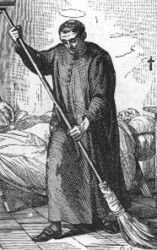
Image: Saint Francis Caracciolo.jpg · Uncertain · Public domain, via Wikimedia Commons

From Sabine Baring-Gould, The Lives of the Saints, new edition in 16 vols. (London: John C. Nimmo, 1897–98); text from the Internet Archive scan (OCR, lightly cleaned; errors possible). Public domain.

Image: Uncertain, Wikimedia Commons (Public domain)

From “Catholic Encyclopedia (1913)/St. Francis Caracciolo,” The Catholic Encyclopedia (New York: Robert Appleton Company, 1907–1914), via Wikisource. Public domain. Matched by name and feast date; text unedited except for our bracketed notes in grey.

From Sabine Baring-Gould, The Lives of the Saints, new edition in 16 vols. (London: John C. Nimmo, 1897–98); text from the Internet Archive scan (OCR, lightly cleaned; errors possible). Public domain in the United States. Reproduced unedited, except for short bracketed notes in grey that we added to explain names and terms (“S.” is the old abbreviation for Saint). Some history and judgments reflect 19th-century scholarship.