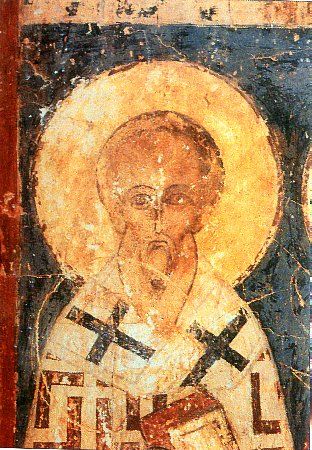
A shepherd who stayed with his people through hard times.
March 18
Not verified yet
Bishop
This remarkable man was the son of Ultach, an Irish king, and was baptized without his father's consent.
Learn from the kind of life it was. A shepherd who stayed with his people through hard times.
Keep their day. Remember them on March 18 with a short prayer, and ask for their help.
S. Finnian of Moville is mentioned in the life of S. Enda as one of his disciples in Aran, the Isle of Saints. This remarkable man was the son of Ultach, an Irish king, and was baptized without his father's consent. He was first placed under the care of S. Colman of Dromore, who flourished about the year 510. It is expressly mentioned in the life just referred to, that it was from Aran he set out on his pilgrimage to Rome. This was probably his first visit to the apostolic See. Being of an active temperament, he there devoted himself with great ardour for several years to the study of the ecclesiastical and apostolic traditions. He then returned to Ireland, carrying with him a rich store of relics [the bodily remains of a saint, or objects they used, kept with honor] of the saints given him by the pope, and the penitential canons, which in his biographer's time, were still called "The Canons of S. Finnian." He also brought to Ireland the earliest copy of S. Jerome [translator of the Bible into Latin (d. 420)]'s translations of the Gospels; a treatise of such value in the estimation of his ecclesiastical contemporaries, that the records of this period very frequently refer to them as S. Finnian's Gospels.
In 540, he founded the great monastery of Moville, where S. Columba [Irish abbot of Iona (d. 597), apostle of Scotland] spent a portion of his youth. After labouring with energy in Ireland, S. Finnian returned to Italy, where, according to the best authorities, he was made bishop of Lucca, in Tuscany, in which Church he is venerated under the name of Frigidian, or Fridian. During the twenty-eight years that he governed the see of Lucca [a bishop’s “see” is his diocese, named from his seat (Latin sedes)], he built twenty-eight churches; the chief of these he dedicated to the three holy Levites, but it has since borne his name. He is said to have carried a huge stone towards the erection of the church, which none else could lift. It is still preserved in the church as a monument of his strength and zeal. S. Gregory the Great relates a story of his miraculous power. One day the river Arno had overflowed the country, devastating the fields. The saint ran a plough down to the flood, and it recoiled before the share.
The Italian annals give 588 as the year of his death; the annals of Ulster and Tigernach 589.
Feast: March 18
One short email a day for nine days. The day's prayer, a line from St. Frigidian or…'s story, and a nudge to keep going.
From Sabine Baring-Gould, The Lives of the Saints, new edition in 16 vols. (London: John C. Nimmo, 1897), digitized text from Project Gutenberg. Public domain.
From Sabine Baring-Gould, The Lives of the Saints, new edition in 16 vols. (London: John C. Nimmo, 1897), digitized text from Project Gutenberg. Public domain in the United States. Reproduced unedited, except for short bracketed notes in grey that we added to explain names and terms (“S.” is the old abbreviation for Saint). Some history and judgments reflect 19th-century scholarship.