Their story
Adapted in modern English from Baring-Gould (1897) · original text below
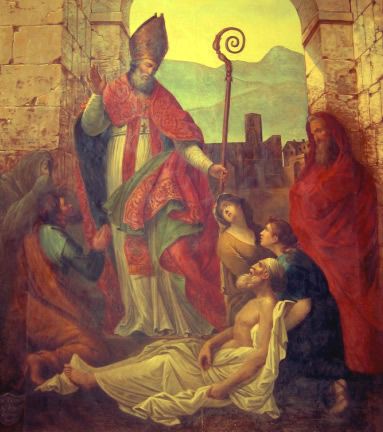
Fulcran was a native of Lodève in southern France and was devout from childhood. Theodoric, Bishop of Lodève, educated and ordained him. When Theodoric died, the city chose Fulcran as his successor, and he was consecrated at Narbonne on 4 February 949. His zeal, his humility and his generous charity in time of famine endeared him to his people.
Once, told that a neighbouring bishop had fallen into heresy, Fulcran exclaimed without thinking, 'The man deserves to be burnt!' Soon afterwards he heard that the people had burned that bishop alive. He was filled with remorse, afraid his rash words had been reported and had encouraged the crime. Unable to find peace, he went to Rome. Entering the city, he tore the clothes from his back and had his companions beat him with thorn branches all the way to St Peter's, where he made his confession in tears. Back home the remorse returned, and he went to Rome a second time and then a third, doing penance each time.
When his end drew near he said so, and crowds came to Lodève for his last blessing. Though burning with fever, he said Mass in the cathedral before them all and prayed for his flock in tears. He blessed the tomb he had had prepared and died peacefully soon afterwards.
Early life
Selected sentences from the original account, unaltered.
The blessed Fulcran was a native of Lodeve, in the archdiocese of Narbonne, in France; and from his childhood exhibited marked piety. He was educated by Theodoric, Bishop of Lodeve, who also ordained him.
How they teach us to live
Drawn from themes in the original account
Give to people in need. The account records care for the poor.
Pray a little every day. Prayer runs all through this account.
Choose humility over status. The account singles out humility.
Learn from the kind of life it was. A shepherd who stayed with his people through hard times.
From the Catholic Encyclopedia
1913 · 318 words
Bishop of Lodève; d. 13 February, 1006. According to the biography which Bernard Guidonis, Bishop of Lodève (d. 1331), has left us his saintly predecessor, Fulcran came of a distinguished family, consecrated himself at an early age to the service of the Church, became a priest, and from his youth led a pure and holy life. When in 949 Theoderich, Bishop of Lodève, died, Fulcran, notwithstanding his unwillingness, was chosen as his successor and was consecrated by the Archbishop of Narbonne on 4 February of the same year. He was untiring in his efforts to conserve the moral life within his diocese, especially among the clergy and the religious orders; he rebuilt many churches and convents, among them the cathedral dedicated to St. Genesius and the church of the Holy Redeemer with the Benedictine [monks following the Rule of St. Benedict] monastery attached to it. The poor and the sick were the objects of his special care; for their support he founded hospitals and endowed others already existing. The following anecdote from his life is worthy of mention. A bishop of Gaul [roughly modern France and Belgium] had fallen away from the Faith and had accepted Jewish teachings. When the news reached Fulcran, he exclaimed in an excess of zeal: "This bishop should be burned!" Shortly afterwards the renegade prelate was actually seized by his incensed flock and delivered up to death by fire. Fulcran was then filled with remorse that by his utterance he should have been the cause of the apostate's death, and after doing severe penance, he made a pilgrimage to Rome, there to receive absolution for his supposed guilt. After his death he was buried in the cathedral of Lodève and honoured as a saint. His body, which had been preserved intact, was burned by the Huguenots in 1572, and only a few particles of his remains were saved. He is the second patron of the Diocese of Lodève, and his feast falls on 13th February.