St. Gildas the Wise in Brittany

Building a community where people could actually live the Gospel.

Read the essentials →
January 29 · Abbot

St. Gildas the Wise in…

St. Gildas the Wise in Brittany

Building a community where people could actually live the Gospel.

Traditional feast

January 29
1914 / pre-1969 calendar, per Baring-Gould (1914)

Current feast

January 29
Secondary source · Wikipedia

Represents

Abbot

Their story

Adapted in modern English from the Catholic Encyclopedia (1913) · original text below

The Catholic Encyclopedia warns that the two medieval lives of Gildas are confused, but harmonizes them this way. He was born by the Clyde to a noble British family and educated in Wales under St. Iltut, alongside St. Samson. He became a monk and went to Ireland, where he was ordained priest and built churches and monasteries.

He is said to have made a pilgrimage to Rome. On the way home his love of solitude led him to the island of Houat off Brittany. The Bretons found him and persuaded him to found a monastery at Rhuys. There he wrote his severe letter rebuking five British kings and the lazy clergy of his day. He is counted the earliest British historian. He died at Houat in 570.

Early life

Selected sentences from the original account, unaltered.

S. Gildas, surnamed the Wise, was born in North-Britain near the Clyde, in the kingdom of which Dumbarton was the capital. His father was of princely birth; his eldest son, Howel, was a great warrior, who, succeeding his father in the principality, was slain by King Arthur. Mailoc, another son, was brought up to the religious life.

What they represent

How they teach us to live

Drawn from themes in the original account

Share your faith, in words and by example. Preaching and conversion are central here.

Feed your mind with Scripture and good books. Learning and the Scriptures matter in this life.

Build up the community you belong to. This life was lived with and for a community.

Learn from the kind of life it was. Building a community where people could actually live the Gospel.

From the Catholic Encyclopedia

1913 · 624 words

Surnamed the Wise; b. about 516; d. at Houat, Brittany, 570. Sometimes he is called "Badonicus" because, as he tells us, his birth took place the year the Britons gained a famous victory over the Saxons at Mount Badon, near Bath, Somersetshire (493 or 516). The biographies of Gildas exist — one written by an unknown Breton monk of the Abbey of Rhuys in the eleventh century, the other by Caradoc, a Welshman in the twelfth century. Both biographies contain unchronological and misleading statements, which have led some critics to reject the lives as altogether valueless. Ussher, Ware, Bale, Pits, and Colgan endeavour to adjust the discrepancies by contending that there were at least two saints named Gildas, hence their invention of such distinctive surnames as "Albanicus", "Badonicus", "Hibernicus", "Historicus", etc. The more general opinion, however, adopted by Lanigan, Leland, Healy, Stingfleet, Mabilon, Bollandus, and O'Hanlon, is that there was but one St. Gildas. The discrepancies may be accounted for by the fact that the lives were drawn up in separate countries, and several centuries after the saint existed. As to Caradoc's statement that Gildas died at Glastonbury, O'Hanlon remarks that Glastonbury appropriated more saints than Gildas (Lives of Irish Saints, I, 493).

Both narratives agree in several striking details, and may thus be harmonized: Gildas was born in Scotland on the banks of the Clyde (possibly at Dumbarton), of a noble British family. His father's name was Cau or Nau; his brother's, Huel or Cuil. He was educated in Wales under St. Iltut, and was a companion of St. Samson and St. Peter of Léon. Having embraced the monastic state, he passed over to Ireland, where he was advanced to the priesthood. He is said to have lived some time in Armagh, and then to have crossed to North Britain, his teaching there being confirmed by miracles. On his return to Ireland, at the invitation of King Ainmire, he strengthened the faith of many, and built monasteries and churches. The Irish annalists associate him with David and Cadoc in giving a special liturgy or Mass to the second order of Irish saints. He is said to have made a pilgrimage to Rome. On the homeward journey his love of so!itude caused him to retire to the Isle of Houat, off Brittany, where he lived a life of prayer, study and austerity. His place of retreat having become known, the Bretons induced him to establish a monastery at Rhuys on the mainland whither multitudes flocked (Marius Sepet, "St. Gildas de Rhuys", Paris, s.d.). It was at Rhuys he wrote his famous epistle to the British kings. His relics [the bodily remains of a saint, or objects they used, kept with honor] were venerated there till the tenth century, when they were carried for safety into Berry. In the eighteenth century they were said to be preserved in the cathedral of Vannes. He is the patron of several churches and monasteries in Brittany and elsewhere. His feast is locally observed on 29 January; another feast, 11 May, commemorates the translation [the solemn moving of a saint’s relics to a new shrine] of his relics.

The authentic work of St. Gildas, "De excidio Britannae liber querulus", is now usually divided into three parts: (1) The preface; (2) A sketch of British history from the Roman invasion to his own time; (3) An epistle of severe invective addressed to five petty British kings — Constantine, Vortipor, Cyneglas, Cynan, and Maelgwn. In the same epistle he addresses and rebukes the clergy whom he accuses of sloth and simony. His writings are clearly the work of a man of no ordinary culture and sanctity, and indicate that the author was thoroughly acquainted with the Sacred Scriptures.

Read the rest of the article

Gildas is regarded as the earliest British historian and is quoted by Bede [English monk and historian (d. 735)] and Alcuin. Two MSS. copies of his writings are preserved in Cambridge University library.

Read more

The full original · 560 words

Read Baring-Gould’s full account

Baring-Gould’s sources: There are said to have been several British saints of this name. But that commemorated on this day is the famous author, whose writings are extant. It is probable that Gildas, having been born in Scotland, bred in Wales, and a monastic founder in Brittany, has been divided into three, and some of the incidents have attached themselves to S. Gildas the Scotchman, others to S. Gildas the Welshman, and others again to him of Brittany. Yet these are all easily reducible into a consecutive history, and belong, in fact, to one man. His life was written by Caradoc of Llancarvan, about 1150; another life is by an anonymous monk of Rhys.

S. Gildas, surnamed the Wise, was born in North-Britain near the Clyde, in the kingdom of which Dumbarton was the capital. His father was of princely birth; his eldest son, Howel, was a great warrior, who, succeeding his father in the principality, was slain by King Arthur. Mailoc, another son, was brought up to the religious life. Two other brothers, and their sister, Peteona, in like manner left the world, and choosing a retired place in the furthest extremity of that country, built themselves separate oratories, where, by watching, fasting, and fervent prayer, they continually strove to reach their heavenly country. As to Gildas, we learn from his own writings, that he was born in the year of the famous victory, gained (as some say, by Ambrose; or, as others say, by Arthur,) over the Saxons at Mount Badon, near Bath, about a.d. 520. He was, when a child, committed by his parents to the care of S. Iltut, who brought him up in his monastery of Llan-Iltut in Glamorganshire, instructing him in the divine Scriptures, and in the liberal arts. These divine meditations wonderfully increased his faith and love of heavenly things, and influenced in such a manner the whole conduct of his life, that from his very youth he attained to great perfection and was favoured with the gift of miracles. From S. Iltut's school, where he had for companions S. Samson and S. Paul of Leon, both of whom were afterwards illustrious prelates, he went over into Ireland, for his further improvement in virtue and learning, among the disciples of S. Patrick [apostle of Ireland (5th century)]. There he frequented the most celebrated masters of divine and human learning; and like the industrious bee, gathered honey from every flower—the honey of virtue and of knowledge. In the meantime, he failed not to chastise his body and bring it into subjection, lest, with all his learning and preaching to others, he himself might become a cast-away. Therefore he fasted much, and often watched whole nights, employing that silent time in prayer.

After Gildas was ordained priest, he preached the Gospel in the northern parts of Britain; where a great part of the inhabitants were heathen, and those calling themselves Christians were infected with the Pelagian [followers of Pelagius, who taught people could be good without God’s grace] heresy. God blessed his labours there with such success, that great numbers of heathen and heretics were by his means converted to Christ; and many miracles were wrought through him in the cure of the sick, in confirmation of his doctrine. The reputation of his success having reached Ireland, the king, Ainmeric, invited him over. Gildas accepted the call, and there, by his preaching and miracles, he mightily advanced the kingdom of God. He built churches and monasteries, established Christian discipline, regulated the liturgy, taught for some time in the famous school of Armagh, and was, in a word, another S. Patrick to that nation, by which he has been ever since gratefully honoured among their most illustrious Saints.

After these things, leaving Ireland and Britain, he sailed over into Armorica [Brittany in north-west France] or Brittany, and there founded the monastery of Rhys. But as he was desirous of solitude and undisturbed contemplation, he made himself an oratory, at some distance from that monastery, under a rock upon the bank of the river Blavet, where he devoted his solitary hours to prayer. [132] The exact date of his death is uncertain.
Feast days

Feast: January 29

Nine days · Free

Pray the novena
with us.

One short email a day for nine days. The day's prayer, a line from St. Gildas the Wise in…'s story, and a nudge to keep going.

Also on January 29
St. Valerius of Treves

St. Valerius of Treves

January 29 · Bishop
S

Sts. Sabinian and Sabina

January 29 · Martyr, Virgin
S

St. Sulpicius Severus…

January 29 · Bishop
← All 1727 saints in the library
Sources & notes

Feast-day sources

Story sources

Sources

Credits

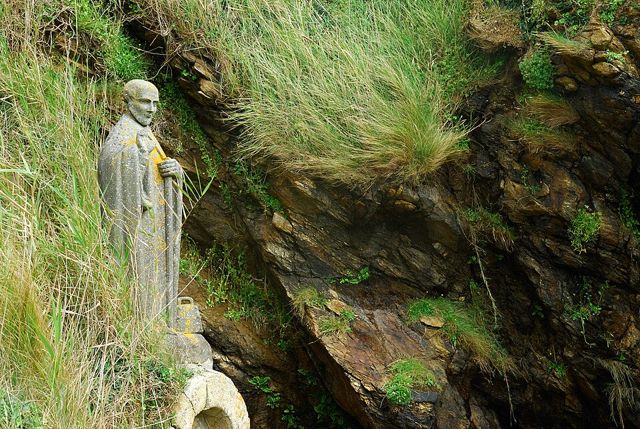
Image: Statue St-Gildas 07082.jpg · Romary · CC BY 2.5, via Wikimedia Commons

From Sabine Baring-Gould, The Lives of the Saints, new and revised edition (Edinburgh: John Grant, 1914; first edition 1872). Public domain.

Image: Romary, Wikimedia Commons (CC BY 2.5)

From “Catholic Encyclopedia (1913)/St. Gildas,” The Catholic Encyclopedia (New York: Robert Appleton Company, 1907–1914), via Wikisource. Public domain. Matched by name and feast date; text unedited except for our bracketed notes in grey.

From Sabine Baring-Gould, The Lives of the Saints, new and revised edition (Edinburgh: John Grant, 1914; first edition 1872). Public domain in the United States. Reproduced unedited, except for short bracketed notes in grey that we added to explain names and terms (“S.” is the old abbreviation for Saint). Some history and judgments reflect 19th-century scholarship.