G

Building a community where people could actually live the Gospel.

Read the essentials →
September 2 · Abbot

St. Giles

St. Giles

Building a community where people could actually live the Gospel.

Traditional feast

September 2
1914 / pre-1969 calendar, per Baring-Gould (1897)

Current feast

Not verified yet

Represents

Abbot

Their story

Adapted in modern English from the Catholic Encyclopedia (1913) · original text below · little is known

Giles is said to have been born of noble Athenian parents in the seventh century. Seeking solitude, he went to Gaul and finally hid in a forest near Nîmes with a hind as his only companion. According to the legend, the king's hunters chased the hind to his refuge. The king honoured him, and Giles consented to receive disciples and built a monastery under St Benedict's rule. He died early in the eighth century. His shrine became one of the great pilgrimages of medieval Europe.

Early life

The book says little or nothing about early life. This is how the account begins.

Sept, i.] S. Giles. One day Childebert, King of the Franks, according to some; according to others, Wamba, King of the Goths,1 was following the chase in the forests on the side of the Rhone where it flows into the Mediterranean, when a doe was started, and pursued by the hunters, fled for refuge to a cave, and penetrated into it; an arrow was shot after it. The hunters entered the grotto, and found a whitehaired hermit sheltering the doe, with the arrow in his shoulder.

What they represent

How they teach us to live

Drawn from themes in the original account

Learn from the kind of life it was. Building a community where people could actually live the Gospel.

Keep their day. Remember them on September 2 with a short prayer, and ask for their help.

From the Catholic Encyclopedia

1913 · 483 words

An Abbot, said to have been born of illustrious Athenian parentage about the middle of the seventh century. Early in life he devoted himself exclusively to spiritual things, but, finding his noble birth and high repute for sanctity in his native land an obstacle to his perfection, he passed over to Gaul [roughly modern France and Belgium], where he established himself first in a wilderness near the mouth of the Rhone and later by the River Gard. But here again the fame of his sanctity drew multitudes to him, so he withdrew to a dense forest near Nimes, where in the greatest solitude he spent many years, his sole companion being a hind. This last retreat was finally discovered by the king's hunters, who had pursued the hind to its place of refuge. The king [who according to the legend was Wamba (or Flavius?), King of the Visigoths, but who must have been a Frank, since the Franks [the Germanic people who ruled Gaul and gave France its name] had expelled the Visigoths from the neighbourhood of Nimes almost a century and a half earlier] conceived a high esteem for solitary, and would have heaped every honour upon him; but the humility of the saint was proof against all temptations. He consented, however, to receive thenceforth some disciples, and built a monastery in his valley, which he placed under the rule of St. Benedict. Here he died in the early part of the eighth century, with the highest repute for sanctity and miracles.

His cult spread rapidly far and wide throughout Europe in the Middle Ages, as is witnessed by the numberless churches and monasteries dedicated to him in France, Germany, Poland, Hungary, and the British Isles; by the numerous MSS. in prose and verse commemorating his virtues and miracles; and especially by the vast concourse of pilgrims who from all Europe flocked to his shrine. In 1562 the relics [the bodily remains of a saint, or objects they used, kept with honor] of the saint were secretly transferred to Toulouse to save them from the hideous excesses of the Huguenots who were then ravaging France, and the pilgrimage in consequence declined. With the restoration of a great part of the relics to the church of St. Giles in 1862, and the discovery of his former tomb there in 1865, the pilgrimages have recommenced. Besides the city of St-Gilles, which sprang up around the abbey, nineteen other cities bear his name, St-Gilles, Toulouse, and a multitude of French cities, Antwerp, Bridges, and Tournai in Belgium, Cologne and Bamberg, in Germany, Prague and Gran in Austria-Hungary, Rome and Bologna in Italy, possess celebrated relics of St. Giles. In medieval art he is a frequent subject, being always depicted with his symbol, the hind. His feast is kept on 1 September. On this day there are also commemorated another St. Giles, an Italian hermit of the tenth century (Acta SS., XLI, 305), and a Blessed Giles, d. about 1203, a Cistercian [strict Benedictine reform begun at Cîteaux in 1098] abbot of Castaneda in the Diocese of Astorga, Spain (op. cit. XLI, 308).
Read more

The full original · 387 words

Read Baring-Gould’s full account

Baring-Gould’s sources: Roman Martyrology; some of the additions to Bede's Martyrology. Not Usuardus. Gallican Martyrologies. York, Sarum, and modern Anglican Kalendars. The Lives of S. Giles are all later than the 8th cent.; full of anachronisms and marvels. They make Giles son of a Greek king, who came to S. Csesarius, B. of Arles, and met Flavius, King of the Goths; then, by orders of Charles Martel, King of the Franks, he went to Orleans. S. Csesarius died A.D. 542, Charles Martel in A.D. 741. Mabillon "unum illud pro certo enuntiat, ActaS. ^gidii nullius pene esse momenti; adeoque idonea non esse ad factum aliquod historicum stabiliendum. HmccensurGe,” says the Bollandist father, “ libenter subscribo cum eruditis omnibus.”] All the earlier part of the legend of S. Giles is purely fabulous. It relates that he was a Greek of Athens, son of Theodore and Pelagia, who sailed to Marseilles and became acquainted with S. Csesarius of Arles. This must be cast aside as utterly legendary, and we come to what appears to be history.

Sept, i.] S. Giles. One day Childebert, King of the Franks [the Germanic people who ruled Gaul and gave France its name], according to some; according to others, Wamba, King of the Goths [Germanic peoples who invaded the Roman Empire, many of them Arian Christians],1 was following the chase in the forests on the side of the Rhone where it flows into the Mediterranean, when a doe was started, and pursued by the hunters, fled for refuge to a cave, and penetrated into it; an arrow was shot after it. The hunters entered the grotto, and found a whitehaired hermit sheltering the doe, with the arrow in his shoulder. For the old man had lived long in this solitary place, nourished by the milk of the doe. The king, touched, as these wild but simple natures almost always were, by the sight of this grand old man, almost naked, caused the wound to be dressed, returned often to see him, and at last made him consent to the erection of a monastery upon the site of his grotto, of which he became abbot.

The fame of the venerable Giles reached the ears of Charles Martel, and he sent for him to Orleans. The abbot made the journey, saw and conversed with the iron hero. On his return to Provence, he was greeted with the news that two cedar doors had been washed up on the strand. They were at once, by his orders, removed and fitted to entrances of the church of his abbey. Such was the origin of that celebrated and powerful abbey of S. Giles, which became one of the great pilgrim shrines of the Middle Ages, and gave birth to a town, the capital of a district whose name was borne with pride by one of the most powerful feudal races, and which retains still a venerable church, classed amongst the most remarkable monuments of sculpture and architecture.

S. Giles is represented in art in monastic habit with his i Thc Lives say King Flavian; no such name is known among the Visigothic kings. Wamba reigned from 672 to 680.

[Sept, x hind at his side, his hand resting on its head and pierced with an arrow. The relics [the bodily remains of a saint, or objects they used, kept with honor] of S. Giles are preserved at S. Sernin in Toulouse. S. Giles is reckoned in Germany as one of the Vierzehn Noth-helfer. On his day at Valencia, it is the custom to bless a sprig of fenneL Antoninus [Antoninus Pius, Roman emperor 138–161].

Feast days

Feast: September 2

Nine days · Free

Pray the novena
with us.

One short email a day for nine days. The day's prayer, a line from St. Giles's story, and a nudge to keep going.

Also on September 2
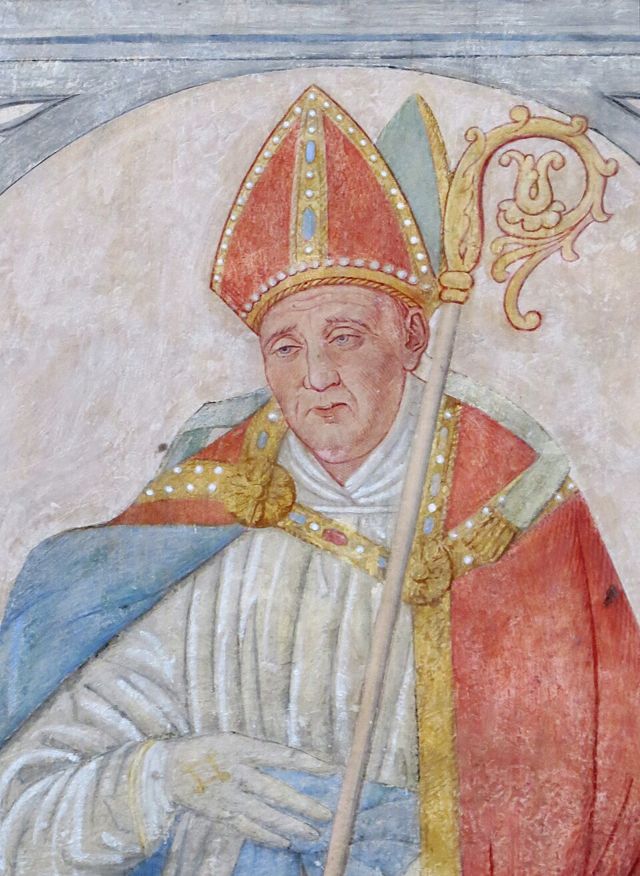
St. Antoninus

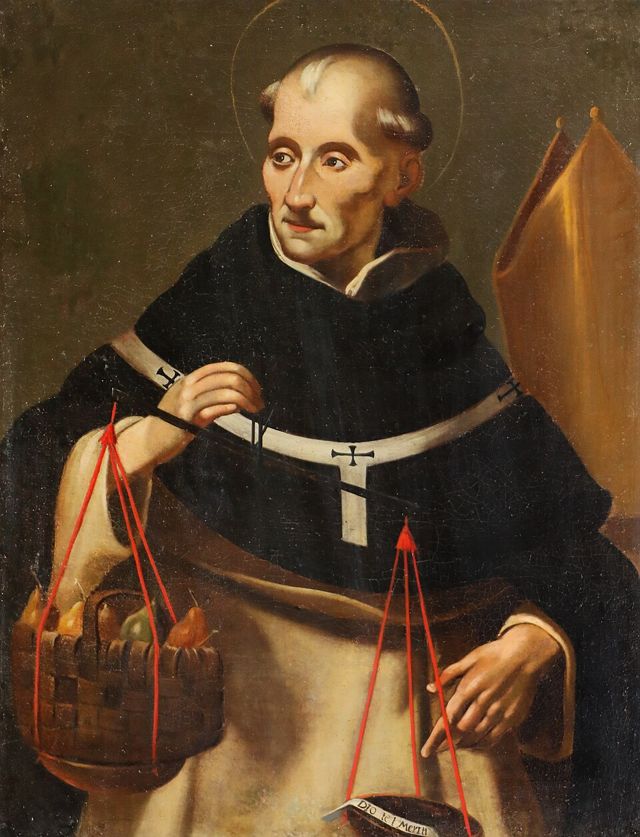
St. Antoninus

September 2 · Martyr
St. Nonnosus

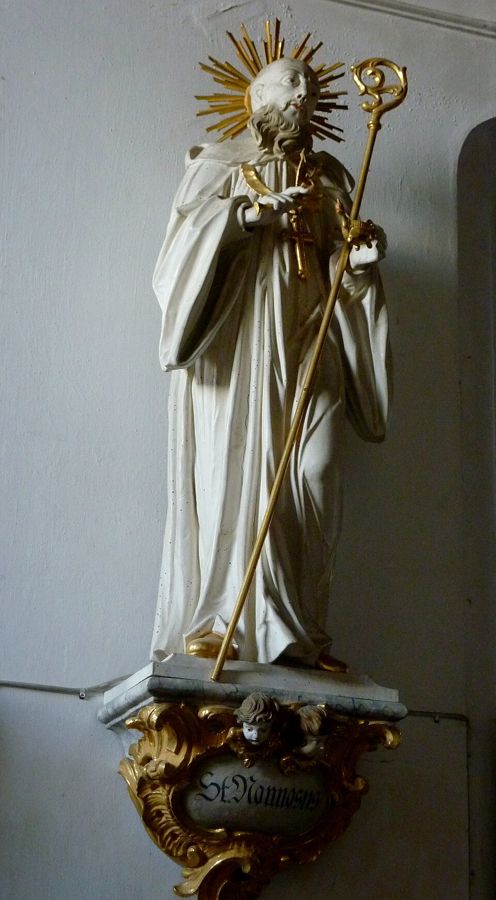
St. Nonnosus

September 2 · Abbot
St. William of Roskilde

St. William of Roskilde

September 2 · Bishop
← All 1726 saints in the library
Sources & notes

Feast-day sources

Story sources

Sources

Credits

From Sabine Baring-Gould, The Lives of the Saints, new edition in 16 vols. (London: John C. Nimmo, 1897–98); text from the Internet Archive scan (OCR, lightly cleaned; errors possible). Public domain.

From “Catholic Encyclopedia (1913)/St. Giles,” The Catholic Encyclopedia (New York: Robert Appleton Company, 1907–1914), via Wikisource. Public domain. Matched by name and feast date; text unedited except for our bracketed notes in grey.

From Sabine Baring-Gould, The Lives of the Saints, new edition in 16 vols. (London: John C. Nimmo, 1897–98); text from the Internet Archive scan (OCR, lightly cleaned; errors possible). Public domain in the United States. Reproduced unedited, except for short bracketed notes in grey that we added to explain names and terms (“S.” is the old abbreviation for Saint). Some history and judgments reflect 19th-century scholarship.