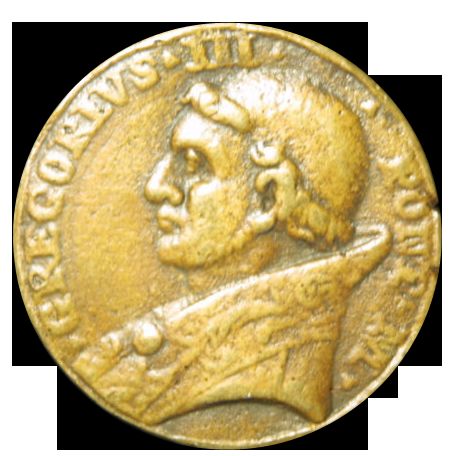
St. Gregory III., Pope

Now, however, that the real power of the empire in Italy was extinguished, it might seem that nothing could resist the Lombards.

Read the essentials →
November 28 · —

St. Gregory III.

St. Gregory III., Pope

Now, however, that the real power of the empire in Italy was extinguished, it might seem that nothing could resist the Lombards.

Traditional feast

November 28
1914 / pre-1969 calendar, per Baring-Gould (1897)

Current feast

December 10
Secondary source · Wikipedia

Represents

Feast

Their story

Adapted in modern English from the Catholic Encyclopedia (1913) · original text below

Gregory III, son of a Syrian named John, was so respected for learning and virtue that the Romans acclaimed him pope at his predecessor's funeral on 11 February 731. He opposed the iconoclast (the movement to destroy religious images) Emperor Leo III with legates, letters and two Roman synods, and in protest gave special honour to images and relics. In response Leo seized papal estates in southern Italy and Sicily.

He sent the pallium to Egbert of York and to the archbishops of Canterbury, and warmly supported St Boniface's mission to Germany, sending St Willibald to help him. His last years were troubled by the Lombard king Liutprand. He finished rebuilding the walls of Rome and appealed to Charles Martel for help. He died in 741 and was buried in the oratory of Our Lady he had built in St Peter's.

Early life

The book says little or nothing about early life. This is how the account begins.

Now, however, that the real power of the empire in Italy was extinguished, it might seem that nothing could resist the Lombards. Though King Luitprand and Gregory III., at least for the first eight years of Gregory's pontificate, maintained their outward amity, the Lombards, albeit now no longer Arians, were dreaded as barbarian invaders, and the Pope shuddered lest he should become the subject of a sovereign of savage manners and foreign origin. At this juncture the attention of Europe, of all Christendom, was centred on the Franks.

What they represent

How they teach us to live

Drawn from themes in the original account

Give to people in need. The account records care for the poor.

Keep their day. Remember them on November 28 with a short prayer, and ask for their help.

From the Catholic Encyclopedia

1913 · 705 words

Pope St. Gregory III was the son of a Syrian named John. The date of his birth is not known. His reputation for learning and virtue was so great that the Romans elected him pope by acclamation, when he was accompanying the funeral procession of his predecessor, 11 February, 731. As he was not consecrated for more than a month after his election, it is presumed that he waited for the confirmation of his election by the exarch at Ravenna. In the matter of Iconoclasm, he followed the policy of his predecessor. He sent legates and letters to remonstrate with the persecuting emperor, Leo III, and held two synods in Rome (731) in which the image-breaking heresy was condemned. By way of a practical protest against the emperor's action he made it a point of paying special honour to images and relics [the bodily remains of a saint, or objects they used, kept with honor], giving particular attention to the subject of St. Peter's. Fragments of inscriptions, to be seen in the crypts of the Vatican basilica, bear witness to this day of an oratory he built therein, and of the special prayers he ordered to be there recited.

Leo, whose sole answer to the arguments and apologies for image worship which were addressed to him from both East and West, was force, seized the papal patrimonies in Calabria and Sicily, or wherever he had any power in Italy, and transferred to the patriarch [the title of the bishops of the great ancient sees: Rome, Constantinople, Alexandria, Antioch, Jerusalem] of Constantinople the ecclesiastical jurisdiction which the popes had previously exercised both there, and throughout the ancient Prefecture of Illyricum. Gregory III confirmed the decision of his predecessors as to the respective rights of the Patriarchs of Aquileia and Grado, and sent the pallium [a woolen band the pope gives to archbishops as a sign of their authority] to Antoninus [Antoninus Pius, Roman emperor 138–161] of Grado. In granting it also to Egbert of York, he was only following out the arrangements of St. Gregory I who had laid it down that York was to have metropolitical rights in the North of England, as Canterbury had to have them in the South. Both Tatwine and Nothelm of Canterbury received the pallium in succession from Gregory III (731 and 736). At his request Gregory III extended to St. Boniface the same support and encouragement which had been afforded him by Gregory II. "Strengthened exceedingly by the help of the affection of the Apostolic See", the saint joyfully continued his glorious work for the conversion of Germany. About 737 Boniface came to Rome for the third time to give an account of his stewardship, and to enjoy the pope's "life-giving conversation", At Gregory's order the monk and great traveller, St. Willibald, went to assist his cousin St. Boniface in his labours.

The close of Gregory's reign was troubled by the Lombards [a Germanic people who ruled much of Italy from 568 to 774]. Realizing the ambition which animated Liutprand, Gregory completed the restoration of the walls of Rome which had been begun by his predecessors, and bought back Gallese, a stronghold on the Flaminian Way, from Transamund, Duke of Spoleto, which helped to keep open the communications between Rome and Ravenna. In 739, Liutprand was again in arms. His troops ravaged the exarchate, and he himself marched south to bring to subjection his vassals, the Dukes of Spoleto and Benevento, and the Duchy of Rome. Transamund fled to Rome, and Gregory implored the aid of the great Frankish chief, Charles Martel. At length ambassadors from the viceroy (subregulus) of the Franks [the Germanic people who ruled Gaul and gave France its name] appeared in Rome (739). Their arrival, or the summer heats, brought a momentary peace. But in the following year, Liutprand again took the field. This time the Romans left their walls, and helped Transamund to recover Spoleto. When, however, he had recovered his duchy, he would not or could not comply with Gregory's request, and endeavour to recover for the pope "the four cities of the Roman duchy which had been lost for his sake." In the midst of all these wars and rumours of war, Gregory died, and was buried in the oratory of our Lady which he had himself built in St. Peter's. He died in 741, but whether in November or December is not certain. It is however, on 28 November that he is commemorated in the Roman martyrology.

Read the rest of the article

Codex Carolinus in JAFFE, Monumenta Carolina (Berlin, 1867), or in Mon. Germ. Hist.; Epp., III (Berlin, 1892). See also bibliography of article GREGORY II.
Read more

The full original · 752 words

Read Baring-Gould’s full account

Baring-Gould’s sources: Roman Martyrology. Authorities: — Anastasius the Librarian, and his own Letters.] Gregory III., who succeeded Gregory II. in the see of Rome, was a Syrian by birth, skilled in the Greek and Latin tongues, and noted for his knowledge of the Scriptures and his eloquent preaching. He was liberal and charitable, and spent large funds in redeeming captives and relieving widows and orphans. Gregory II. died in 731, in the heat of contest with the Emperor Leo III. in the matter of images. Gregory III. was elected by acclamation of the people, whilst he was following the coffin of Gregory II. to its tomb. His nomination was at once forwarded to the exarch of Ravenna, for his approbation and confirmation. But no sooner had he obtained this, than he sent a deputation to Constantinople to announce to the emperor his inflexible adhesion to the sacredness of images. The mission was confided to George the priest, but the language of the message was so sternly condemnatory of the emperor’s proceedings, that the trembling ambassador had hardly begun his journey when he fled back to Rome, and confessed that the enthusiasm and faith to carry him to martyrdom were wanting in his breast. The Pope indignantly threatened to degrade him from his priestly office, and was hardly persuaded to content himself with forcing the timorous George to resume his dangerous mission. George was arrested in Sicily and not allowed to proceed. Gregory thereupon summoned a council, November 1, 732. It was attended by the archbishops of Grado and Ravenna and ninety-three Western bishops, together with the consuls and people of Rome, and many laics of distinction. The council decreed that “ In future whoever shall carry off vol xiv. 14 destroy, dishonour, or insult the images of the Saviour or of ‘ the immaculate and glorious Virgin/ or of the apostles, &c., should be forbidden to receive the body and blood of the Lord, and be excluded from the Church.” All signed this decision. The Pope then sent another letter to the Emperor Leo, and made the Defender of the Poor — an officer of the Roman Church — bearer of the despatch. He also was arrested in Sicily, and his papers taken from him. The same fate attended the ambassadors of the Italian towns who were made bearers of similar missives. A fourth attempt was made, but we do not learn the result. In 732, Leo the Isaurian sent a fleet to punish Rome, the Pope, and Italy for their opposition to his enterprises against images. But the fleet was wrecked in the Adriatic, and the emperor was obliged to content himself with raising the imposts in Sicily and Calabria, and in confiscating the “patrimony” of the apostles Peter and Paul, consisting of three and a half talents of gold, which was paid annually to the Church of Rome. The emperor also detached Sicily and Calabria and the provinces of Illyria from the Roman see, and placed them under the patriarchate of Constantinople. With the week of the imperial navy, the authority of the eastern emperor over northern Italy virtually came to an end. The exarch of Ravenna, unsupported, could not make his power and authority felt, and some years later he abandoned the seat of government, and took refuge in Naples.

Now, however, that the real power of the empire in Italy was extinguished, it might seem that nothing could resist the Lombards [a Germanic people who ruled much of Italy from 568 to 774]. Though King Luitprand and Gregory III., at least for the first eight years of Gregory's pontificate, maintained their outward amity, the Lombards, albeit now no longer Arians [followers of Arius, who taught that the Son is a created being, not fully God], were dreaded as barbarian invaders, and the Pope shuddered lest he should become the subject of a sovereign of savage manners and foreign origin. At this juncture the attention of Europe, of all Christendom, was centred on the Franks [the Germanic people who ruled Gaul and gave France its name]. The great victory of Tours had raised Charles Martel to the position of protector of the liberties and the religion of the Western world. When at last the Lombards and the Pope were involved in open war, Gregory was forced to appeal to Charles Martel for protection. “His tears,” he wrote, “were falling day and night for the destitute state of the Church. The Lombard king and his son were ravaging by fire and sword the last remains of the property of the Church, which no longer sufficed for the sustenance of the poor, or for providing lights for the daily service. They had invaded the territory of Rome, and seized all his farms; his only hope was in the timely succour of the Frankish king.” Gregory knew that the Lombards were negotiating with the Frank, and dexterously appealed to his pride. “ The Lombards were perpetually speaking of him with contempt, — 4 Let him come, this Charles, with his army of Franks; if he can, let him rescue you out of his hands.’ O unspeakable grief, that such sons so insulted should make no effort to defend their holy mother the Church ! Not that S. Peter was unable to protect his successors, and to exact vengeance upon their oppressors; but the apostle was putting the faith of his followers to trial.” Gregory sent Charles the keys of the tomb of S. Peter, and the offer of the titles of Patrician and Consul of Rome. Charles Martel received the first mission of Gregory III. with munificence, yet not without hesitation. He owed a debt of gratitude to the Lombard king for services rendered, perhaps all Western Christendom was also indebted to him, for according to the Lombard’s epitaph, he had fought in person by the side of Charles against the Saracens [medieval Christian name for Arab and Muslim peoples]. Accordingly Charles returned a courteous but evasive answer, and sent presents to Rome. It is curious to note that while the Pope was appealing to Charles as the champion of Christendom, the clergy of France were denouncing him to damnation as a sacrilegious person, a robber of churches. He had, in fact, in the hour of need, when the fate of Christendom trembled in the balance, laid his hand on the wealth of the rich bishops and abbots, to pay his mercenaries and soldiers who were to fight and repel the wave of invading Mohammedanism. A second letter of Gregory met with no better result. Charles Martel died almost immediately after, in 741, at Quercy on the Oise, and Gregory followed him in the same year. Although the patrimony of the Church was so plundered that there was not money for the support of the poor, he was able to adorn sumptuously several of the churches in Rome. Six silver columns given him by the exarch Eutychius he placed round the Confession of S. Peter, and set on them silver architraves and statues of the Saviour and the apostles, and on six other columns the images of the B. Virgin and female saints. He hung silver lilies and candelabra above the sacred spot. He built an oratory in honour of all the saints, which he adorned with a gold chalice encrusted with jewels, an image of the Virgin, and a crown with a cross dependent from it, all of gold. He gave a gold statue of the Virgin Mother holding her Divine Child, enriched with jewels, to the church of S. Maria Maggiore. He gave a similar costly statue of S. Andrew to the church of that apostle. The amount of gold he used for these ornaments weighed 73 lbs.; of silver, 376 lbs.: a considerable amount considering the circumstances of destitution in which the Papacy, the poor, and the lamps then found themselves. He also gave lands and slaves to the monks of S. Chrysogonus. He paid for rebuilding the walls of Rome, and he purchased of Thrasimund, duke of Spoleto, a castle, which threatened the estates of the Church.

Feast days

Feast: December 10
Traditional: November 28

Nine days · Free

Pray the novena
with us.

One short email a day for nine days. The day's prayer, a line from St. Gregory III.'s story, and a nudge to keep going.

Also on November 28
S

St. Sosthenes

November 28 · Confessor
St. Secundinus in Meath

St. Secundinus in Meath

November 28 · Bishop
St. Stephen the Younger

St. Stephen the Younger

November 28 · Martyr
← All 1726 saints in the library
Sources & notes

Feast-day sources

Story sources

Sources

Credits

Image: 178-7866 IMG - Gregorius III AV.png · ASKI · CC BY-SA 3.0, via Wikimedia Commons

From Sabine Baring-Gould, The Lives of the Saints, new edition in 16 vols. (London: John C. Nimmo, 1897–98); text from the Internet Archive scan (OCR, lightly cleaned; errors possible). Public domain.

Image: ASKI, Wikimedia Commons (CC BY-SA 3.0)

From “Catholic Encyclopedia (1913)/Pope St. Gregory III,” The Catholic Encyclopedia (New York: Robert Appleton Company, 1907–1914), via Wikisource. Public domain. Matched by name and feast date; text unedited except for our bracketed notes in grey.

From Sabine Baring-Gould, The Lives of the Saints, new edition in 16 vols. (London: John C. Nimmo, 1897–98); text from the Internet Archive scan (OCR, lightly cleaned; errors possible). Public domain in the United States. Reproduced unedited, except for short bracketed notes in grey that we added to explain names and terms (“S.” is the old abbreviation for Saint). Some history and judgments reflect 19th-century scholarship.