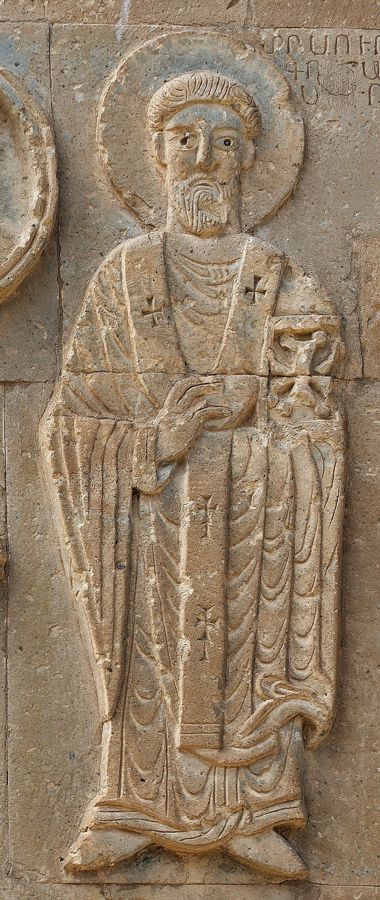
…information concerning the early life of the saint a letter by Artitheus, an Armenian bishop, written at the solicitation of Mark, a hermit. He quotes also the Life of S. Gregory by Agathangelos, the secretary of Tiridates. A Life exists purporting to be by Agathangelos, but no reliance can be placed on it; it is a tissue of fabulous matter, whether embroidered on an original genuine document, cannot be said. Certain it is that Moses of Chorene says not one word of much that is now found in the book of Agathangelos, he does not even allude to his tortures under Tiridates. The MS. copies of Agathangelos vary greatly. There is also a Life by Metaphrastes founded on Agathangelos, and a Life in the Armenian Collection of Lives of the National Saints. A modern life in Armenian by the Vartabad Matthew, an Uniat Armenian, has been translated by the Rev. S. C. Malan. London, 1868. It contains the whole legend, but is entirely uncritical.] According to Armenian tradition the light of the Gospel penetrated very early into Armenia. The apocryphal letters from Abgar — one of the Armenian Arsacidce, who reigned in Edessa from b.c. 5 to a.d. 32 — to our Saviour, and the answer of our Lord to Abgar testify at least to the prevalence of the belief that Armenia was one of the first lands into which a knowledge of Christ penetrated. The Apostles Thaddeus, Bartholomew, and Jude are said to have sown the seed of the Word in Armenia, and to have watered it with their blood. But the prevailing religion, which was a mixture of Persian fire-worship and Greek idolatry, was so ingrained in the people, that a long time elapsed before the good seed thus sown could take root, grow, and yield abundant fruit. But the finishing of the work begun by the Apostles was reserved for S. Gregory, who has immortalized himself in the history of the Christian Church under the S. Gregory.
name of “the Illuminator,” in Armenian “ Lusavoritch.” He was of the reigning family of the Arsacidae, and lived and wrought towards the end of the third and the beginning of the fourth centuries — a time of trouble for Armenia. The country was then under Ardashir, the father of the Sassanidae; who, after putting down the Arsacidae of Parthia, caused the death of Chosroes I., the Arsacide then reigning in Armenia, by the hand of Anak, another man of the same family, a.d. 232. Chosroes whilst dying from the treacherous stab of Anak, ordered the whole family of Anak, man and woman, old and young, to be put to the sword. Now it fell out that at this time there was at Valarshabad, where was the house of Anak, a merchant named Burdar with his wife Sophia; they were on their road to Caesarea, where lived Euthalius, a Christian noble, the brother of Sophia.
When the order of Chosroes reached Valarshabad, the wife of Anak had been recently delivered of a male child, and the nurse carried it to the merchant for safety, and Burdar and Sophia went on to Caesarea, carrying the babe with them, as though it were their own. Thus it came to pass that the future illuminator of his native land was saved from death, and was brought up in the Christian faith. When he came of age to marry, by the care of his fostermother, he was given to wife Mary, daughter of a noble of Caesarea, named David, and by her he had two sons, Vithanes and Arisdaghes.
Three years after the birth of the youngest, by mutual consent Gregory and his wife separated, to serve God by a closer union, leaving the bulk of their substance to the two children. Mary took her infant son with her into a convent and spent the rest of her life as a nun. This child afterwards joined himself to an anchorite [a hermit, sometimes walled into a cell beside a church], called Nicomachus, who lived near Caesarea, and took holy orders [ordination; “orders” means the sacrament by which deacons, priests and bishops are ordained]. Gregory, however, returned to Armenia. Dertad or Tiridates, the son of Chosroes, by the support of the Romans had, in the meantime, been raised to the throne (a.d. 259). Gregory entered the service of Tiridates, but prudently did not inform him that he was the son of Anak, the murderer of the father of Tiridates. He served him well for some years, but an event occurred which altered their relations.
One day Tiridates gave wreaths of flowers into the hands of Gregory, and bade him lay them before an image of Anahid, a female deity whom he honoured. Gregory refused, saying, “ God forbid that I should obey such an order as this. I came to wait on thee, and with devotedness to obey thy commands, but not to adore or honour thy idols.” The king was vexed. “ Thou/' said he, “ a man from another country, who didst come to join thyself to us, how darest thou worship a God we do not worship?” Tiridates did not punish him at once. The nobles and courtiers came to Gregory and remonstrated with him for not obeying the king, but found that on this point he was not to be moved. On the next day the king again spoke to him on the subject, but Gregoiy showed such firmness that Tiridates became exasperated, and determined to break him by insult and suffering. He therefore ordered his hands to be tied behind his back, a bit to be placed in his mouth, and that a heavy lump of rock salt should be laid on his shoulders, and that, thus burdened, he should be made to walk. As he still refused to deposit wreaths before the goddess Anahid, Tiridates ordered him to be hung up by one foot, and that various foul things should be burnt under him, so that the noxious smoke might enter his nostrils. Next two wooden clubs, the size of a shin-bone, were brought, and fitted like the bars of a wine-press; the legs of Gregory were placed between them, and cords were bound round them, and they S. Gregory.
were tightened, till the blood spurted from his swollen veins on the fingers of the men who tortured him. Not satisfied with this, the barbarous king had hot vinegar, nitre, and salt poured into his nostrils, and then a bag of soot emptied over his face. He was then taken back to prison. When he had recovered these horrible tortures, he was reconducted before Tiridates, who urged him to offer incense to his gods. To this the blessed Gregory replied, “I offer incense and sacrifice only to the true and living God, our Lord Jesus Christ, whom I love.”
The king thereupon had iron caps placed on his knees, which were tightened with wedges, so as to cause the knee joints to swell in great lumps, but as Gregory bore this torment without yielding, he sent him to Ardashat, and ordered him to be cast into a subterranean prison in the castle there. This pit was a hole full of stinking mud, the sewage of the prison. It swarmed with venomous reptiles.1 Agathangelos pretends that Gregory was cast into this pit, and spent in it thirteen, fourteen, or even fifteen years. What is far more probable is that the governor of the fort kept him in durance all that while, but certainly not in the Barathrum. The king Tiridates knew when he tortured him who Gregory was, and the jailer would probably treat with courtesy and indulgence a prince of royal blood. Very little, if any, reliance can be placed on the story of the sufferings of Gregory through the rage of Tiridates; it is significant that Moses of Chorene says nothing about them. That he was imprisoned, as soon as the king discovered that he was the son of his father’s murderer, is highly probable, and that he may have been treated with some barbarity is not improbable.
How, or by what means, Tiridates became convinced of the truth of Christianity does not appear, for we must put 1 The Barathrum, see pp. 28g, 290.
Lives, of the Scnnts. aside the ridiculous story of Agathangelos. He says that the king was transformed into a boar, and came to the feet of S. Gregory, who restored him to his original form. This is an allegory treated as history. Tiridates was baptized by S. Gregory, and so became a new creature, and laid aside his former brutal ferocity. Gregory was released from prison and became the adviser of the king. At his exhortation Tiridates raised a convent over the relics [the bodily remains of a saint, or objects they used, kept with honor] of SS. Rhipsime, Gaiane, and their companions, who had been martyred by his orders, at Etchmiadzin, at the roots of Ararat. S. Gregory was sent to Caesarea, by the king and his nobles, to be consecrated bishop by Leontius the Archbishop; he was received by Leontius with great joy, and by him was ordained patriarch [the title of the bishops of the great ancient sees: Rome, Constantinople, Alexandria, Antioch, Jerusalem] over the whole of Armenia, a.d. 302. He returned to his native land laden with relics, and baptized Tiridates, his queen, Ashkhen, and his sister, Chosrovitukht — a remarkable woman, who “did not, like other females, let loose her tongue, even when she was not a Christian.'’ The baptism of the king was followed by that of the majority of his subjects. He then set about consecrating bishops, organizing dioceses, and establishing schools. “ Taking a number of rough country boys, he cast them into the crucible of instruction for a spiritual life; he taught them in the Holy Scriptures, and rubbed off their minds the rust of vice and evil habits. And from that time such was the eagerness of some to withdraw from the habits of their fathers, in order to devote themselves to God’s service, that they might say, 4 1 have forgotten my people and my father’s house/ ” They were instructed in Greek and Syriac, and made to read the writings of the fathers, and the canons of the Church. “It was marvellous to see how those who a short while before were empty, worldly, and rough, soon became spiritual, attentive to the word of God, instructed in the writings of the Prophets and Apostles, and inheritors of the Gospel; and how, by S. Gregory.
the grace of Christ, they became skilled in all the commandments and precepts of God ” He also founded many monasteries and nunneries, and filled them with religious men and women.
“The first object of the holy patriarch after his return to the royal city, Valarshabad, from the great solemnity of baptizing the people in the Euphrates, was to build there a magnificent temple to the name of the Only Begotten Son of God; the site of which he had consecrated with holy oil and surrounded with a wall, and marked by a cross, at the time he built the church in honour of S. Rhipsime and her companions. And he called this temple Etchmiadzin (i-e., “ the descent of the Only Begotten”), in consequence of a divine vision he had, in which the Only Begotten Son, descending from heaven to earth, marked the spot by smiting it with his hammer of gold, which resounded aloud into the very depths of hell Likewise also in the city of Ardashat, and in other cities of every province, did he command churches to be built, and appointed to them priests and ministers.”
“ At all seasons, and in all weathers, in summer and winter, by night and by day, untiringly and earnestly in the ways of an evangelist, on this side of the country and on that, rushing with invincible force against adversaries, before kings and princes, and before all the heathen, did our illuminator carry the saving name of Jesus; and enlightening every soul with the knowledge of God, by the new birth of baptism made them children of God. Many prisoners also and captives, and others who were being tormented by tyrants, did he rescue with great display of the glory of Christ; many unjust bonds for debt did he also tear up and destroy; many also who were afflicted, and lived in constant fear, did he comfort by his teaching; and by placing before them the hope of the glory of God, of our Lord Jesus Christ, well established in their souls, did he bring them round to unfeigned joy.” 1 After having established the Church firmly in the land, S. Gregory retired into Mount Sebuh, to prepare for his passage into another world; yet issuing from his solitude whenever the calls of the Church needed his presence. Tiridates sent to Caesarea for Arisdagh, the younger son of S. Gregory, and had him brought into Armenia, and consecrated patriarch of all Armenia by his father and a synod of bishops.
Agathangelos, or the author of the stuff that passes as his memoir of S. Gregory, asserts that the Illuminator and Tiridates the king made a journey to Rome to visit Pope S. Sylvester and the Emperor Constantine. The visit of Gregory never took place. Neither Eusebius [Eusebius of Caesarea (d. c. 339), the first historian of the Church], Socrates, Sozomen, nor Theodoret even mention the saint, much less his visit* to Constantine and Sylvester; though Sozomen speaks of the conversion of Tiridates,2 and Theodoret ot Pope Sylvester;8 neither does Simeon Metaphrastes, who gives at length the history, or rather legend, of S. Gregory, say anything of this journey to Rome, though he speaks of the friendship which existed between Tiridates and Constantine. Nor yet does Cedrenus, who mentions both Pope Sylvester and S. Gregory, and who relates the release of the Illuminator from the pit, say anything about the interview; nor does Moses of Chorene, who speaks of the journey made by Tiridates to Rome.4 The first to state it was Nicephorus Callistus, in the 14th century. It has since been made the subject of apocryphal letters from Constantine and Sylvester. When Constantine convened the great council of Nicsea, a.d. 325, S. Gregory was too far advanced in age to be able to undertake the 1 Life of S. Gregory the Illuminator by the Vartabad Matthew, translated by Rev. S. C. Malan. London, 1868.
Sept. 30O S. Gregory. journey, but he sent his son, Arisdagh, as Patriarch of Armenia, and his name is found in some copies of the lists of the bishops present, as signing the creed then drawn up. When the decrees of that great council were brought to Valarshabad, and laid before S. Gregory, the aged saint took them up and read them; and said, “Now let us praise Him who was before the worlds, worshipping the most Holy Trinity and the Godhead of the Father, Son, and Holy Ghost, now and ever, world without end, Amen f words ever after remembered in the Armenian Church, and recited by it in conclusion when it chants that great symbol of the Faith.
Now, as age advanced on this great apostle of the Faith, he went further from the busy throng of men, into the province of Taran, and dwelt in Mount Manyea, in the hollow of a fragrant juniper tree; and there, unknown to men, unattended by any, he died. Some time after the body was found by shepherds, who covered it with a heap of stones, and there it lay for some years, hidden from the sight of men, lest, as Moses of Chorene thinks, his new converts should worship it in the place of God. But when, after many years, the faith of the people was stronger, then the body of the saint was found by a hermit called Kamig, and laid by him to rest in the village of Thorkan in Mount Sebuh. S. Gregory had been ordained patriarch in a.d. 302; and he lived thirty years after. About a.d. 474, the relics of S. Gregory were moved to Greece by the Emperor Zeno; and thence, before the fall of Constantinople, to Italy.
The head of S. Gregory is shown at Naples, together with the chains he wore when in the dungeon, and one of his arms is in the cathedral of Nardo in Calabria. VOL. X